What Does a Fraction Actually Mean?
Root Concept
The bottom of a fraction says how many equal parts the whole is cut into; the top says how many of those parts you have.
CodePLU Goal
Upgrading Human Mental Models
Learn how to think in Workflows

Concept Development By codeplu.com
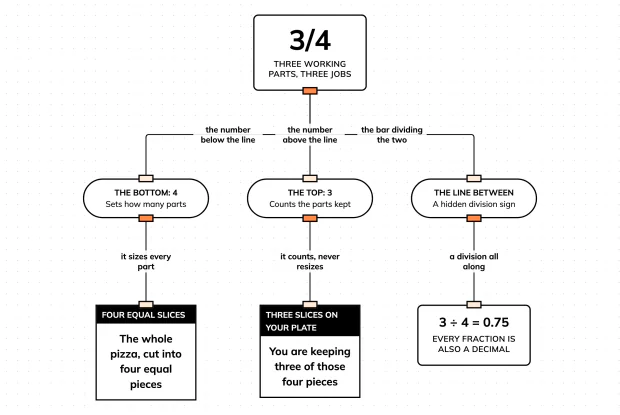
3/4 branches into its three working parts, each changing something different
Why Are There Two Numbers In One Fraction?
Most numbers are one thing. A fraction is two numbers stacked up, and they are not doing the same job — which is why fractions feel harder than they need to. Look at 3/4. The 4 underneath is telling you how big each piece is: the whole thing has been cut into four equal parts. The 3 on top is telling you how many of those pieces you are dealing with. Two different questions, two different numbers, one notation.
That order matters more than people expect. You cannot know what the 3 means until you know what a part is, so a fraction is easier to read from the bottom up: first find out how big the pieces are, then count them. Read it top-down and you are counting things before you know their size.
There is also a third part that is easy to overlook — the line itself. It is not decoration, it is a division sign. Three quarters really does mean three divided by four, which is why it also equals 0.75. In the playground below you will build 3/4 down into those three parts, and each part down to what it does to the whole.
How Do You Read a Fraction?
What do the two numbers actually tell you?
The bottom number is called the denominator, and it names the size of the piece. A denominator of 4 means the whole has been divided into four equal parts, so each part is a quarter. The top number is the numerator, and it simply counts how many of those parts you have. So 3/4 is three of the four quarters. The word denominator shares a root with denomination, as in the denomination of a banknote — it is telling you what kind of unit you are counting in, exactly as a 20 note tells you the unit before you count how many you hold. The crucial condition hiding in that definition is the word equal. Cutting a cake into four wildly uneven slices and taking one does not give you a quarter. Fractions only describe equal parts, which is what makes them comparable at all.
Why does a bigger bottom number mean a smaller fraction?
This is the misconception that causes the most trouble, because it runs against everything learned about whole numbers so far. With whole numbers, bigger digits mean more. With denominators, bigger means less. One eighth is smaller than one quarter, even though 8 is bigger than 4. The reason is straightforward once you picture the cutting: the more pieces you cut a fixed whole into, the smaller each piece has to be. Split a pizza between four people and everyone eats well; split the same pizza between eight and the slices are half the size. So when you compare 1/8 with 1/4, you are not comparing 8 with 4 — you are comparing how finely the whole was divided. More cuts, smaller pieces.
Why is a fraction also a division?
The line in a fraction means divide, and taking that literally makes the rest of the topic much easier. 3/4 means 3 divided by 4, and if you do that division you get 0.75. This is not a coincidence or a shortcut — it is what the notation says. It also explains something that otherwise looks strange: how three things can be shared between four people when there is not one each. Divide three pizzas among four people and everyone gets three quarters of a pizza. The fraction is the answer to a sharing problem, not a description of one object. Seeing the line as a division sign is also what makes converting to decimals obvious later: you do not need a new rule, you just do the division the fraction was asking for all along.
Real World Example
How Do Three Pizzas Feed Four People?
Fractions stop being abstract the moment there is not one each. Four friends have three pizzas, and they want equal shares:
The obvious approach fails
There are three pizzas and four people, so nobody can have a whole one. Whole numbers have run out — there is no whole number answer to three shared between four. This is exactly the gap fractions exist to fill, and it is worth noticing that the need comes first and the notation second.
Cutting into quarters
Cut every pizza into four equal pieces. Three pizzas give twelve quarters, and twelve quarters shared between four people is three quarters each. Written down, that is 3/4 — the 4 recording that pizzas were cut into quarters, and the 3 recording how many quarters each person receives.
The same answer as a division
You could have skipped the cutting and just done the division the fraction was describing: 3 divided by 4 is 0.75, so each person gets three quarters of a pizza. Same answer, different notation. And notice what would happen with eight friends instead of four: 3 divided by 8 is 0.375, a smaller share, because the bigger denominator means the pizzas were cut more finely.
FAQs
Final Words
A fraction is two numbers doing two jobs plus a line that means divide. The bottom sets how big each part is, the top counts how many of those parts you have, and reading it bottom-up is what makes it make sense. That is also why a bigger denominator gives a smaller fraction: more cuts, smaller pieces.
Holding on to the line-means-divide idea is what makes the rest of this category easy. It is the reason 3/4 and 0.75 are the same number, and the reason the next concept — how two different-looking fractions can be equal — is about rewriting rather than changing.
Continue This Track
This concept is part 1 of Three Ways to Write the Same Number.
What Does a Fraction Actually Mean?
A fraction is not one number but two doing different jobs. Learn what the top and bottom each tell you, and build 3/4 down into its three working parts in an interactive playground.
How Can Two Different Fractions Be Equal?
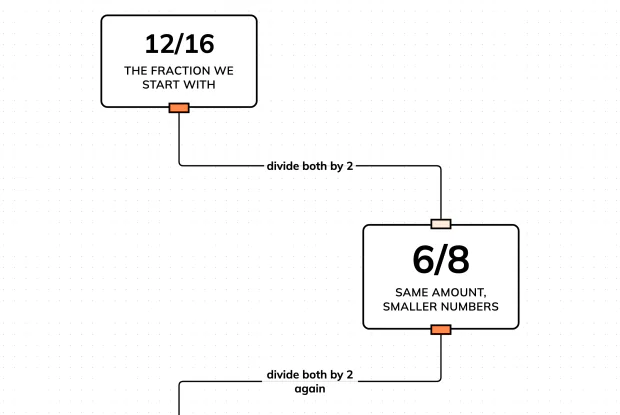
1/2, 2/4 and 8/16 are the same amount written three ways. Learn why multiplying or dividing both parts changes nothing.
How Do You Convert Between Fractions, Decimals and Percentages?
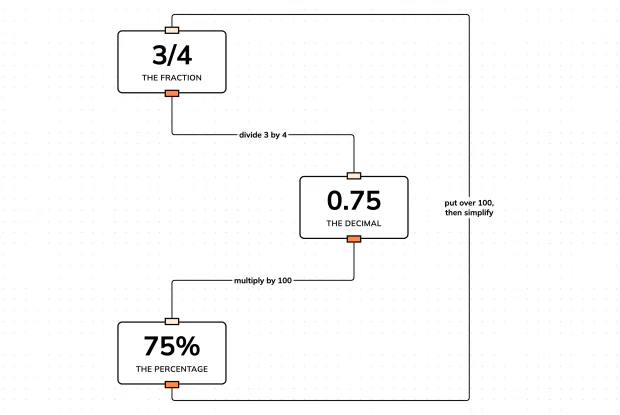
3/4, 0.75 and 75% are one value in three notations. Learn the move between each pair, then close the conversion loop yourself.
What Is a Percentage Actually Measuring?
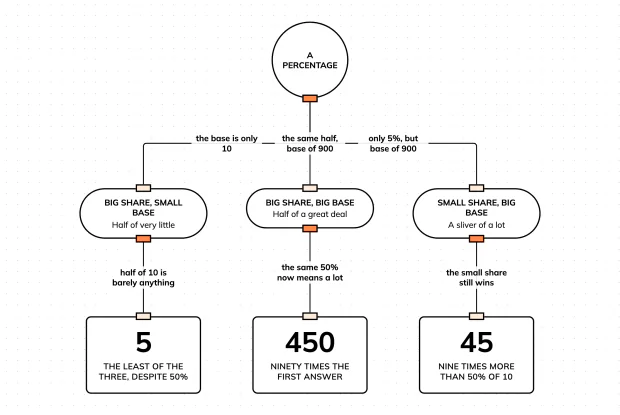
A percentage on its own tells you almost nothing — it needs something to be a percentage of. Learn why the base decides everything, in an interactive playground.