How Can Two Different Fractions Be Equal?
Root Concept
Multiplying or dividing the top and bottom of a fraction by the same number rewrites it without changing its value, because you are multiplying by a disguised 1.
CodePLU Goal
Upgrading Human Mental Models
Learn how to think in Workflows

Concept Development By codeplu.com
Simplifying one fraction without ever changing its value
How Can 1/2 and 8/16 Be the Same Number?
Half a pizza is half a pizza whether you cut it into two pieces and take one, or into sixteen pieces and take eight. The amount on your plate is identical; only the number of cuts changed. That is the whole idea behind equivalent fractions: 1/2, 2/4, 5/10 and 8/16 are one amount wearing different clothes.
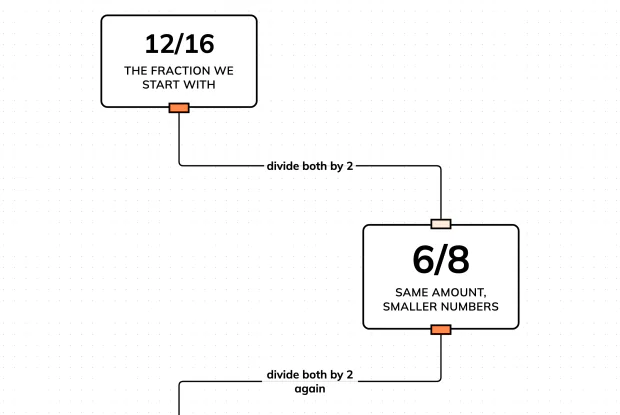
The rule that generates them is short. Multiply the top and the bottom by the same number, or divide them both by the same number, and the value stays put. Multiply 1/2 by 8 on both parts and you get 8/16. Divide 12/16 by 2 on both parts and you get 6/8. Nothing was added or removed at any point — the fraction was only rewritten.
That rule is doing quiet work everywhere later on. Simplifying an answer, comparing two fractions, and adding fractions with different denominators are all the same move applied for different reasons. In the playground below you will take 12/16 and simplify it in stages, watching the numbers get smaller while the amount stays exactly the same.
Why Does Rewriting a Fraction Not Change It?
Why does multiplying both parts change nothing?
Multiplying the top and bottom by the same number works because you are secretly multiplying by 1. Take 1/2 and multiply both parts by 3: that is the same as multiplying 1/2 by 3/3, and 3/3 is just 1 written awkwardly. Anything multiplied by 1 is unchanged, so 1/2 becomes 3/6 with the same value. Picture it as cutting rather than arithmetic: every cut you make doubles or triples both the number of pieces in the whole and the number of pieces you hold, so your share of the whole is untouched. This is also the deeper reason the rule fails if you use different numbers on top and bottom — then you are no longer multiplying by 1, you are genuinely changing the amount.
How do you simplify a fraction?
Simplifying is the same rule run backwards: divide the top and bottom by a number that goes into both. To simplify 12/16, notice that 2 divides both, giving 6/8; 2 divides both again, giving 3/4; and now nothing except 1 divides both, so you are finished. A fraction in that state is in its lowest terms. If you would rather do it in one move, divide by the highest common factor — the largest number that goes into both. For 12 and 16 that is 4, and 12/16 divided by 4 top and bottom gives 3/4 straight away. This is exactly why factors were worth learning: simplifying a fraction is a factor-hunting job wearing different clothes.
Why can't you add the same number to both parts?
This is the most common wrong move in the whole topic, and it looks reasonable — if doing the same thing to both parts is allowed, why not addition? Try it. Add 1 to both parts of 1/2 and you get 2/3. But 1/2 is 0.5 and 2/3 is about 0.667, so the value moved. The rule was never do the same thing to both; it was multiply or divide both by the same number, because only multiplication and division can be undone by a disguised 1. Addition changes the ratio between the two parts, and the ratio is precisely what a fraction records. If you want a quick check on any rewriting step, convert both versions to decimals — equivalent fractions always give the same decimal.
Real World Example
Which Discount Is Actually Bigger?
Equivalent fractions earn their keep when two amounts are written in different units and you need to compare them honestly:
The two offers
One shop takes 3/8 off the price of a jacket. Another takes 5/12 off the same jacket. Which is the better deal? You cannot tell by looking, because the pieces are different sizes — eighths in one and twelfths in the other. Comparing 3 with 5 is meaningless when the units differ.
Rewriting both in the same units
Find a denominator both can become. 8 and 12 both divide into 24, so rewrite each. Multiply 3/8 top and bottom by 3 to get 9/24. Multiply 5/12 top and bottom by 2 to get 10/24. Neither offer changed at all — both were only rewritten in twenty-fourths.
Now the comparison is trivial
9/24 against 10/24: the pieces are now the same size, so you just compare how many. Ten beats nine, so the 5/12 discount is slightly better. This is the same move used to add fractions with different denominators, and it is why 24 mattered — it is a common multiple of 8 and 12, which is the other half of the factors and multiples idea.
FAQs
Final Words
Equivalent fractions are one amount written many ways. Multiply the top and bottom by the same number, or divide them both by the same number, and the value holds because you are quietly multiplying by 1. Adding to both parts breaks it, because addition alters the ratio the fraction exists to record.
You now have the move that makes comparing and adding fractions possible: rewrite them until the pieces are the same size. It is also the move behind the next concept — the same amount can be written as a fraction, a decimal or a percentage, and converting between them is rewriting rather than changing.
Continue This Track
This concept is part 2 of Three Ways to Write the Same Number.
What Does a Fraction Actually Mean?
A fraction is not one number but two doing different jobs. Learn what the top and bottom each tell you, and build 3/4 down into its three working parts in an interactive playground.
How Can Two Different Fractions Be Equal?
1/2, 2/4 and 8/16 are the same amount written three ways. Learn why multiplying or dividing both parts changes nothing.
How Do You Convert Between Fractions, Decimals and Percentages?
3/4, 0.75 and 75% are one value in three notations. Learn the move between each pair, then close the conversion loop yourself.
What Is a Percentage Actually Measuring?
A percentage on its own tells you almost nothing — it needs something to be a percentage of. Learn why the base decides everything, in an interactive playground.