Why Does a Digit's Position Change Its Value?
Root Concept
A digit's value is decided by the column it sits in, and each column is worth ten times the one to its right.
CodePLU Goal
Upgrading Human Mental Models
Learn how to think in Workflows

Concept Development By codeplu.com
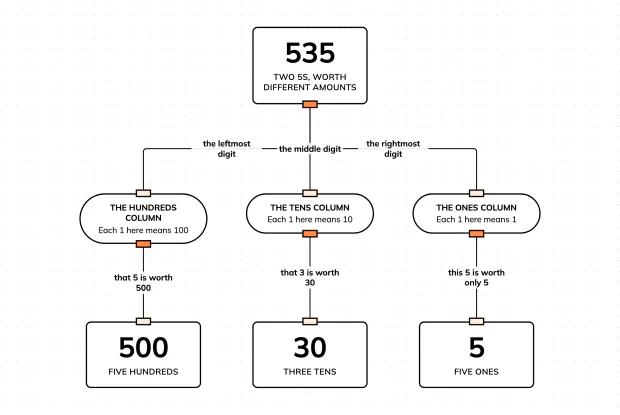
535 branches into its three columns, each giving its digit a different worth
How Can the Same Digit Be Worth Two Different Amounts?
Look at the number 535. It contains the digit 5 twice, and those two 5s are not worth the same thing. The one on the left is worth five hundred. The one on the right is worth five. Same digit, same shape on the page, and a difference of 495 between them. Nothing about the digit itself explains that — the only thing that changed is where it is sitting.
That idea has a name: place value. A number is not just a string of digits read left to right; it is a set of columns, and each column carries its own weight. A digit tells you how many, and the column tells you how much each one is worth. Put those two facts together and you can read any number, however long, without being taught it separately.
This is the quietest and most important idea in arithmetic, because everything later leans on it. Lining up columns to add, carrying a ten, understanding why 0.5 is half rather than five — all of it is place value doing the work. In the playground below you will build 535 down into its three columns, and each column down to what its digit is actually worth.
How Does Place Value Actually Work?
What does each column in a number mean?
Reading from the right, the columns are ones, tens, hundreds, thousands, and onwards. The rule that generates them is simple and never changes: each column is worth exactly ten times the column to its right. Ones are worth 1, so tens are worth 10, so hundreds are worth 100. You do not have to memorise the list, because you can always rebuild it by multiplying by ten as you step left. This is why our system is called base ten — ten is the number that moves you one column over. Worth noticing: the columns are not labels somebody chose arbitrarily, they are a consequence of only having ten digits to work with. Once you run out of single digits at 9, the only way to keep counting is to start a new column and reuse the same ten digits there.
Why is one 5 worth a hundred times the other?
Take 535 apart column by column. The rightmost 5 is in the ones column, so it means five ones: 5. The 3 is in the tens column, so it means three tens: 30. The leftmost 5 is in the hundreds column, so it means five hundreds: 500. Add those together — 500 + 30 + 5 — and you get 535 back. The number was always a sum; the notation just hides the addition. Here is the misconception to drop: many people read a number as a single lump, so 535 feels like one thing rather than three amounts stacked together. Reading it as 500 and 30 and 5 is not a childish crutch — it is what the notation actually says, and it is the habit that makes mental arithmetic possible.
Why does zero do so much work?
Compare 35 and 305. Both contain a 3 and a 5, in the same order, yet one is nearly ten times the other. The difference is a zero sitting in the tens column of 305, and its job is not to add anything — it is to hold a column open so the 3 stays in the hundreds. Take the zero away and the 3 slides right into the tens, and the number collapses to 35. So the common description of zero as meaning nothing is exactly wrong here. In a number, a zero is a placeholder doing structural work, and removing it changes every digit to its left. This is also why writing 3 5 with a gap does not work: we need a symbol that says this column is empty but still counts.
Real World Example
What Happens When You Read One Column Wrong?
Place value stops feeling abstract the moment money is involved, because a single column is the difference between an amount you can afford and one you cannot:
The balance you expected
You check your account and read 1,250. Broken into columns that is one thousand, two hundreds, five tens and no ones — a comfortable month. You have read four columns without thinking about it, which is exactly how it should feel once place value is automatic.
The digit that moved
Now imagine the same digits shifted one column right: 125. Nothing was added or removed, and the digits are in the same order. But every one of them dropped a column, so each is now worth a tenth of what it was. One thousand became one hundred, two hundreds became two tens, five tens became five ones.
Why the columns are the whole story
The gap between 1,250 and 125 is not a small slip — it is a factor of ten, caused purely by position. This is why a misplaced decimal point in a form or an invoice is such a costly mistake, and why anyone handling numbers professionally reads the columns rather than the digits. The digits tell you what is there; the columns tell you what it is worth.
FAQs
Final Words
A number is a set of columns, not a string of digits. The digit tells you how many; the column tells you how much each one is worth; and each column is worth ten times the one to its right. That is why the two 5s in 535 are worth 500 and 5, and why a zero in the middle of a number is doing real structural work rather than nothing at all.
Keep the habit you used in the playground: when a number looks confusing, read it column by column instead of as a lump. It is the same habit that makes adding, carrying and decimals feel obvious later — and it is what makes the order of operations, the next concept in this category, worth looking at.
Continue This Track
This concept is part 2 of Making Sense of Numbers.
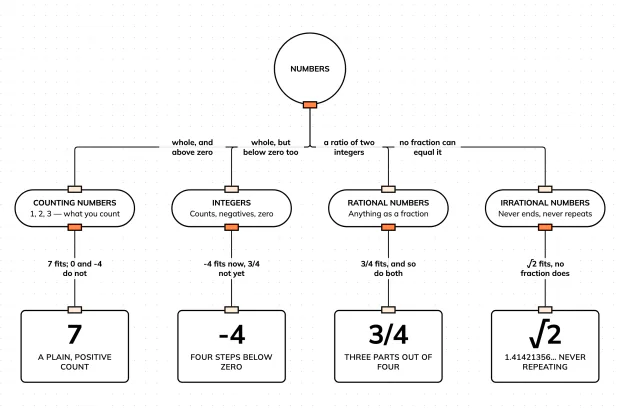
What Are the Different Types of Numbers?
Counting numbers, integers, rationals and irrationals explained in plain words — then sort each number into its family yourself in an interactive playground.
Why Does a Digit's Position Change Its Value?
The same digit can be worth 5 or 500 depending on where it sits. Learn how columns decide a digit value, then build 535 down into its columns in an interactive playground.
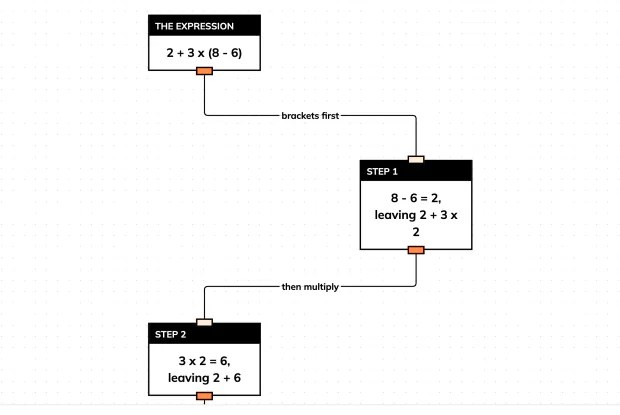
Why Does the Order of Operations Matter?
Two people can get two different answers from the same sum unless they agree on an order. Learn the rule and build the steps yourself in an interactive playground.
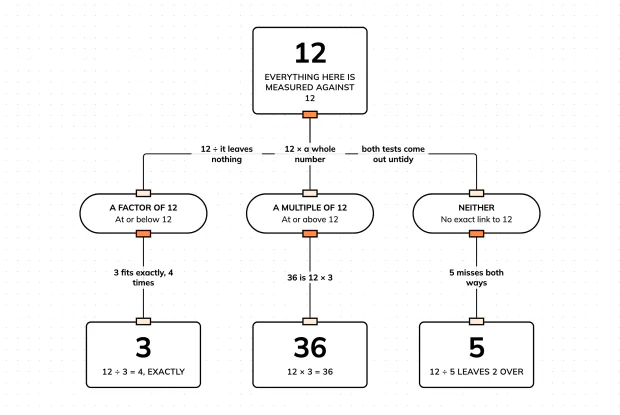
What's the Difference Between a Factor and a Multiple?
Factors go into a number; multiples come out of it. Learn which direction each word points, then sort three numbers by how they relate to 12.