Why Does an Isosceles Triangle Have Two Equal Angles?
Root Concept
Equal sides force equal angles opposite them, so one angle of an isosceles triangle determines all three.
CodePLU Goal
Upgrading Human Mental Models
Learn how to think in Workflows

Concept Development By codeplu.com
Tick marks are a claim, not decoration: matching ticks say the sides are equal, and different ticks say they are not.
What Does Isosceles Actually Guarantee?
An isosceles triangle is defined by its sides: two of them are the same length. Nothing in that definition mentions angles at all. And yet every isosceles triangle turns out to have two equal angles as well — specifically the two opposite the equal sides, which on a triangle drawn sitting on its base are the two base angles. The sides were chosen and the angles came along whether anyone wanted them or not.
That is worth pausing on, because it is the first time in this track that a fact about lengths has forced a fact about angles. It is also the reason a single number is enough to describe an isosceles triangle completely. Tell me one angle and I can give you the other two, which is not true of triangles in general, where two angles are needed before the third is fixed.
The practice below turns on reading the tick marks. Matching ticks on two sides are a claim that those sides are equal, and that claim is what licenses the shortcut. Two of the six triangles carry different tick marks, which says the opposite — and applying the isosceles rule to them is exactly the mistake the board is there to catch.
Where the Equal Angles Come From
Which Two Angles Are the Equal Ones?
The two angles opposite the equal sides. If a triangle has two sides of 7 cm and one of 4 cm, the equal angles are the two that face the 7 cm sides, and the odd one out faces the 4 cm side. When the triangle is drawn resting on its unequal side, the equal angles are the two at the bottom, which is why they are usually called the base angles, and the odd one is at the top and is called the apex angle. That naming is a convenience of how the picture is drawn, not a rule: turn the triangle on its side and the equal angles are no longer at the bottom of anything. The reliable test is always opposite the equal sides, which is why reading the tick marks matters more than reading the orientation.
Why Must Those Angles Be Equal?
Fold the triangle down the middle. Draw the line from the apex to the midpoint of the base and it splits the triangle into two smaller ones. Those two halves have all three sides the same as each other: they share the fold line, the two equal sides give one matching pair, and the two halves of the base give another. Three matching sides means the two halves are identical, which is the SSS rule coming later in this track, so every part of one matches the corresponding part of the other — including the base angles. That is the whole argument, and it is why the result is so robust. It does not depend on the triangle being acute or obtuse or on how long the base is; it depends only on two sides being equal.
How Do You Find the Other Angles From One?
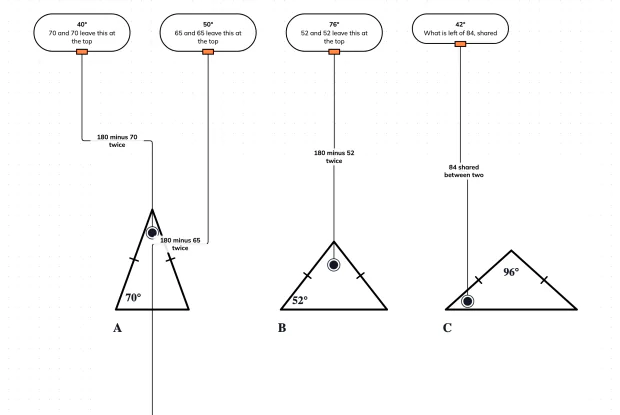
There are two cases and it matters which you are in. If you are given a base angle, the other base angle is the same, and the apex is what is left: apex = 180 − 2 × base. A base angle of 52° gives an apex of 180 − 104 = 76°. If instead you are given the apex, the two base angles share what remains equally: base = (180 − apex) ÷ 2. An apex of 96° leaves 84° to share, so each base angle is 42°. The common error is doing the wrong one of these, usually by halving when you should have doubled. Look at where the given angle sits relative to the tick-marked sides before reaching for a calculation.
Does the Rule Work Backwards?
Yes, and the converse is used at least as often. If a triangle has two equal angles, then the sides opposite those angles are equal, so the triangle is isosceles. This is how isosceles triangles are usually detected rather than assumed: a question gives you angles of 70°, 70° and 40° and you conclude that two sides match, which then tells you a length you were not given. An equilateral triangle is the case where this happens twice over — all three sides equal, so all three angles equal, and since they must total 180° each one is 60°. The two directions are worth keeping apart. Going forwards, tick marks on a diagram let you claim two angles are equal; going backwards, two angles that turn out equal let you claim two sides are. Most questions of any length use both at different points, and knowing which one you are leaning on keeps the reasoning honest.
Real World Example
Why Is a Step Ladder an Isosceles Triangle?
The two legs are made identical so the ladder stands square, and that single manufacturing decision fixes both angles at the floor.
Two legs, one length
Equal by design
A step ladder is built with its two legs the same length. That is not an aesthetic choice: legs of different lengths would put the top rail at a tilt and the user off balance. So the ladder standing open on a flat floor is an isosceles triangle, with the two legs as the equal sides and the floor between the feet as the base. Nobody specifies the angles anywhere on the drawing. They specify two lengths and a spread, and the angles follow from the geometry, which is precisely the direction of reasoning this tutorial is about.
The angle at the hinge
40° at the top
Open the ladder until the hinge at the top reads 40° — many step ladders have a strap or a stay that fixes this angle, because it sets both how tall and how stable the ladder is. That 40° is the apex angle. The remaining 140° has to be shared between the two angles at the floor, and because the legs are equal those two angles are equal, so each is 70°. One measurement at the hinge has given both angles at the feet, which is what the manufacturer needs to know when shaping the non-slip feet so they sit flat on the floor.
When a leg is damaged
The rule stops applying
Now suppose one leg is bent or a foot has worn down, so the two legs are no longer the same length. The triangle is still a triangle and its angles still total 180°, but it is no longer isosceles, and the two angles at the floor are no longer equal. Splitting the remaining 140° evenly between them would now be wrong, and the ladder leans. This is the situation the two odd triangles in the playground represent: the shortcut is not a property of triangles in general but a consequence of two sides genuinely being the same, and the tick marks are how a drawing tells you whether they are.
FAQs
Final Words
Two equal sides force the two angles opposite them to be equal, and folding the triangle down the middle shows why: the two halves have three matching sides, so every part of one matches the other. One given angle is then enough for the whole triangle, provided you notice whether you were handed a base angle to double or an apex angle to share.
The fold argument leaned on something that has not been stated properly yet — that three matching sides make two triangles identical. That is a congruence rule, and it is the subject of the next two tutorials: which combinations of sides and angles are enough to pin a triangle down completely, and which ones only look as though they should be.
Continue This Track
This concept is part 3 of Proving Things About Triangles.
Why Does an Exterior Angle Equal the Two Opposite Angles?
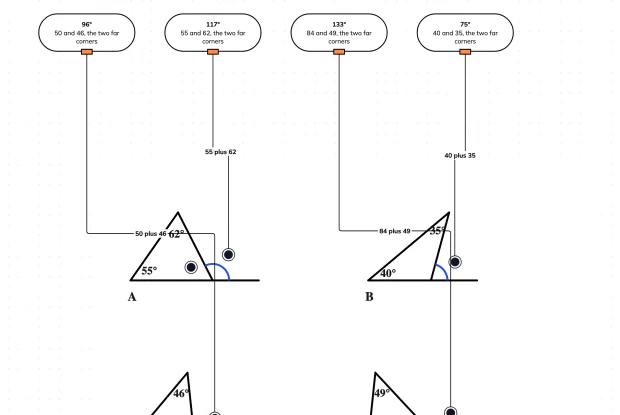
Extend any side of a triangle and the angle that opens up outside it is exactly the sum of the two angles at the far corners. It is the fastest shortcut in triangle geometry and it falls straight out of two rules you already have. Use it on four triangles in an interactive playground.
Can Any Three Lengths Make a Triangle?
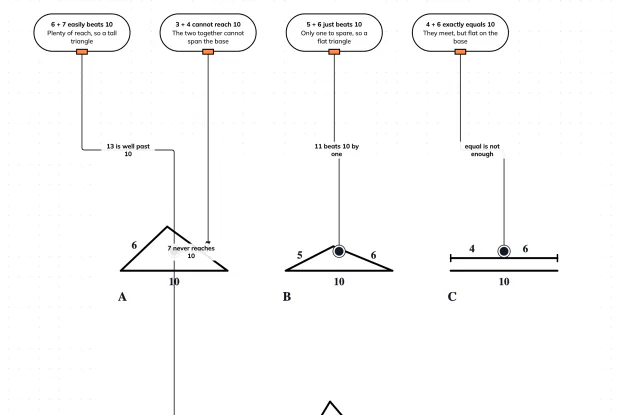
Not every three lengths will close into a triangle. The test is one addition: the two shorter sides together must be longer than the longest one, and longer is doing real work — equal is not enough. See exactly where the failure happens in an interactive playground.
Why Does an Isosceles Triangle Have Two Equal Angles?
In an isosceles triangle the two angles opposite the equal sides are equal too. That is not a second fact bolted on to the first — the equal sides force it, and folding the triangle in half shows why. One given angle is then enough to find the rest, which you can practise in an interactive playground.
When Are Two Triangles Congruent? SSS and SAS
Congruent means identical in shape and size. You do not need all six measurements to be sure of it — three of the right kind will do. Three sides work, and so do two sides with the angle between them, while two very similar-looking sets of facts do not. Sort them in an interactive playground.
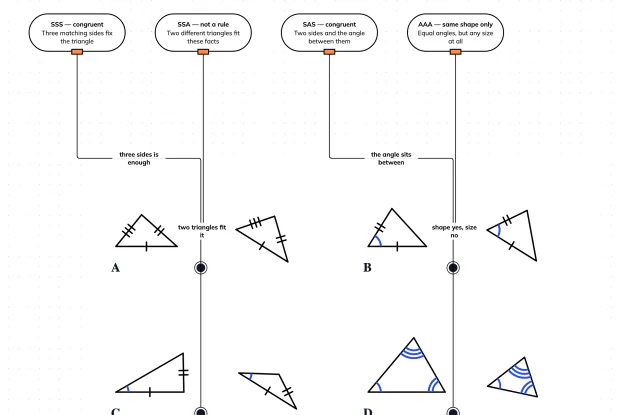
When Are Two Triangles Congruent? ASA and RHS
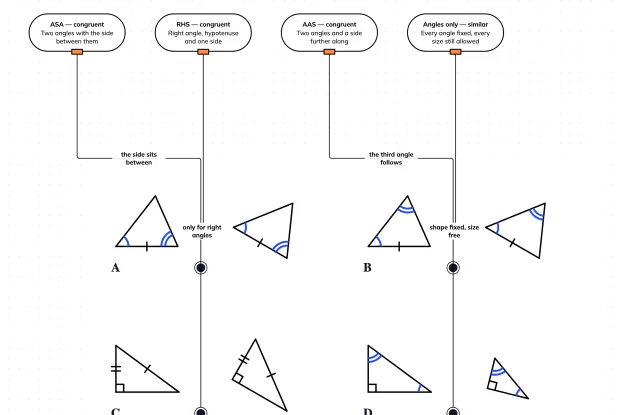
Angles alone can never prove two triangles identical, because they say nothing about size. Add a single side and they can: ASA and AAS both work, and right-angled triangles get a rule of their own in RHS. Sort the rules from the near-misses in an interactive playground.