When Are Two Triangles Congruent? SSS and SAS
Root Concept
Three of the right measurements fix a triangle completely, and which three it is matters more than how many.
CodePLU Goal
Upgrading Human Mental Models
Learn how to think in Workflows

Concept Development By codeplu.com
A rule earns its name only if no second triangle can fit the same facts. Where a second one can, the facts are not a rule.
What Does Congruent Mean, and Why Not Just Measure Everything?
Two triangles are congruent when they are identical: same three side lengths, same three angles, so that one could be picked up, possibly turned over, and laid exactly on the other. Congruent is not the same as looking alike, and it is not the same as being the same shape at a different size, which has its own word and comes later in the chapter.
Checking all six measurements would certainly settle it, but it is far more than necessary and in practice you are rarely given six. The useful question is how few you need. The answer is three — but only three of the right kind, arranged in the right way. Some sets of three pin a triangle down completely; others leave room for a genuinely different triangle to fit the same facts.
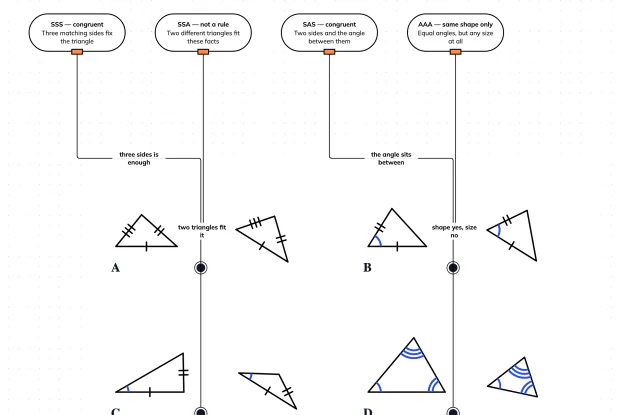
This tutorial covers the two that work with sides: SSS, three matching sides, and SAS, two matching sides with the angle between them. Just as important are the two near-misses, SSA and AAA, which look as though they ought to work and do not. In the playground the pairs where the facts fall short are drawn as genuinely different triangles, so you can see the failure rather than take it on trust.
Which Sets of Three Are Enough?
Why Does SSS Work?
If all three sides of one triangle match all three sides of another, the triangles are congruent. You met the reason in the tutorial on three lengths: given three lengths that can close, there is only one triangle they can make. Lay the longest side down, swing the other two in from its ends, and they meet at exactly one point above the line — or at its mirror image below, which is the same triangle turned over. Nothing is left free to vary, so the angles are forced too, even though nobody measured them. This rigidity is why triangles are the shape of choice in bridges, roof trusses and bicycle frames: fix the lengths and you have fixed the shape, whereas a four-sided frame with fixed sides can still be pushed over.
Why Does SAS Work, and Why Must the Angle Be Between?
SAS gives you two sides and the angle between them. Picture building it: draw the first side, turn through the given angle at its end, and draw the second side. The two far ends are now fixed points, and joining them completes the triangle in exactly one way. There was never a choice at any stage, so the triangle is determined. The word between is carrying all the weight here. The angle has to be the one enclosed by the two sides, which is why the rule is properly called two sides and the included angle. Move that angle somewhere else and the construction stops being forced, which is exactly what goes wrong in the next section.
Why Does SSA Fail?
SSA gives two sides and an angle that is not between them, and it is the most convincing of the near-misses because it has the same shopping list as SAS, just arranged differently. Build it and you can see the problem. Draw the angle, run one side out from it, then swing the second side from that side's far end and see where it lands on the remaining arm. Often it can land in two different places, giving two triangles that agree on all three given facts and disagree on everything else. Pair C in the playground shows both of them. Because a second triangle can fit, SSA cannot prove congruence, and it is sometimes called the ambiguous case for that reason.
Why Does AAA Fail?
AAA gives all three angles and no lengths at all, and this failure is easier to see. Take any triangle and photocopy it at half size. Every angle is unchanged — enlarging does not bend corners — but the two triangles are obviously not identical. There are infinitely many triangles with angles of 50°, 60° and 70°, one for every size you care to pick. Angles fix the shape and say nothing at all about the size, and since congruence is about both, AAA cannot deliver it. It is not useless, though: two triangles with equal angles are similar, which is its own useful relationship and the subject of a later track.
Real World Example
How Does a Workshop Cut Two Identical Brackets?
A bracket is a triangle, and the maker's real question is how few numbers have to be controlled for the second one to come out identical to the first.
Working from three lengths
SSS on the bench
The simplest way to make a second bracket identical to the first is to copy its three sides: cut three pieces of steel to the same three lengths as the original, and join them. No angle is measured anywhere. The maker does not have to trust a protractor, only a tape measure, and the angles come out right because three lengths leave the triangle no freedom. This is SSS doing real work, and it is why jigs in workshops are often built as lengths rather than angles: a length is easy to measure accurately and easy to check afterwards, while an angle is neither.
Working from a corner
SAS on the bench
The other common method uses the corner. Clamp two pieces of steel at the fixed angle the bracket needs — 90° for a shelf, say — cut them to the two lengths the design calls for, then cut the diagonal to fit whatever gap is left. Again nothing is left to choice: the angle and the two lengths fix the far ends, and the third side simply joins them. This is SAS, and it is the method of choice when the corner angle is the part that really matters, because it is being set directly rather than being arrived at.
The method that goes wrong
Two lengths, wrong angle
Now imagine specifying the bracket as: a 30 cm side, a 20 cm side, and a 25° angle at the end of the 30 cm side, away from where the two meet. That is SSA, and two different brackets satisfy it — one squat and one long — so two workshops given the same drawing can send back two different parts, each correctly made to spec. This is not a hypothetical failure; ambiguous dimensioning is a standing problem in engineering drawing, and the fix is exactly the rule above: dimension the angle between the two sides you have given, not one off to the side of them.
FAQs
Final Words
Congruence needs three of the right measurements, not all six. Three matching sides work, because three lengths that close make only one triangle. Two sides with the angle between them work, because building it leaves no choice at any step. The near-misses fail for reasons worth keeping: SSA lets a second triangle fit, and AAA fixes only the shape and never the size.
So far both working rules have been built around sides. The next tutorial takes the other direction and asks how much can be done with angles — which turns out to be a great deal, as long as at least one side is included somewhere to settle the size, plus one special rule that applies only to right-angled triangles.
Continue This Track
This concept is part 4 of Proving Things About Triangles.
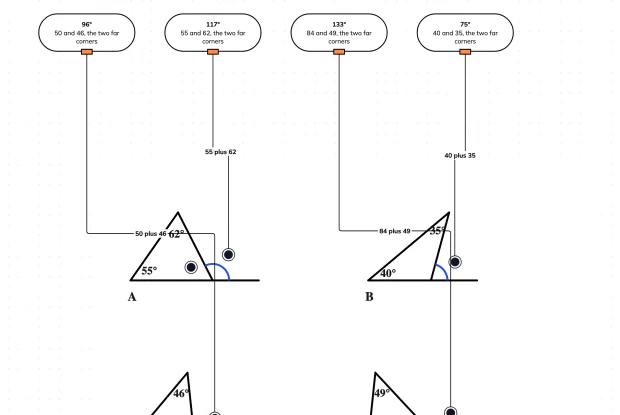
Why Does an Exterior Angle Equal the Two Opposite Angles?
Extend any side of a triangle and the angle that opens up outside it is exactly the sum of the two angles at the far corners. It is the fastest shortcut in triangle geometry and it falls straight out of two rules you already have. Use it on four triangles in an interactive playground.
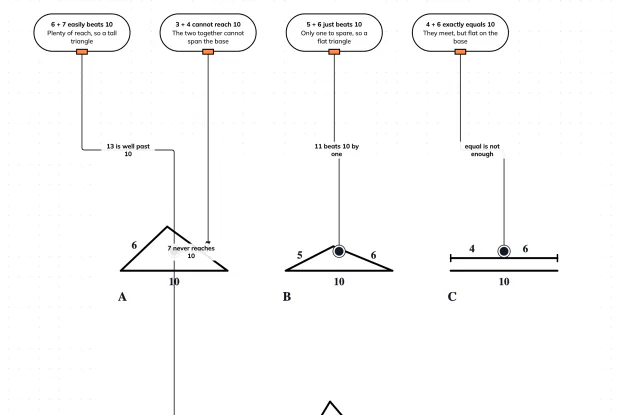
Can Any Three Lengths Make a Triangle?
Not every three lengths will close into a triangle. The test is one addition: the two shorter sides together must be longer than the longest one, and longer is doing real work — equal is not enough. See exactly where the failure happens in an interactive playground.
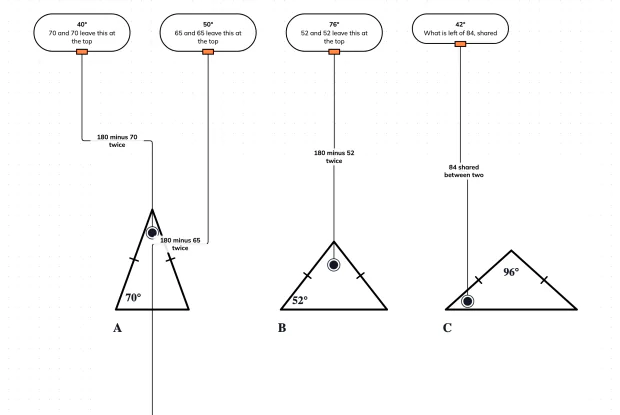
Why Does an Isosceles Triangle Have Two Equal Angles?
In an isosceles triangle the two angles opposite the equal sides are equal too. That is not a second fact bolted on to the first — the equal sides force it, and folding the triangle in half shows why. One given angle is then enough to find the rest, which you can practise in an interactive playground.
When Are Two Triangles Congruent? SSS and SAS
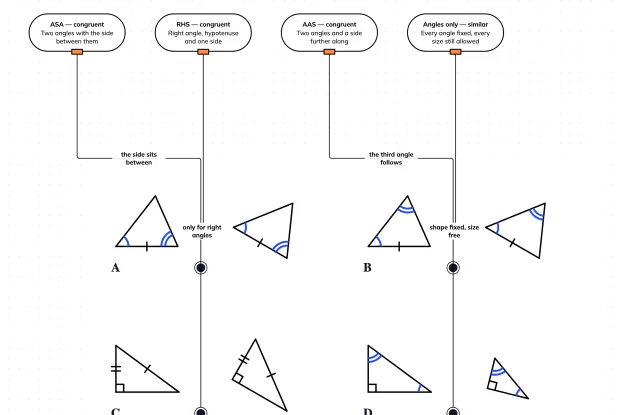
Congruent means identical in shape and size. You do not need all six measurements to be sure of it — three of the right kind will do. Three sides work, and so do two sides with the angle between them, while two very similar-looking sets of facts do not. Sort them in an interactive playground.
When Are Two Triangles Congruent? ASA and RHS
Angles alone can never prove two triangles identical, because they say nothing about size. Add a single side and they can: ASA and AAS both work, and right-angled triangles get a rule of their own in RHS. Sort the rules from the near-misses in an interactive playground.