Can Any Three Lengths Make a Triangle?
Root Concept
Three lengths close into a triangle exactly when the two shorter ones add to more than the longest.
CodePLU Goal
Upgrading Human Mental Models
Learn how to think in Workflows

Concept Development By codeplu.com
Compare the two shorter lengths added together against the longest one. More closes, equal lies flat, less leaves a gap.
Why Can Three Lengths Fail?
Angles have an obvious limit — the three of them must add to 180° — and it is easy to believe lengths are free to be anything. They are not. Hand someone three sticks of 2 cm, 3 cm and 10 cm and ask for a triangle and they will fail, not through lack of skill but because it cannot be done. The two short sticks laid end to end reach only 5 cm, and the gap to the far end of the long one never closes.
The rule is a single comparison. Take the two shorter lengths, add them, and compare the total with the longest length. If the total is greater, the three close into a triangle. If it is smaller, they cannot reach. And if the total is exactly equal, the two short sides lie flat along the long one and meet at a point, which makes a line rather than a triangle. That last case is the one people get wrong, so it is worth saying plainly: equal is a failure.
The playground shows all three outcomes drawn honestly. Where the lengths close, the triangle is drawn; where they do not, the two sides are laid flat along the base so you can see exactly how much is missing. What you are practising is not the drawing but the arithmetic that predicts it before any drawing happens.
How the Test Works and What It Means
What Exactly Is the Test?
Add the two shorter lengths and compare with the longest. If the sum is bigger, you have a triangle; otherwise you do not. That single comparison is all that is needed, which surprises people, because the full statement of the rule says that the sum of any two sides must exceed the third, and that sounds like three separate checks. It is not, in practice. If the two shorter sides beat the longest, then any pair including the longest side automatically beats the remaining one, since the longest is already at least as big as either of them on its own. So the only comparison that can fail is the one involving the two shortest, and checking it is enough. Find the longest length first, add the other two, and compare.
Why Does Equal Fail?
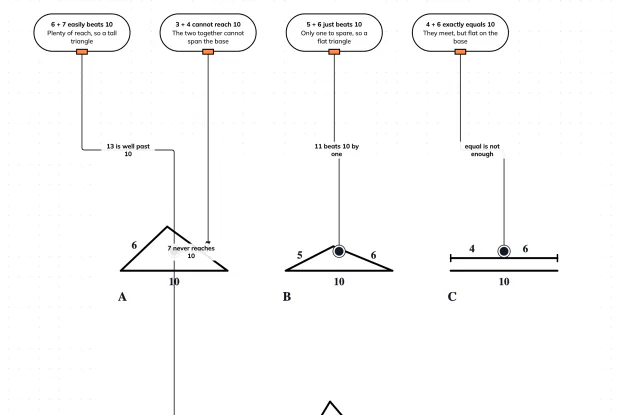
Picture the two shorter sides hinged at the two ends of the longest one and swung down towards each other. If together they are longer than the base, their ends overlap when flat, so swinging them up brings them to meet somewhere above the base and a triangle appears. If they are exactly as long as the base, their ends meet precisely on the base itself, and the only place they can touch is flat. There is no height, no interior, and the three angles come out as 0°, 0° and 180°. Mathematicians call this a degenerate triangle, which is a polite way of saying it is a line segment. So 4, 6 and 10 do not make a triangle, even though 4 + 6 = 10 looks like it ought to be the boundary case that just scrapes in.
How Far Can a Third Side Go?
Turn the rule around and it tells you the range a missing side can occupy. Suppose two sides are 8 and 5. The third side must be less than 8 + 5 = 13, or those two could not reach across it. It must also be more than 8 − 5 = 3, because otherwise the 5 and the missing side together could not reach across the 8. So the third side lies strictly between 3 and 13. Both ends are excluded, for the reason in the previous section: at exactly 3 or exactly 13 the figure collapses flat. Questions asking for the possible whole-number values of a third side are asking for this range, and the usual lost mark is including the endpoints.
Where Does This Actually Matter?
Anywhere three fixed lengths have to meet. A tripod with legs too short for how far apart its feet are placed simply will not stand up. A bridge truss, a tent frame, a bicycle frame and a roof truss are all built from triangles precisely because three lengths that do close can close in only one way — a triangle is rigid, while a four-sided frame of fixed lengths can be pushed out of shape. That rigidity is the reason triangles are everywhere in structures, and the inequality is the condition for getting one at all. Before any of the angle work in the rest of this track, this is the test for whether there is a triangle to reason about.
Real World Example
Why Will a Camera Tripod Sometimes Refuse to Stand?
Any two legs of a tripod and the stretch of ground between their feet form a triangle, so the same test decides whether the tripod can be set up as asked.
Legs at full extension
6 and 7 across a 10 span
Take any two of the three legs and the straight line on the ground between their feet. That is a triangle, with the two legs as two sides and the ground as the third. With the legs extended to 6 units and 7 units and the feet placed 10 units apart, the test gives 6 + 7 = 13, comfortably more than 10, so the triangle closes and the tripod stands. The spare reach of 3 units is what lets the photographer choose how wide to spread the feet: the wider the spread, the lower and steadier the camera, right up until the reach runs out.
Legs collapsed down
3 and 4 across the same 10
Now collapse the legs to 3 and 4 units but leave the feet marked at 10 units apart, perhaps because the only level patches of ground are that far from each other. Now 3 + 4 = 7, which is less than 10, and no amount of adjustment will help. The legs are not too weak or badly designed; the arrangement is geometrically impossible, and the tripod cannot be made to reach. The photographer's only options are to move the feet closer together or to extend the legs, which are exactly the two quantities in the inequality.
The boundary case
4 and 6 across 10
The interesting case is 4 and 6 against a span of 10, where the sum is exactly 10. It is tempting to think this just works, with the legs perfectly straight and the camera at zero height. In practice the two legs lie flat along the ground in a straight line, there is no triangle, and there is nothing holding anything up. This is the degenerate case, and it is why the rule insists on greater than rather than greater than or equal to. In engineering the same boundary is avoided deliberately: a structure built at exactly the limit has no stiffness at all, so real designs keep a margin well clear of it.
FAQs
Final Words
Three lengths make a triangle only when the two shorter ones, added together, come to more than the longest. Less and they cannot reach; exactly equal and they meet lying flat, which is a line and not a triangle. One comparison settles it, and read backwards the same rule gives the range a missing third side is allowed to occupy.
This is also the first result in the track about what a triangle can be rather than what its angles measure, and it hints at something the next tutorials develop: three fixed lengths determine a triangle completely. The next tutorial takes the special case where two of those lengths are equal and shows that the angles are then forced to match as well.
Continue This Track
This concept is part 2 of Proving Things About Triangles.
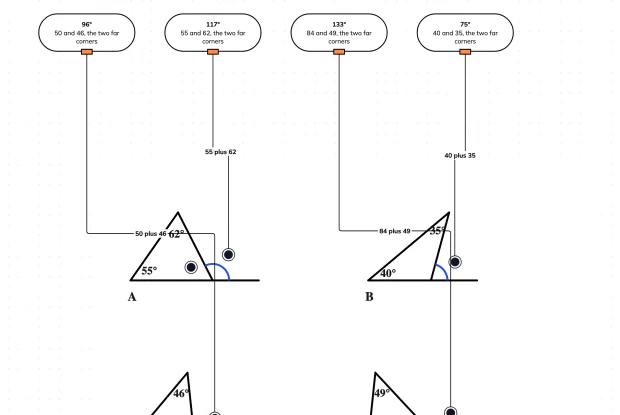
Why Does an Exterior Angle Equal the Two Opposite Angles?
Extend any side of a triangle and the angle that opens up outside it is exactly the sum of the two angles at the far corners. It is the fastest shortcut in triangle geometry and it falls straight out of two rules you already have. Use it on four triangles in an interactive playground.
Can Any Three Lengths Make a Triangle?
Not every three lengths will close into a triangle. The test is one addition: the two shorter sides together must be longer than the longest one, and longer is doing real work — equal is not enough. See exactly where the failure happens in an interactive playground.
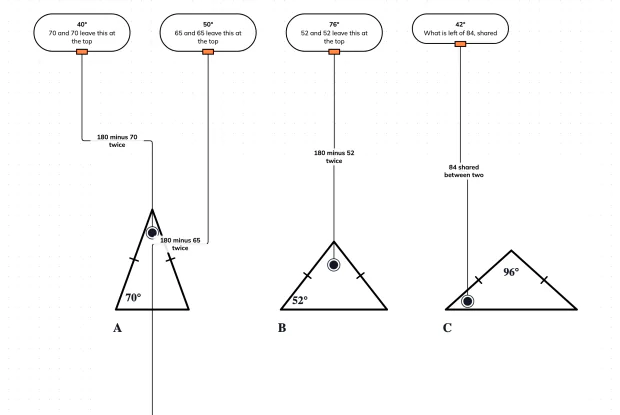
Why Does an Isosceles Triangle Have Two Equal Angles?
In an isosceles triangle the two angles opposite the equal sides are equal too. That is not a second fact bolted on to the first — the equal sides force it, and folding the triangle in half shows why. One given angle is then enough to find the rest, which you can practise in an interactive playground.
When Are Two Triangles Congruent? SSS and SAS
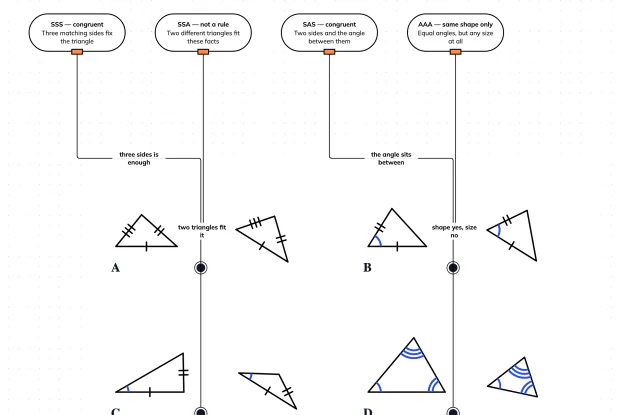
Congruent means identical in shape and size. You do not need all six measurements to be sure of it — three of the right kind will do. Three sides work, and so do two sides with the angle between them, while two very similar-looking sets of facts do not. Sort them in an interactive playground.
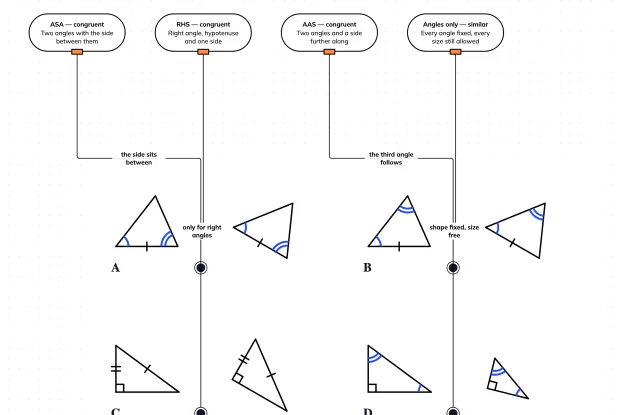
When Are Two Triangles Congruent? ASA and RHS
Angles alone can never prove two triangles identical, because they say nothing about size. Add a single side and they can: ASA and AAS both work, and right-angled triangles get a rule of their own in RHS. Sort the rules from the near-misses in an interactive playground.