Why Does an Exterior Angle Equal the Two Opposite Angles?
Root Concept
An exterior angle of a triangle equals the sum of the two interior angles it does not touch.
CodePLU Goal
Upgrading Human Mental Models
Learn how to think in Workflows

Concept Development By codeplu.com
The two angles you add are the ones at the corners the exterior angle does not touch — never the one right beside it.
What Happens If You Extend a Side?
Draw a triangle, pick one side, and carry on past a corner in a straight line. A new angle opens up outside the triangle, between that extension and the side next to it. It is called an exterior angle, and every triangle has six of them, two at each corner, because either side can be extended either way.
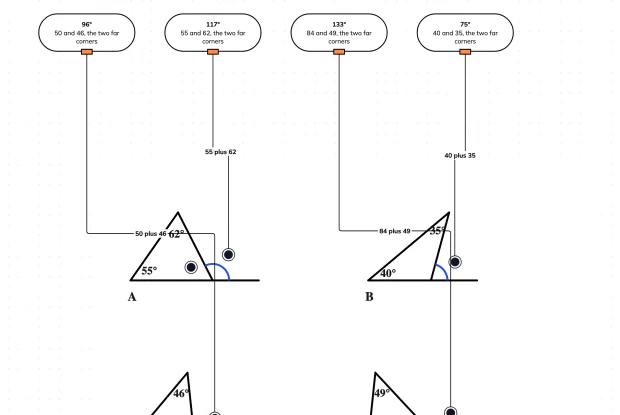
The remarkable thing about an exterior angle is that it is exactly equal to the two interior angles at the other two corners added together. Not related to them, not approximately equal: the same number. If the two far corners are 55° and 62°, the exterior angle is 117°, and you never need to work out the third angle of the triangle to get there.
That shortcut is the point of this tutorial. It saves a step every time, and it is one of the standard reasons you may quote in a written solution. The playground gives you four triangles with the two far corners marked and the exterior angle missing, so the habit you build is adding the right pair rather than working round the triangle the long way.
What the Rule Says and Why It Is True
Which Angles Count as the Opposite Ones?
The exterior angle sits at one corner, so it touches that corner's interior angle. The two angles you add are the other two — the ones at the corners the exterior angle does not touch. They are called the interior opposite angles, or sometimes the remote interior angles, which is the clearer name because remote is exactly what they are. The mistake worth guarding against is including the neighbouring angle, the one right beside the exterior angle at the same corner. That one is not part of the sum; in fact it is the angle the exterior angle is supplementary to. So at any corner there are three angles in play and you need to be clear which two you are adding: reach across the triangle, not next door.
Why Does the Rule Hold?
Two facts you already have do all the work. Call the interior angles of the triangle a, b and c, with c at the corner where the side is extended, and call the exterior angle e. First, the angles of a triangle add to 180°, so a + b + c = 180°. Second, e and c sit next to each other on the extended straight line, so they are a linear pair and e + c = 180°. Both a + b + c and e + c equal 180°, so they equal each other, and taking c away from both sides leaves a + b = e. That is the proof in full. Nothing new was assumed, which is why the result is safe to use anywhere and why it is worth reconstructing rather than memorising if you ever doubt it.
When Is It Actually Quicker?
Almost always, when the two far angles are the ones you are given. The alternative route takes two steps: find the third interior angle by subtracting the two known ones from 180°, then subtract that from 180° again to get the exterior angle. The shortcut does it in one addition. With 55° and 62° given, the long way gives 180 − 55 − 62 = 63° and then 180 − 63 = 117°, while the short way is simply 55 + 62 = 117°. Both are correct, and the fact that they agree is a good check when you are learning the rule. Once you trust it, the single addition is fewer chances to slip.
What Else Does the Rule Tell You?
Two useful things fall out of it. First, an exterior angle is always bigger than either of the interior angles it is opposite, because it is their sum and both are positive. That is a real theorem in its own right and it is sometimes the quickest way to show one angle cannot be as large as another. Second, the rule runs backwards: if you know the exterior angle and one of the far interior angles, subtract to get the other. An exterior angle of 133° with one far corner at 84° means the other far corner is 49°. Exam questions use this direction at least as often as the forwards one, so practise reading the relationship both ways.
Real World Example
How Does a Roof Truss Use the Exterior Angle?
The rafter does not stop at the corner of the roof; it carries on to form the overhang, and that extension makes an exterior angle.
The two pitches
55° and 62°
A simple truss is a triangle: two rafters meeting at a ridge, tied across the bottom. On an asymmetric roof the two rafters sit at different pitches, and the angles at the two upper corners — at the ridge and at the far wall — come out at 62° and 55°. These are the numbers an architect works with, because they are what determine how the roof sheds water and how the two slopes look from the ground. They are also, in the language of this tutorial, the two interior opposite angles for the corner we are about to look at.
The cut on the overhang
117°, in one addition
At the near wall the rafter does not stop; it runs past the wall plate and out to form the eaves overhang. That extension makes an exterior angle between the overhanging timber and the tie beam below, and the carpenter needs it to cut the bracket that sits in the gap. By the rule it is 55 + 62 = 117°, straight from the two pitches, with no need to work out the angle inside the truss at that corner first. The fact that the short way and the long way agree is worth one check on a first truss; after that the addition stands on its own.
Reading it backwards
One unknown pitch
The same rule is more useful still when a roof already exists and the drawings do not. Measure the exterior angle at the eaves with a bevel gauge — say it comes out at 117° — and measure the pitch of the one rafter you can safely reach, at 62°. The other pitch, up by the ridge where nobody wants to climb, must be 117 − 62 = 55°. This is the backwards reading of the rule, and it is the version that earns its keep in survey work: one awkward measurement replaced by two easy ones and a subtraction.
FAQs
Final Words
Extend a side of a triangle and the angle that appears outside is the sum of the two angles at the far corners. It is a one-step replacement for a two-step calculation, it reads backwards just as usefully as forwards, and it rests on nothing more than the angle sum of a triangle and the straight line you drew to make it.
The rule also carries a piece of information that is not about arithmetic: an exterior angle is always larger than either angle it is opposite. That is a statement about what a triangle can and cannot be, and questions of that kind are what the next tutorial is about — starting with whether three given lengths can make a triangle at all.
Continue This Track
This concept is part 1 of Proving Things About Triangles.
Why Does an Exterior Angle Equal the Two Opposite Angles?
Extend any side of a triangle and the angle that opens up outside it is exactly the sum of the two angles at the far corners. It is the fastest shortcut in triangle geometry and it falls straight out of two rules you already have. Use it on four triangles in an interactive playground.
Can Any Three Lengths Make a Triangle?
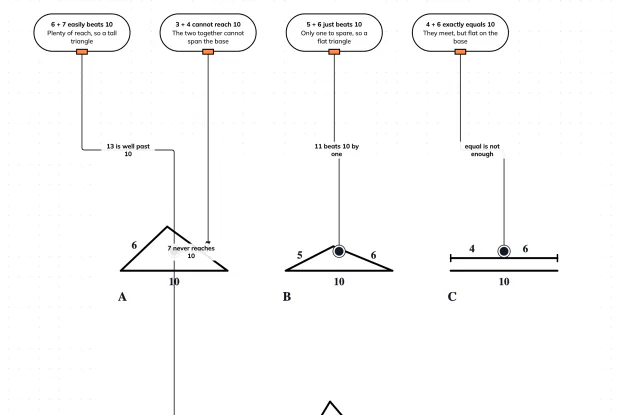
Not every three lengths will close into a triangle. The test is one addition: the two shorter sides together must be longer than the longest one, and longer is doing real work — equal is not enough. See exactly where the failure happens in an interactive playground.
Why Does an Isosceles Triangle Have Two Equal Angles?
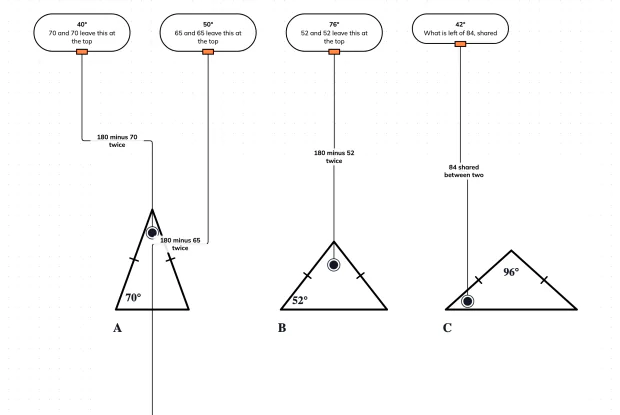
In an isosceles triangle the two angles opposite the equal sides are equal too. That is not a second fact bolted on to the first — the equal sides force it, and folding the triangle in half shows why. One given angle is then enough to find the rest, which you can practise in an interactive playground.
When Are Two Triangles Congruent? SSS and SAS
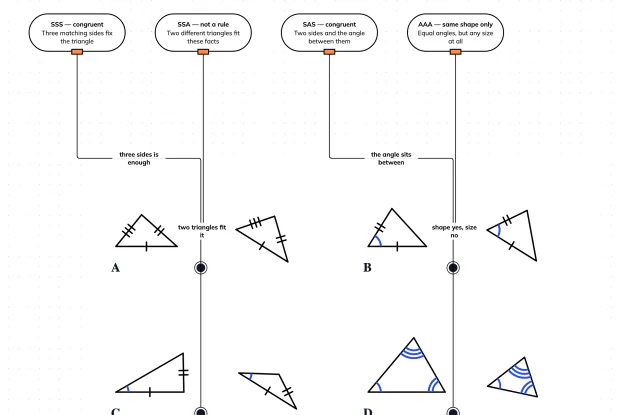
Congruent means identical in shape and size. You do not need all six measurements to be sure of it — three of the right kind will do. Three sides work, and so do two sides with the angle between them, while two very similar-looking sets of facts do not. Sort them in an interactive playground.
When Are Two Triangles Congruent? ASA and RHS
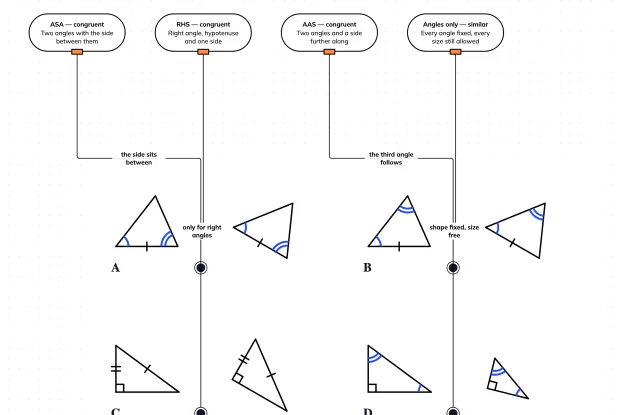
Angles alone can never prove two triangles identical, because they say nothing about size. Add a single side and they can: ASA and AAS both work, and right-angled triangles get a rule of their own in RHS. Sort the rules from the near-misses in an interactive playground.