When Are Two Triangles Congruent? ASA and RHS
Root Concept
Angles fix the shape and one side fixes the size, so every angle-based congruence rule needs exactly one length.
CodePLU Goal
Upgrading Human Mental Models
Learn how to think in Workflows

Concept Development By codeplu.com
Count the sides in the given facts. No side at all can only ever give you the shape, never the size.
What Do Angles Leave Undecided?
The last tutorial ended on a failure worth carrying forward: three matching angles do not make two triangles congruent, because enlarging a triangle changes every length and no angle. Angles fix the shape and leave the size entirely open. So any congruence rule built on angles has to include at least one length somewhere, and that length is doing one job only — settling how big the triangle is.
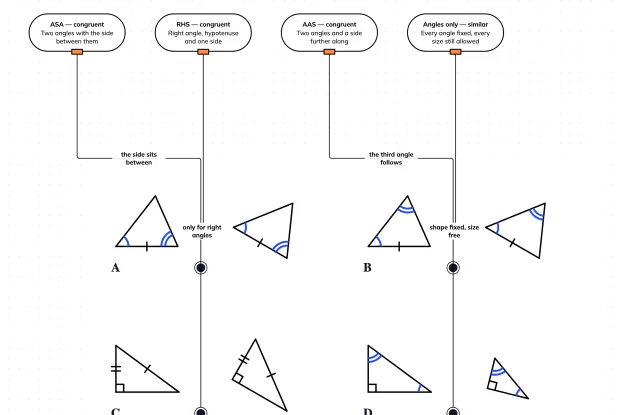
With one side included, angles turn out to be very powerful. Two angles and the side between them is enough, which is the rule called ASA. So is two angles and a side somewhere else along the triangle, called AAS, and the reason it also works is worth knowing: once you have two angles you have the third for free, because the three of them must total 180°. That makes AAS quietly the same rule as ASA wearing different clothes.
Right-angled triangles then get a rule of their own, RHS, which works with the right angle, the hypotenuse and one other side. It looks like the discredited SSA and it is not, for a reason the tutorial sets out. In the playground the pairs where the facts do not go far enough are drawn as genuinely different triangles.
Which Angle-Based Rules Work?
Why Does ASA Work?
ASA gives two angles and the side between them. Build it and nothing is ever left to choose. Draw the given side to its exact length; that fixes both its ends. At one end turn through the first given angle and draw a ray; at the other end turn through the second angle and draw another. Two rays in a plane that are not parallel meet at exactly one point, and that point is the third corner. There was no moment at which a different triangle could have resulted. Notice how the single side does its job: it sets the distance between the two corners, and everything else scales from that. Change the length of that side and you get a different triangle of exactly the same shape, which is precisely the freedom that angles alone leave open.
Why Does AAS Work Too?
AAS gives two angles and a side that is not between them, which sounds worryingly like the SSA near-miss from the last tutorial. It is not, and the reason is the angle sum. If you know two angles of a triangle, the third is forced: subtract the two from 180°. So AAS secretly hands you all three angles, and once you have all three you can always re-describe the situation as two angles with the given side between them, which is ASA. The rule works because it collapses into one you already trust. This is why some courses do not teach AAS as a separate rule at all, and why exam mark schemes usually accept either name. Nothing similar rescues SSA, because knowing two sides tells you nothing about the third.
What Is RHS, and Why Is It Not SSA?
RHS applies only to right-angled triangles and asks for three things: the right angle, the hypotenuse, and one of the other two sides. On the face of it that is two sides and a non-included angle, which is the arrangement that failed as SSA. What rescues it is Pythagoras. In a right-angled triangle the three sides are locked together by the relation between the two shorter sides and the hypotenuse, so knowing the hypotenuse and one leg determines the other leg exactly, with no second possibility. That turns RHS into SSS in disguise. The ambiguity that spoils SSA in general comes from the third side being free to land in two places, and a right angle removes exactly that freedom.
How Do You Choose the Right Rule?
Start by counting what you have been given rather than by trying to recall names. If you have no sides at all, stop: no congruence rule exists and the most you can claim is similar triangles. If you have sides, ask how many and where the angles sit relative to them. Three sides is SSS. Two sides with the angle between them is SAS. Two angles with any side is ASA or AAS, and the distinction rarely matters. A right angle with the hypotenuse and one other side is RHS. The only combination that looks usable and is not is two sides with an angle outside them, in a triangle that is not right-angled. When you write a proof, name the rule you are using; it is usually worth a mark on its own.
Real World Example
How Does a Surveyor Fix a Distance Without Crossing a River?
The far bank cannot be walked to, so every length in the triangle except one has to come from angles, which is exactly what ASA is for.
The one length you can walk
A 40 m baseline
A surveyor needs the distance to a marker on the opposite bank of a river. Crossing to measure it directly is not an option, so the work is done from one side. First a baseline is measured along the near bank between two pegs, say 40 metres, using a tape on flat accessible ground. This is the only length that will be measured anywhere in the job, and it is the side in ASA. Everything about the size of the final triangle traces back to those 40 metres, which is why surveyors take great care over a baseline and much less over anything else.
The two angles from its ends
68° and 74°
Standing at the first peg, the surveyor measures the angle between the baseline and the line of sight to the marker: 68°. Moving to the second peg, the same measurement comes out at 74°. That is two angles with the measured side between them, which is ASA, so the triangle is now completely determined — one triangle and no other fits those three facts. The distance across the river is a side of that triangle, and it can be calculated without anybody getting wet. The whole method rests on the rule being a genuine congruence rule rather than merely a plausible one.
Why two angles alone will not do
The baseline is not optional
Suppose the surveyor skipped the tape and measured only angles — 68° and 74° at the two pegs, and by subtraction 38° at the marker. The shape of the triangle is now known exactly, and the distance across is still completely unknown, because the same three angles fit a triangle 40 metres wide and one 4 kilometres wide equally well. This is the failure of angles alone, made concrete. It is also why every practical survey begins with a measured baseline, and why an error in that one length scales straight through into every distance derived from it.
FAQs
Final Words
Angles do most of the work in these rules, but never all of it. Two angles and any side prove congruence, whether the side lies between them as in ASA or elsewhere as in AAS, because two angles always give the third. Right-angled triangles add RHS, which escapes the SSA trap because the right angle forces the third side rather than leaving it a choice.
That completes the set of congruence rules: SSS, SAS, ASA and RHS, each containing at least one length because nothing else can settle the size. These rules are what turns geometry from measuring into proving — they let you claim two parts of a figure are equal without ever measuring either one, and that is the move most written geometry proofs are built from.
Continue This Track
This concept is part 5 of Proving Things About Triangles.
Why Does an Exterior Angle Equal the Two Opposite Angles?
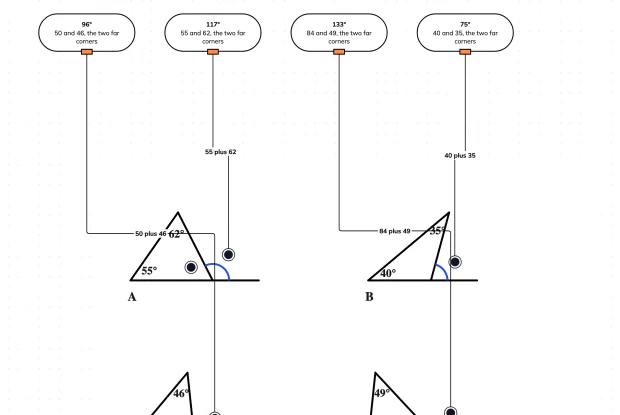
Extend any side of a triangle and the angle that opens up outside it is exactly the sum of the two angles at the far corners. It is the fastest shortcut in triangle geometry and it falls straight out of two rules you already have. Use it on four triangles in an interactive playground.
Can Any Three Lengths Make a Triangle?
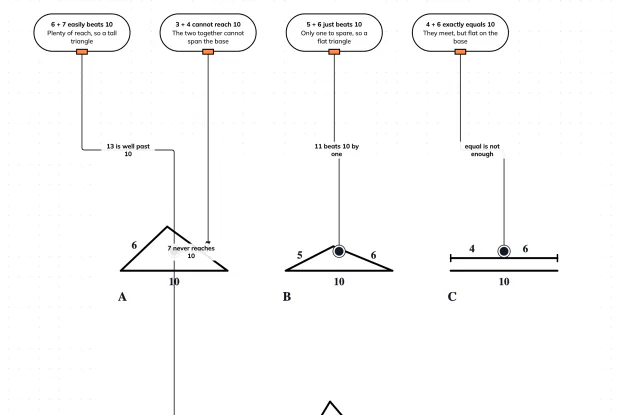
Not every three lengths will close into a triangle. The test is one addition: the two shorter sides together must be longer than the longest one, and longer is doing real work — equal is not enough. See exactly where the failure happens in an interactive playground.
Why Does an Isosceles Triangle Have Two Equal Angles?
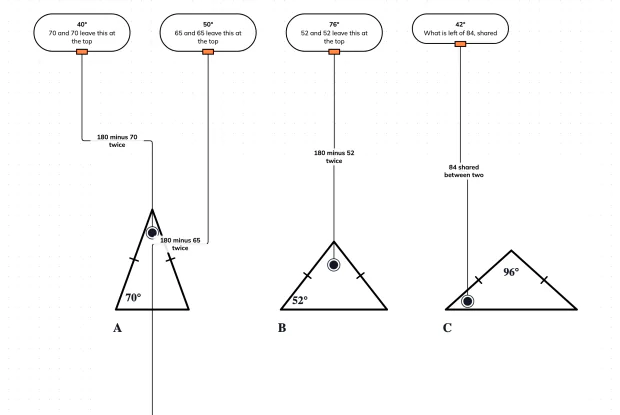
In an isosceles triangle the two angles opposite the equal sides are equal too. That is not a second fact bolted on to the first — the equal sides force it, and folding the triangle in half shows why. One given angle is then enough to find the rest, which you can practise in an interactive playground.
When Are Two Triangles Congruent? SSS and SAS
Congruent means identical in shape and size. You do not need all six measurements to be sure of it — three of the right kind will do. Three sides work, and so do two sides with the angle between them, while two very similar-looking sets of facts do not. Sort them in an interactive playground.
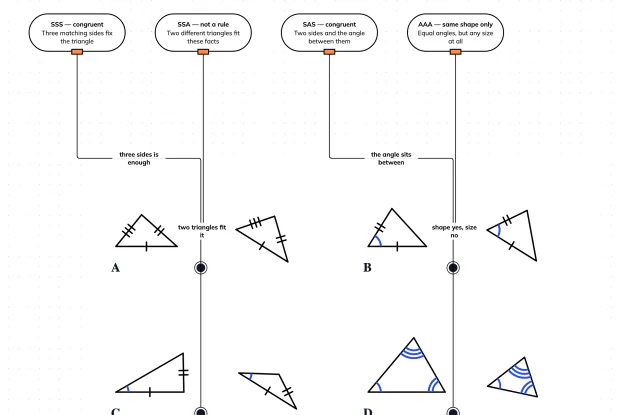
When Are Two Triangles Congruent? ASA and RHS
Angles alone can never prove two triangles identical, because they say nothing about size. Add a single side and they can: ASA and AAS both work, and right-angled triangles get a rule of their own in RHS. Sort the rules from the near-misses in an interactive playground.