Proving Things About Triangles
Knowing that a triangle's angles total 180° is where most people stop. This track is about what else that fact forces. It opens with the exterior angle, which turns out to equal the two angles at the far corners added together, replacing a two-step calculation with one addition. Then the subject shifts from angles to lengths: three lengths only close into a triangle when the two shorter ones reach past the longest, and equal is not enough — at exactly equal the figure lies flat. Make two of those lengths the same and the angles are forced to match as well, which is the isosceles result, proved by folding the triangle down the middle. That fold quietly uses a congruence rule, and the last two tutorials set the rules out properly: which three measurements pin a triangle down completely, and which convincing-looking combinations leave room for a second triangle to fit the same facts. By the end the question has changed from what is this triangle to what must this triangle be.
CodePLU Goal
Upgrading Human Mental Models
Learn how to think in Workflows
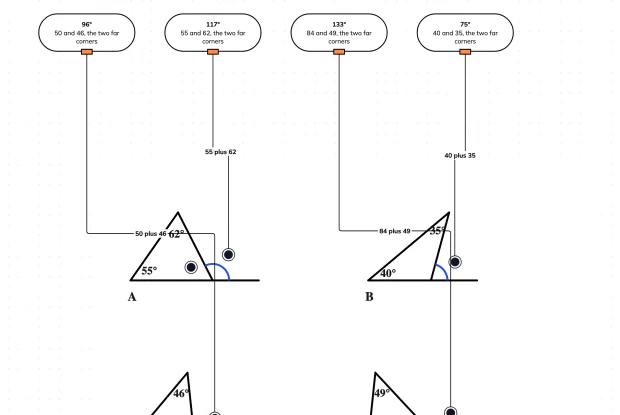
Why Does an Exterior Angle Equal the Two Opposite Angles?
Extend any side of a triangle and the angle that opens up outside it is exactly the sum of the two angles at the far corners. It is the fastest shortcut in triangle geometry and it falls straight out of two rules you already have. Use it on four triangles in an interactive playground.
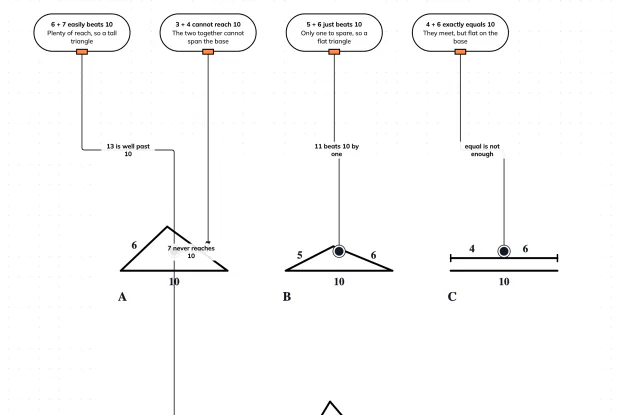
Can Any Three Lengths Make a Triangle?
Not every three lengths will close into a triangle. The test is one addition: the two shorter sides together must be longer than the longest one, and longer is doing real work — equal is not enough. See exactly where the failure happens in an interactive playground.
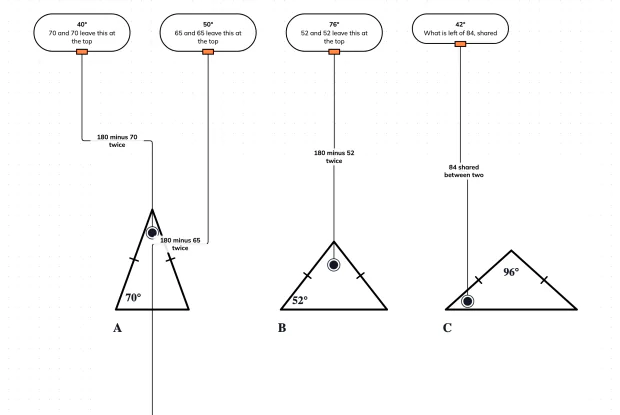
Why Does an Isosceles Triangle Have Two Equal Angles?
In an isosceles triangle the two angles opposite the equal sides are equal too. That is not a second fact bolted on to the first — the equal sides force it, and folding the triangle in half shows why. One given angle is then enough to find the rest, which you can practise in an interactive playground.
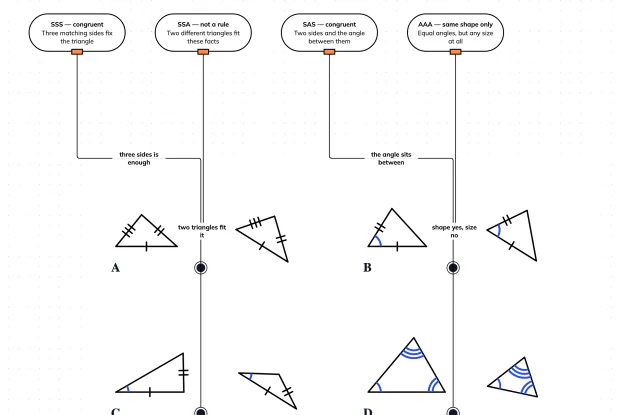
When Are Two Triangles Congruent? SSS and SAS
Congruent means identical in shape and size. You do not need all six measurements to be sure of it — three of the right kind will do. Three sides work, and so do two sides with the angle between them, while two very similar-looking sets of facts do not. Sort them in an interactive playground.
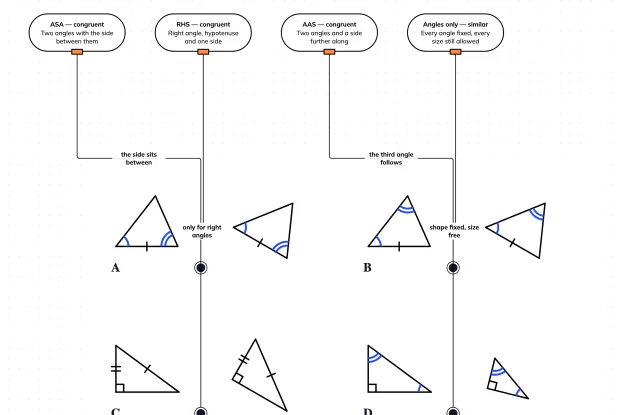
When Are Two Triangles Congruent? ASA and RHS
Angles alone can never prove two triangles identical, because they say nothing about size. Add a single side and they can: ASA and AAS both work, and right-angled triangles get a rule of their own in RHS. Sort the rules from the near-misses in an interactive playground.