What Does Percent Really Mean?
Root Concept
Percent means 'per hundred', so a percentage tells you how many out of 100. The % sign is shorthand for 'out of 100', so 25% means 25 out of 100 squares of a whole, which is the same as the fraction 25/100 or one quarter.
CodePLU Goal
Upgrading Human Mental Models
Learn how to think in Workflows

Concept Development By codeplu.com
Each 100-square grid matched to its percentage — 10, 25, 50 and 75 squares shaded out of a hundred
What Does 'Percent' Actually Mean?
You see percentages everywhere — 50% off, 90% battery, 8% interest — but what does the word actually mean? It is simpler than it looks. 'Percent' comes from words meaning 'per hundred', so a percentage is just a way of saying how many out of 100. The little % sign is shorthand for those words 'out of 100'.
So 25% means 25 out of 100. Picture a grid split into 100 little squares: shade 25 of them and you have shaded 25%. Shade 50 and you have 50%, which is also half the grid. Shade 100 and you have 100% — the whole thing. Everything is measured against the same total of 100, which is exactly what makes percentages so easy to compare.
Because a percentage is just 'so many out of 100', it is really a fraction with 100 on the bottom: 25% is the same as the fraction 25/100, which simplifies to one quarter. In the playground you will match each percentage to a 100-square grid shaded that many squares, and see 'per hundred' with your own eyes.
How Do Percentages Work?
Percent means 'per hundred'
The key to percentages is hidden in the word itself: 'per cent' means 'per hundred' ('cent' is the same root as in century, 100 years, or cents, 100 to a dollar). So a percentage always answers the question 'how many out of 100?'. The % sign is just a quick way of writing 'out of 100'. When you read 30%, say to yourself '30 out of 100', and it will make sense. The best picture is a grid of 100 small squares: the percentage is simply how many of those hundred squares are shaded. 30% shades 30 squares, 80% shades 80. Everything in percentages comes back to this one idea — a count out of one hundred.
Percents are fractions of 100
Because a percentage is 'so many out of 100', every percentage is really a fraction with 100 as the denominator. 25% is 25/100, 60% is 60/100, and so on — you can always write a percent as that number over a hundred. Often this fraction simplifies to something familiar: 25/100 is one quarter (1/4), 50/100 is one half (1/2), 75/100 is three quarters (3/4), and 10/100 is one tenth (1/10). This is why a few percentages are worth knowing by heart: 50% is half, 25% is a quarter, 75% is three quarters, 10% is a tenth. Seeing a percent as a fraction of 100 links it straight to fractions you already understand.
Why measuring out of 100 is so handy
Why 100? Because putting everything on the same scale of a hundred makes different amounts easy to compare at a glance. If one test is marked out of 20 and another out of 50, the raw scores are hard to compare — but turn them both into percentages and you instantly know which was better, because both are now out of the same 100. That is the real power of percentages: they are a common language for 'how much of the whole'. A phone at 90% and a class with 90% attendance are using the same idea — 90 out of every 100. Whenever you want to compare parts of different-sized wholes fairly, turning them into percentages puts them all on the friendly scale of one hundred.
Real World Example
Where Do You See Percentages?
Percentages are one of the most common bits of maths in daily life. Here are three:
Test scores
A percentage puts every test on the same scale
Imagine you get 18 out of 20 on one quiz and 40 out of 50 on another. Which did you do better on? It is hard to tell from the raw marks because the totals are different. Turn each into a percentage — a score out of 100 — and it is obvious: 18 out of 20 is 90%, and 40 out of 50 is 80%. Now both are measured against the same hundred, so you can compare them directly, and the first score wins. This is exactly why schools report results as percentages: it lets a mark out of 20, a mark out of 50 and a mark out of 30 all be compared fairly, because a percentage always means the same thing — how many out of 100.
Sales and discounts
50% off means half price
Shops love percentages. '50% off' means the price is cut by 50 out of every 100 — that is half — so a £40 item becomes £20. '25% off' takes away 25 out of every 100, a quarter off, so £40 becomes £30. Reading the percent as 'out of 100' turns a scary-looking discount into something you can picture: 50% is half the grid shaded, so half the price comes off. This is why knowing that 25% is a quarter and 50% is a half is so useful in a shop — you can work out a sale price in your head, because the percentage is just telling you what fraction of the whole to take off.
Your phone battery
100% is full, and each percent is one hundredth
Your phone shows its battery as a percentage, and it is the same idea again: 100% is a completely full battery — the whole thing — and 0% is empty. So 50% means half full, 25% means a quarter left, and 10% means only a tenth remains (time to charge). Each single percent is one hundredth of the full battery, which is why the number ticks down one point at a time. Seeing the battery as 'out of 100' tells you at a glance how much of the whole is left, without needing to know the exact size of the battery. That is percentages doing what they do best: showing a part of a whole on the easy scale of a hundred.
FAQs
Final Words
Percent means 'per hundred', so a percentage is simply how many out of 100, and the % sign is shorthand for 'out of 100'. Picture a grid of 100 squares: 25% shades 25 of them, 50% shades 50 (a half), 100% shades them all. Because it is always a count out of a hundred, every percent is also a fraction over 100 — 25/100 is a quarter, 50/100 a half, 75/100 three quarters.
Measuring on the same scale of 100 is what makes percentages so useful, letting you compare test scores, read a sale, or check a battery at a glance. Now that you can read a percent as a part of a hundred, the next steps are converting between fractions, decimals and percents, and working out a percentage of an amount.
Related Concepts
What Are the Different Types of Numbers?
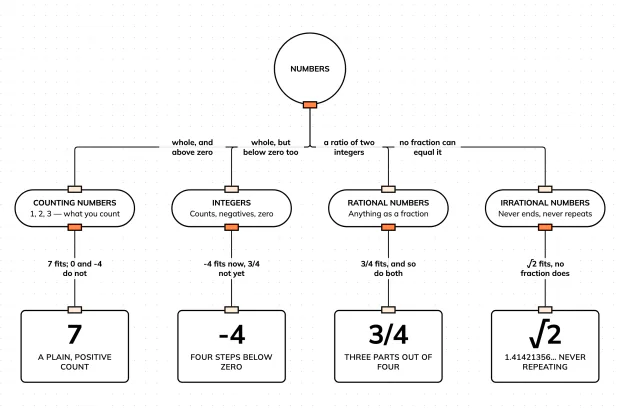
Counting numbers, integers, rationals and irrationals explained in plain words — then sort each number into its family yourself in an interactive playground.
Why Does a Digit's Position Change Its Value?
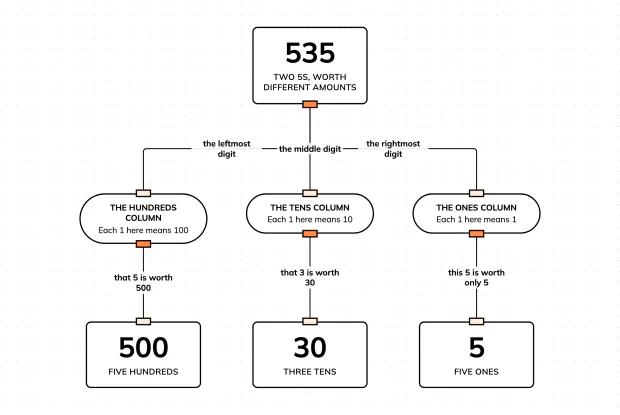
The same digit can be worth 5 or 500 depending on where it sits. Learn how columns decide a digit value, then build 535 down into its columns in an interactive playground.
Why Does the Order of Operations Matter?
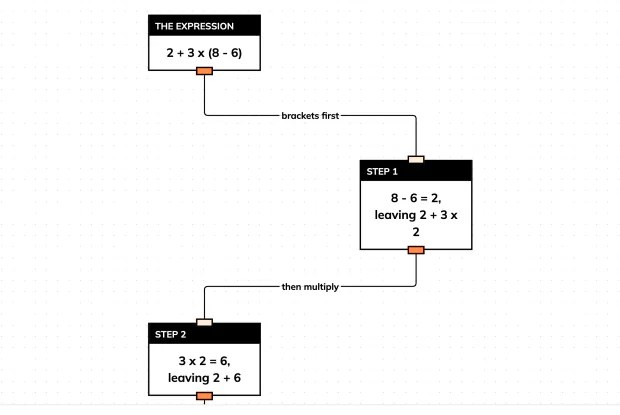
Two people can get two different answers from the same sum unless they agree on an order. Learn the rule and build the steps yourself in an interactive playground.
What's the Difference Between a Factor and a Multiple?
Factors go into a number; multiples come out of it. Learn which direction each word points, then sort three numbers by how they relate to 12.
What Does a Fraction Actually Mean?
A fraction is not one number but two doing different jobs. Learn what the top and bottom each tell you, and build 3/4 down into its three working parts in an interactive playground.
How Can Two Different Fractions Be Equal?
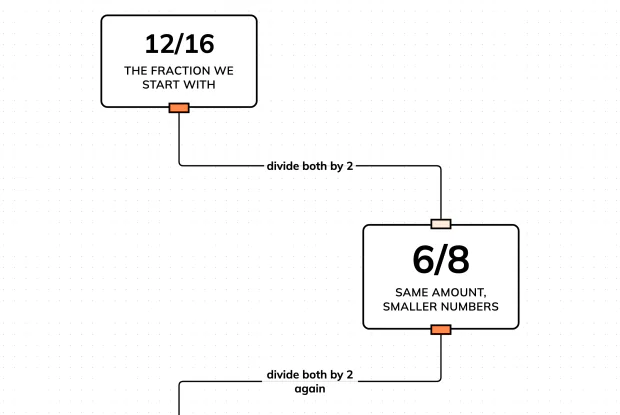
1/2, 2/4 and 8/16 are the same amount written three ways. Learn why multiplying or dividing both parts changes nothing.