How Do You Find the Area of a Trapezium?
Root Concept
A trapezium has the same area as a rectangle whose width is the average of its two parallel sides.
CodePLU Goal
Upgrading Human Mental Models
Learn how to think in Workflows

Concept Development By codeplu.com
Add the two parallel sides, halve, multiply by the height. The slanting sides play no part, exactly as with a parallelogram.
What Do You Do When the Width Keeps Changing?
A rectangle and a parallelogram both have a single width to multiply by their height. A trapezium does not: its two parallel sides are different lengths, so the shape is wider at one end than the other and there is no one number to use.
The answer is to use the number halfway between them. If the parallel sides are 6 and 10, the trapezium behaves for area purposes exactly like a rectangle 8 wide — the extra at the wide end makes up precisely for what is missing at the narrow end. So the area is the average of the two parallel sides multiplied by the perpendicular height, usually written as ½(a + b)h.
Everything else works as it did for the parallelogram. The height is the perpendicular distance between the two parallel sides, not the length of a slanting side, and the slanting sides do not enter the calculation at all. The playground gives you the two parallel sides and the height every time, so the whole task is add, halve, multiply.
Why Averaging Works, and How to Apply It
Why Does the Average Work?
Take two identical trapeziums, turn one upside down, and fit them together along a slanting side. What you get is a parallelogram, and its base is the two parallel sides added together: the long one from one trapezium and the short one from the other. Its height is the same as the trapezium's. So the parallelogram's area is (a + b)h, and since it is made of two copies of the trapezium, one trapezium is half of that: ½(a + b)h. That is the formula, and it is why the halving is there. Nothing has been assumed about the slanting sides, which is why they never appear — the same argument works whether the trapezium is symmetrical or badly lopsided.
In What Order Should You Work?
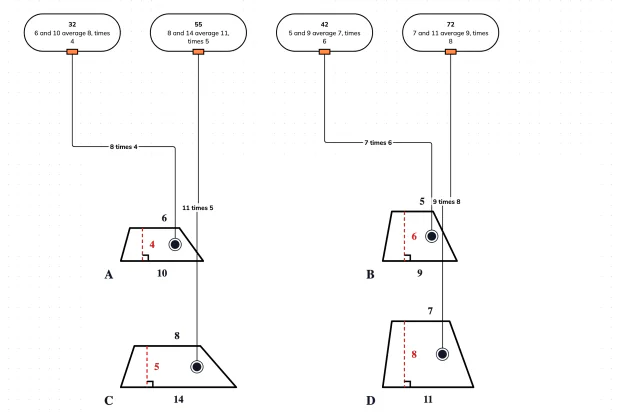
Add the two parallel sides first, then halve, then multiply by the height. Doing it in that order keeps the numbers small and usually keeps them whole: 8 and 14 add to 22, halve to 11, times 5 is 55. Multiplying everything out before halving works too but produces bigger numbers to carry. Where the two parallel sides add to an odd total, halving gives a decimal and it is often easier to multiply by the height first and halve at the end instead: 7 and 10 with height 6 is better done as 17 × 6 = 102, then halved to 51, than as 8.5 × 6. Both routes are correct; pick whichever avoids the decimal.
What Goes Wrong Most Often?
Three things, in order of frequency. Forgetting to halve, which doubles the answer and is by far the most common. Using a slanting side as the height, exactly as with parallelograms — the height is the perpendicular distance between the parallel sides and is usually drawn dashed. And adding the wrong pair: a trapezium has four sides and only two of them are parallel, so the two to add are the ones with the arrowheads, not simply the top and bottom of the drawing, since a trapezium may be drawn on its side. A quick check on any answer is that it must lie between the two rectangles you could build from the shorter and longer parallel sides.
What If the Trapezium Is Part of a Bigger Shape?
Then you have a choice, and sometimes splitting is easier than the formula. Any trapezium can be cut into a rectangle and one or two right-angled triangles, and adding those areas gives the same answer. For a trapezium with parallel sides 6 and 10 and height 4, the rectangle is 6 × 4 = 24 and the triangles together make a triangle of base 4 and height 4, giving 8, for a total of 32 — the same as ½(6 + 10) × 4. The formula is quicker once you trust it, but the splitting method is worth knowing because it generalises to shapes with no formula at all, which is the subject of a later tutorial in this track.
Real World Example
How Much Does a Sloping Field Cost to Sow?
Seed is priced by the hectare, so the odd shape on the map has to be converted into an area before anything is bought.
The shape on the map
80 m and 140 m ends
A field sits between two parallel hedges that run north to south, but the lane at one end cuts across at an angle, so the field is wider at the southern end than the northern one. Measured along the hedges, the two parallel sides come out at 80 metres and 140 metres. There is no single width to use, and a farmer who took either number on its own would be wrong in one direction or the other — too little seed using 80, too much using 140, and neither error visible until the drill runs out or the bill arrives.
The width that behaves like one
110 m, the average
Halfway between 80 and 140 is 110, and the field behaves exactly as though it were a rectangle 110 metres wide. The extra 30 metres at the southern end makes up precisely for the 30 metres missing at the northern one, which is the whole content of the averaging step. Multiplying by the 50-metre distance between the hedges gives 110 × 50 = 5500 square metres, or 0.55 hectares. That is the figure the seed is ordered against, and it would have come out as 4000 or 7000 square metres on either of the two wrong widths.
Checking it is sensible
Between 4000 and 7000
The answer can be sanity-checked without redoing the arithmetic. The field must be bigger than a rectangle 80 metres wide, which is 4000 square metres, and smaller than one 140 metres wide, which is 7000. The calculated 5500 sits between them, and comfortably nearer the middle, which is what averaging should produce. This check takes a few seconds and catches the most common mistake in trapezium questions, which is forgetting to halve — catches the most common mistake in trapezium questions, which is forgetting to halve — an unhalved answer of 11,000 square metres is nearly twice the larger of the two bounds and fails the check before any arithmetic is repeated.
FAQs
Final Words
A trapezium has no single width, so it uses the average of its two parallel sides instead, multiplied by the perpendicular height. The halving comes from a picture rather than a rule: two copies of the shape fit together into a parallelogram, so one of them is half of it.
The check worth carrying is that the answer must sit between the two rectangles the shorter and longer parallel sides would give, which catches a missed halving instantly. The next tutorial leaves parallel sides behind for shapes measured by their diagonals instead — the rhombus and the kite.
Continue This Track
This concept is part 2 of Area Beyond the Basics.
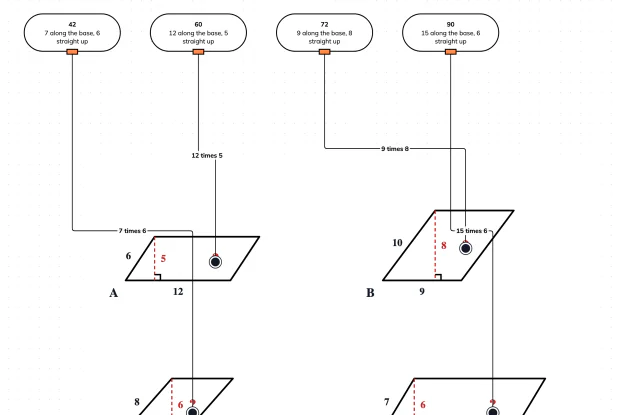
How Do You Find the Area of a Parallelogram?
A parallelogram's area is its base multiplied by its perpendicular height, and the reason is a single cut: slice a triangle off one end, slide it to the other, and you have a rectangle. The one thing to get right is which number is the height. Practise in an interactive playground.
How Do You Find the Area of a Trapezium?
A trapezium's parallel sides are different lengths, so it has no single width — but the average of the two behaves exactly like one. Add them, halve, and multiply by the perpendicular height. See why that works and practise it in an interactive playground.
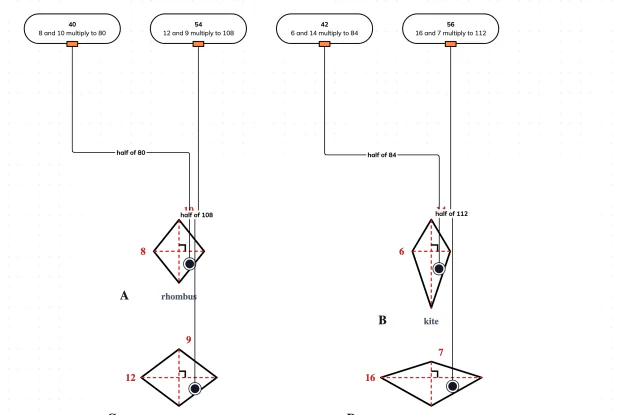
How Do You Find the Area of a Rhombus or a Kite?
Rhombuses and kites are awkward to measure by base and height, but both have diagonals that cross at right angles — and that gives a simpler route. Multiply the two diagonals and halve. See why one rule covers both shapes, in an interactive playground.
How Do You Find the Area of a Compound Shape?
Most real shapes have no area formula at all. They do not need one: cut them into rectangles and triangles, find each piece, and add. The skill is choosing the cut and working out the lengths the drawing does not give you directly. Practise both in an interactive playground.
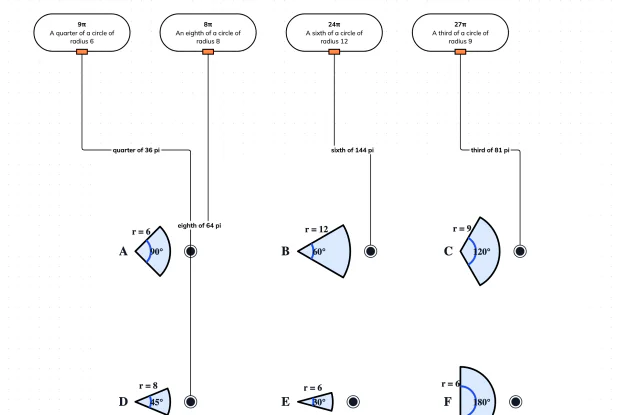
How Do You Find the Area of a Sector?
A sector is a slice of a circle, and its area is that same slice of the circle's area. Find the fraction from the angle, then take that fraction of πr². The trap is different from the arc-length one: here the radius is used as it stands. Practise in an interactive playground.