How Do You Find the Area of a Rhombus or a Kite?
Root Concept
Diagonals that cross at right angles box the shape into a rectangle of exactly twice its area.
CodePLU Goal
Upgrading Human Mental Models
Learn how to think in Workflows

Concept Development By codeplu.com
The rule needs only one thing: diagonals meeting at right angles. Both rhombuses and kites have that, so both use it.
Why Do Two Different Shapes Share a Rule?
A rhombus is a parallelogram, so its area could be found as base × height like any other. In practice that is awkward, because the perpendicular height of a leaning rhombus is rarely the number anyone has. A kite is not a parallelogram at all and has no obvious base and height to use.
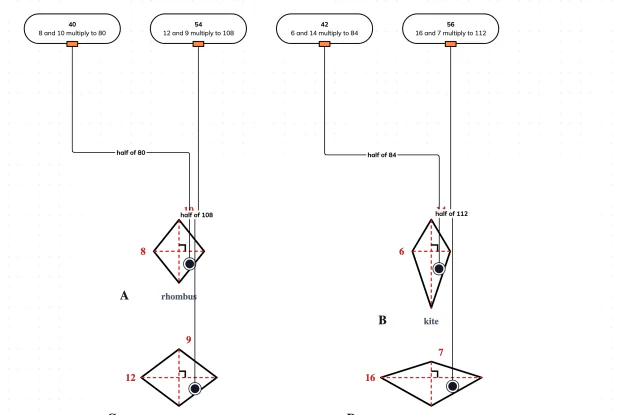
What both shapes do have is a pair of diagonals that cross at right angles. That turns out to be all that is needed. For any quadrilateral whose diagonals are perpendicular, the area is half the product of those two diagonals — written ½ d₁d₂. A rhombus with diagonals of 8 and 10 has an area of 40, and so does a kite with the same two diagonals.
It is worth noticing that the rule belongs to the perpendicular diagonals rather than to either shape. That is why one formula covers a rhombus, a kite and a square all at once, and why it does not cover a general parallelogram, whose diagonals meet at no particular angle.
Where the Rule Comes From and When It Applies
Why Half the Product?
Draw the smallest rectangle that will fit round the shape, with its sides parallel to the two diagonals. That rectangle is exactly d₁ by d₂, so its area is d₁d₂, and the shape sits inside it taking up precisely half. The reason is easy to see once drawn: the diagonals cut the shape into four right-angled triangles, and each of those triangles is half of one of the four smaller rectangles the box is divided into. Half of each part means half of the whole. This is also why the rule fails when the diagonals are not perpendicular — the surrounding box is no longer a rectangle with the diagonals as its dimensions, and the neat halving disappears.
Does It Matter Which Diagonal Is Which?
No, because multiplication does not care about order. A kite with diagonals 6 and 14 has the same area as one with 14 and 6, which is 42 either way. This is a small relief compared with the trapezium, where the two parallel sides must be added and the height kept separate, and compared with the parallelogram, where base and height are quite different roles. Here both numbers do the same job. What does matter is that both numbers really are full diagonals rather than halves of them: a question that gives the distances from the centre out to two corners is handing you half-diagonals, and each needs doubling before the formula is used.
Which Shapes Can Use It?
Any quadrilateral whose diagonals cross at right angles, which in school geometry means the rhombus, the kite and the square. A square is both a rhombus and a kite, so it qualifies twice over: a square with diagonals of 10 has an area of ½ × 10 × 10 = 50, which agrees with the side length of √50 squared. The shapes it does not cover are the general parallelogram and the rectangle, whose diagonals are equal but meet at a slant, and the trapezium. For those, base × height or the averaging formula is still the route. Checking the right-angle marker where the diagonals cross is the quickest way to decide whether this rule is available.
How Do You Run It Backwards?
Multiply the area by two and divide by the diagonal you know. A kite of area 42 with one diagonal of 6 has a second diagonal of 84 ÷ 6 = 14. The doubling is the step that gets forgotten, and the resulting answer is exactly half what it should be, so it is worth a quick check that the two diagonals really do multiply back to twice the area. For a rhombus there is an extra route, because all four sides are equal and the half-diagonals meet at a right angle: Pythagoras on those half-diagonals gives the side length, which is how a rhombus with diagonals 6 and 8 turns out to have sides of 5.
Real World Example
How Much Fabric Does a Kite Need?
The spars fix the two diagonals, and the fabric has to cover the shape they make between them.
The two spars
16 cm across, 7 cm long
A small kite is built round two spars: a long one from nose to tail and a shorter crossbar. Those two spars are the diagonals of the finished shape, they cross at right angles, and their lengths are the first thing decided in the design because they determine everything else. Suppose the crossbar is 16 cm and the spine 7 cm. These are the only two measurements on the drawing, and nobody has worked out the four edge lengths or any of the angles — nor do they need to, for the question being asked here.
The fabric it takes
56 square centimetres
The sail is the region between the four ends of the spars, so its area is half the product of the two diagonals: ½ × 16 × 7 = 56 square centimetres. No edge length and no angle was needed anywhere in that calculation, which is the practical appeal of the rule. It also scales straightforwardly: doubling both spars gives four times the fabric, which matters when a design is enlarged, because fabric is the dominant cost and it grows with the square of the size rather than in step with it, so a kite twice as tall costs four times as much to cover.
Why the box is twice as big
16 by 7 is 112
There is a good way to see the halving on the cutting table. Lay the two spars out crossed and draw the smallest rectangle round them, with its sides parallel to the spars: it measures 16 by 7, an area of 112 square centimetres. The kite sits inside that rectangle and covers exactly half of it, with four right-angled triangles of waste in the corners. That is not just a proof, it is how the cut is actually marked out: rectangle first, then That is not just a proof, it is how the cut is actually marked out on the fabric: rectangle first, then the four corners trimmed away to the ends of the spars.
FAQs
Final Words
Rhombuses and kites are both measured by their diagonals, because both have diagonals that cross at right angles. Multiply the two and halve. The rule belongs to the perpendicular crossing rather than to either shape, which is why one formula covers the rhombus, the kite and the square and leaves the rectangle out.
The picture behind it — a shape filling exactly half the rectangle drawn round its diagonals — is worth keeping, because it is also how the shape gets marked out for cutting. The next tutorial drops formulas altogether and deals with shapes that have none, by cutting them into pieces that do.
Continue This Track
This concept is part 3 of Area Beyond the Basics.
How Do You Find the Area of a Parallelogram?
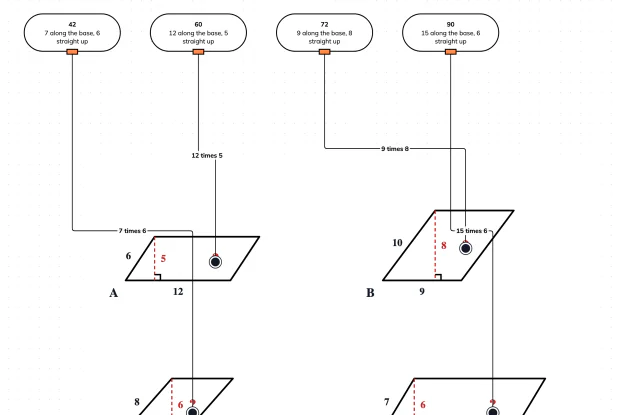
A parallelogram's area is its base multiplied by its perpendicular height, and the reason is a single cut: slice a triangle off one end, slide it to the other, and you have a rectangle. The one thing to get right is which number is the height. Practise in an interactive playground.
How Do You Find the Area of a Trapezium?
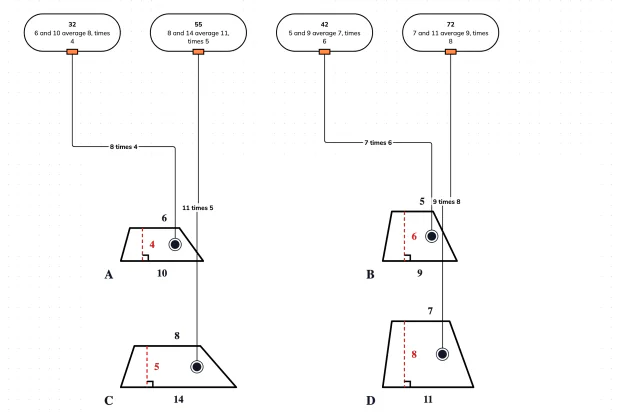
A trapezium's parallel sides are different lengths, so it has no single width — but the average of the two behaves exactly like one. Add them, halve, and multiply by the perpendicular height. See why that works and practise it in an interactive playground.
How Do You Find the Area of a Rhombus or a Kite?
Rhombuses and kites are awkward to measure by base and height, but both have diagonals that cross at right angles — and that gives a simpler route. Multiply the two diagonals and halve. See why one rule covers both shapes, in an interactive playground.
How Do You Find the Area of a Compound Shape?
Most real shapes have no area formula at all. They do not need one: cut them into rectangles and triangles, find each piece, and add. The skill is choosing the cut and working out the lengths the drawing does not give you directly. Practise both in an interactive playground.
How Do You Find the Area of a Sector?
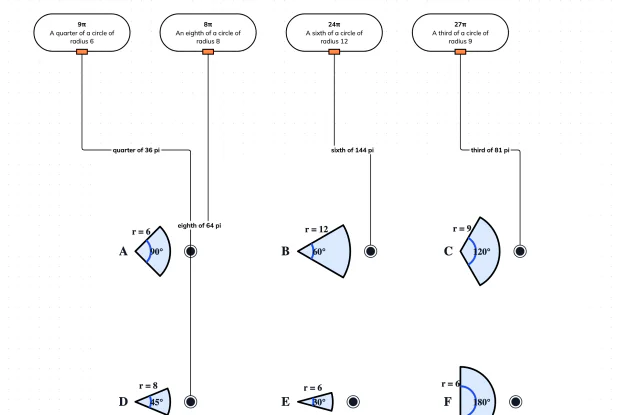
A sector is a slice of a circle, and its area is that same slice of the circle's area. Find the fraction from the angle, then take that fraction of πr². The trap is different from the arc-length one: here the radius is used as it stands. Practise in an interactive playground.