How Do You Find the Area of a Compound Shape?
Root Concept
Any shape made of straight edges can be cut into rectangles and triangles, and areas add.
CodePLU Goal
Upgrading Human Mental Models
Learn how to think in Workflows

Concept Development By codeplu.com
Areas add. Cut the shape wherever it makes the pieces easiest, then find any length the drawing has left out by subtracting.
What Do You Do With a Shape That Has No Formula?
Almost every shape in the real world is an odd one. A room with a bay window, a garden with a cut corner, the end wall of a house: none of them is a rectangle, a triangle or anything with a name, and there is no formula waiting for them.
There does not need to be. Area is a count of the space inside a shape, and counts add up. Cut an awkward shape into pieces that do have formulas, work out each piece, and add the results. Any shape made of straight edges can be cut into rectangles and triangles, and that is all the tools you need.
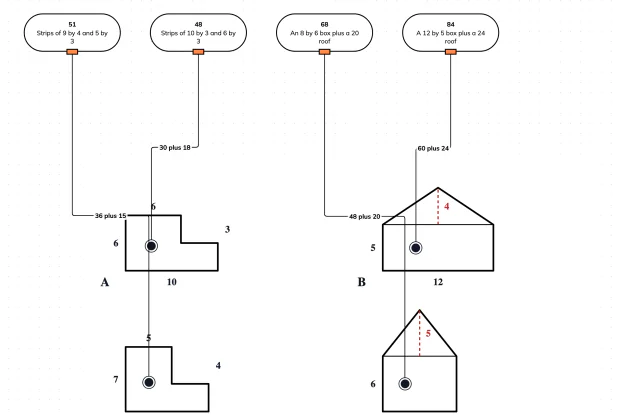
Two skills make the difference between this being easy and being fiddly. The first is choosing a sensible cut — usually the one that makes the pieces rectangles. The second is working out the lengths the drawing does not give you, which is nearly always a subtraction. The playground below has both kinds: shapes to split into two rectangles, and shapes to split into a rectangle and a triangle.
Choosing the Cut and Finding the Lengths
Where Should You Cut?
Wherever the pieces come out as shapes you can do without thinking. For an L-shape, one straight cut across it gives two rectangles, and there are two ways to make that cut — horizontally or vertically. Both are correct and both give the same total, so pick the one whose lengths are already on the drawing. For a shape with a sloping top, cut along the bottom of the slope to leave a rectangle underneath and a triangle above. It is worth drawing the cut on the diagram in pencil rather than holding it in your head, because the commonest error in these questions is not arithmetic but losing track of which piece a number belongs to.
How Do You Find the Missing Lengths?
By subtracting along an edge. A drawing rarely labels every length, because the ones it leaves out can always be worked out. If an L-shape is 6 along the top and 10 along the bottom, the step in the middle must be 10 − 6 = 4. If it is 6 up the left and 3 down the right, the step's vertical edge is 6 − 3 = 3. Opposite sides of the overall rectangle the L sits inside have to match, and every missing length falls out of that. Do these subtractions first and write the answers on the diagram before starting any areas, because trying to do both at once is where numbers get used in the wrong place.
Should You Add or Subtract?
Either, and sometimes subtracting is quicker. An L-shape can be treated as two rectangles added, or as one big rectangle with a corner rectangle taken away. For a shape 10 by 6 with a 4 by 3 corner missing, adding gives 10 × 3 + 6 × 3 = 48 and subtracting gives 10 × 6 − 4 × 3 = 48. Choose whichever needs fewer missing lengths worked out. Subtracting is usually the better route when the missing piece is small and neatly placed, and adding is better when the shape is long and thin. Doing it both ways is also the cheapest possible check on an answer, since two different routes agreeing is strong evidence.
What About Curves?
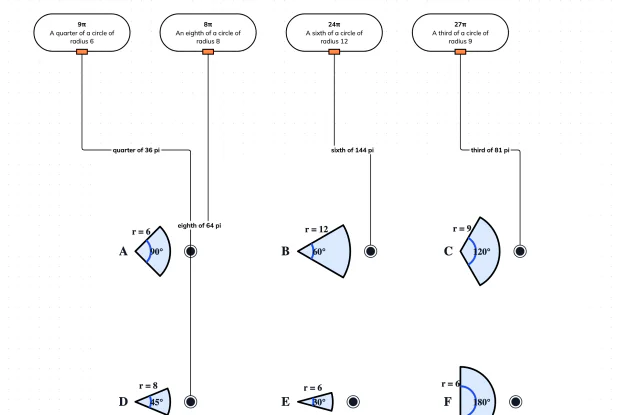
The same idea, with circle formulas as extra tools. A shape with a semicircular end splits into a rectangle and half a circle, and the areas still add. A running track is a rectangle with a half-circle at each end, which together make one whole circle. The only extra care needed is with the radius: a semicircle sitting on a rectangle of width 10 has a diameter of 10 and so a radius of 5, and putting the 10 into πr² gives four times the correct answer. Everything else is unchanged — cut, calculate, add — and the sector answer. Everything else is unchanged — cut, calculate, add — and the sector formula in the next tutorial slots into the same method as just another piece with an area of its own.
Real World Example
How Much Flooring Does an L-Shaped Room Need?
Flooring is sold by the square metre, so the room has to become a single number before anything can be ordered.
What the tape gives
Four lengths, not six
A room measures 6 metres along one wall and 4 metres along the wall at right angles to it, then steps in where a chimney breast cuts the corner, so two shorter walls finish the outline. In practice only four of the six lengths get measured, because the other two are awkward to reach past the units and can be worked out anyway. Suppose the long walls read 6 and 4 metres and the two short ones read 4 and 2.5 metres. That is enough: the remaining two lengths follow by subtraction and do not need a tape at all.
The cut and the pieces
Two rectangles
One straight line across the room, continuing the line of the chimney breast, splits it into two rectangles. The first is the full 6 metres by 2.5 metres, giving 15 square metres. The second sits above it and is 4 metres by the remaining 1.5 metres, which is 6 square metres. The 1.5 came from subtracting 2.5 from the 4-metre wall, which is the missing length nobody measured. Adding the two pieces gives 21 square metres, and the same answer comes from taking a 2 by 1.5 corner away from a 6 by 4 rectangle.
What actually gets ordered
23 or 24 square metres
Nobody orders 21 square metres. Boards have to be cut to fit at the walls, the offcuts are mostly waste, and a pattern that has to line up across the room wastes more. The trade allowance is usually ten per cent, so the order goes in at around 23 square metres, and a little more if the boards are long or the room is awkward. The geometry gives the floor area exactly; the ordering decision sits on top of it. That is the normal relationship between a calculated area and a bought quantity, and it is worth saying because an exam answer of 21 and a builder's answer of 23 are both right.
FAQs
Final Words
A shape with no formula does not need one. Cut it into rectangles and triangles, find each piece and add, because area is a count of space and counts add. The two skills that matter are choosing a cut that makes easy pieces and working out the unlabelled lengths, which is almost always a subtraction along an edge.
Adding pieces and subtracting a missing corner both work, and doing a shape both ways is the cheapest check available. The last tutorial in this track adds one more piece to the toolkit — a slice of a circle — which then drops into compound shapes exactly like any other.
Continue This Track
This concept is part 4 of Area Beyond the Basics.
How Do You Find the Area of a Parallelogram?
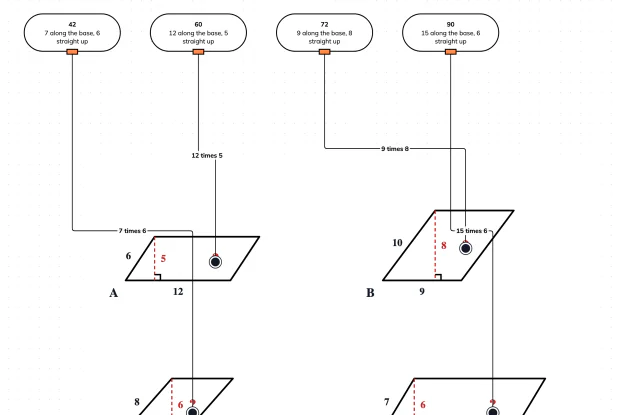
A parallelogram's area is its base multiplied by its perpendicular height, and the reason is a single cut: slice a triangle off one end, slide it to the other, and you have a rectangle. The one thing to get right is which number is the height. Practise in an interactive playground.
How Do You Find the Area of a Trapezium?
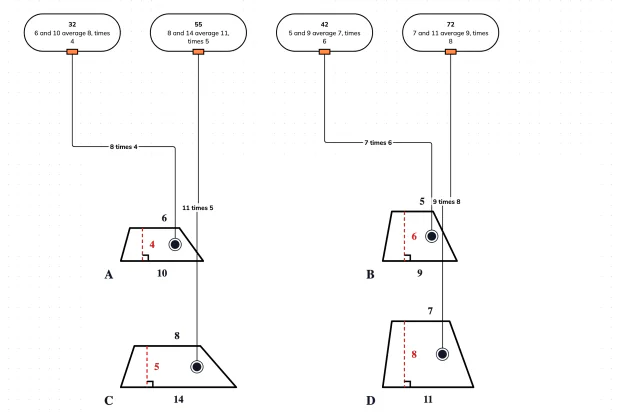
A trapezium's parallel sides are different lengths, so it has no single width — but the average of the two behaves exactly like one. Add them, halve, and multiply by the perpendicular height. See why that works and practise it in an interactive playground.
How Do You Find the Area of a Rhombus or a Kite?
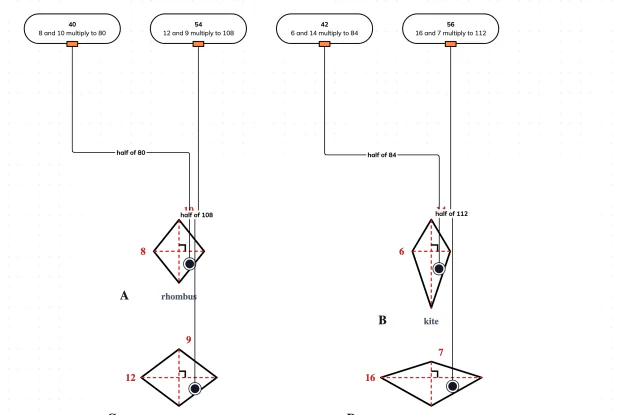
Rhombuses and kites are awkward to measure by base and height, but both have diagonals that cross at right angles — and that gives a simpler route. Multiply the two diagonals and halve. See why one rule covers both shapes, in an interactive playground.
How Do You Find the Area of a Compound Shape?
Most real shapes have no area formula at all. They do not need one: cut them into rectangles and triangles, find each piece, and add. The skill is choosing the cut and working out the lengths the drawing does not give you directly. Practise both in an interactive playground.
How Do You Find the Area of a Sector?
A sector is a slice of a circle, and its area is that same slice of the circle's area. Find the fraction from the angle, then take that fraction of πr². The trap is different from the arc-length one: here the radius is used as it stands. Practise in an interactive playground.