How Do You Find the Area of a Sector?
Root Concept
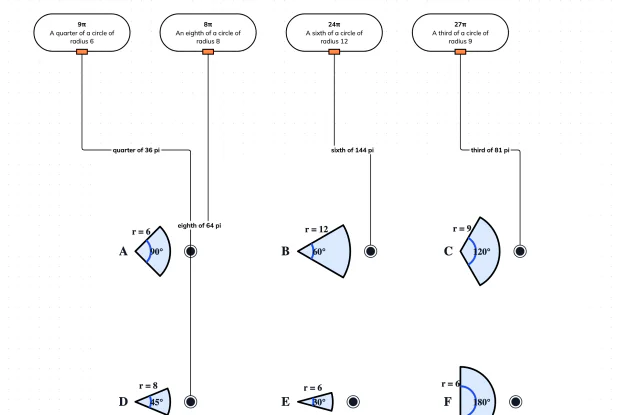
A sector is the same fraction of the circle's area as its central angle is of a full turn.
CodePLU Goal
Upgrading Human Mental Models
Learn how to think in Workflows

Concept Development By codeplu.com
Two steps again: the angle over 360 gives the fraction, and the fraction times πr² gives the area.
Does the Arc Method Work for Area Too?
It does, and that is the whole tutorial. A sector is the wedge of a circle closed off by two radii and the arc between them. It takes up some fraction of the full turn round the centre, and it takes up exactly that same fraction of the circle's area, just as its arc took that fraction of the circumference.
So the method is the same two steps. Divide the angle by 360° to get the fraction, then take that fraction of the whole circle's area, which is πr². A 90° sector of radius 6 is a quarter of a circle of area 36π, so its area is 9π.
There is one difference worth flagging, because it catches people who have just learned arc length. Arc length used 2πr and therefore needed the radius doubled; area uses πr² and uses the radius exactly as given, squared. Bringing the doubling across from the last tutorial is the commonest mistake here, and it makes every answer twice too big.
Applying the Fraction to Area
What Are the Two Steps?
Find the fraction, then apply it. The fraction is the angle over 360°, simplified: 90° is a quarter, 60° a sixth, 45° an eighth, 120° a third. The whole circle's area is πr², so a sector of 120° and radius 9 gives a third of 81π, which is 27π. Written in one line that is area = (angle ÷ 360) × πr², but it is better held as two ideas than memorised as one string. Simplifying the fraction before multiplying is worth the moment it takes, because a third of 81 is the fraction before multiplying is worth the moment it takes, because a third of 81 is obvious while 120/360 of it invites a calculator and a rounding error that never needed to happen.
Why Is the Radius Not Doubled Here?
Because the circle's area formula is built from the radius directly rather than from the diameter. Circumference is π times the diameter, which is why it becomes 2πr and why an arc-length question needs the doubling. Area is πr², with the radius used as it stands and squared. The two formulas look similar enough that they get mixed up, and the symptom is predictable: an area that comes out exactly twice too big means 2πr² was used by mistake. A useful check is the units. Area is measured in square units and arises from a length multiplied by a length, which r × r does and 2 × r does not.
What Is the Difference Between Area and Perimeter Here?
The area is the space inside the wedge; the perimeter is the distance round its outline, which is the arc plus the two straight radii. A 90° sector of radius 6 has an area of 9π square units and a perimeter of 3π + 12 units. They are different quantities in different units and questions ask for both, sometimes in the same question. If an answer comes out as a mixture of a π term and a plain number added together, it is a perimeter; a clean multiple of π on its own is usually an area. Tracing the outline with a finger settles which is being asked for faster than re-reading the question.
How Does This Fit With Compound Shapes?
It drops straight in as one more piece. A quarter-circle in the corner of a rectangular patio, a semicircular window above a rectangular one, a running track's rounded ends: all of them split into shapes with formulas, and a sector is now one of those. The segment — the region between a chord and the arc — is the one case that needs two steps, since it is a sector with a triangle taken away. That is beyond most school courses, but it is worth knowing the method is the same one from the last tutorial rather than anything new: find the pieces, find each area, and add or subtract.
Real World Example
How Much Ground Does a Lawn Sprinkler Cover?
The reach and the sweep angle are both set on the sprinkler, and together they decide how much grass gets watered.
What the sprinkler does
Reaches 6 m, sweeps 90°
A garden sprinkler throws water out to a fixed distance and swings back and forth through a set angle. Both are adjustable and both are set by the user: this one reaches 6 metres and sweeps a quarter turn, 90°, so that it waters one corner of a lawn without soaking the patio. The wetted ground is a sector of a circle, with the sprinkler at the point and the reach as the radius. Nothing about the water pressure or the nozzle changes the shape of the region — only those two settings do, and both of them are written on the sprinkler's own dial.
The ground it covers
9π, about 28 m²
A full circle of radius 6 has an area of 36π square metres. The sprinkler covers a quarter of that, so the watered region is 9π, or about 28 square metres. Notice the radius is used as it stands and squared: putting 12 in by mistake, carried over from arc work, would give 36π and suggest the sprinkler covers four times as much grass as it really does. Twenty-eight square metres is the number that matters for deciding how many positions are needed to cover a lawn and how long each one should run for a given depth of watering.
Why reach matters more than sweep
Double the reach, four times the water
The two settings do not carry equal weight. Doubling the sweep from 90° to 180° doubles the area covered, from 9π to 18π. Doubling the reach from 6 metres to 12 quadruples it, from 9π to 36π, because the radius is squared while the angle is not. That is why a small increase in pressure covers far more ground than widening the sweep, and why the same square relationship makes a slightly larger pizza much better value than it looks. It is the single most useful thing to take away from any area formula built on a radius.
FAQs
Final Words
A sector's area is the same fraction of the circle's area as its angle is of a full turn. Divide the angle by 360°, then take that fraction of πr². The difference from arc length is the one to hold on to: area uses the radius squared, with no doubling, and an answer exactly twice too big is the sign that the doubling came across by mistake.
That completes this track. Parallelograms, trapeziums, rhombuses, kites, compound shapes and sectors all have areas now, and the compound-shape method means they combine freely — any shape made from these pieces can be measured by cutting it up, finding each piece and adding.
Continue This Track
This concept is part 5 of Area Beyond the Basics.
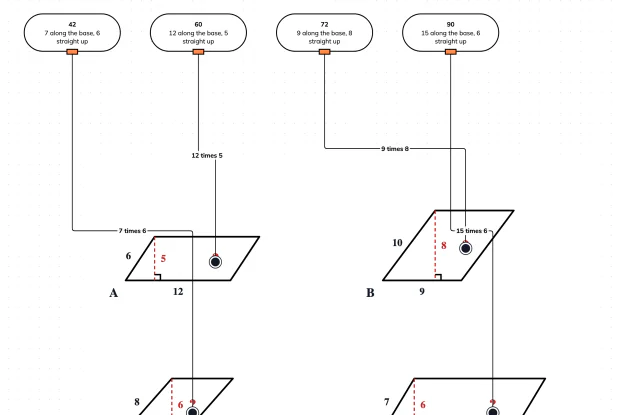
How Do You Find the Area of a Parallelogram?
A parallelogram's area is its base multiplied by its perpendicular height, and the reason is a single cut: slice a triangle off one end, slide it to the other, and you have a rectangle. The one thing to get right is which number is the height. Practise in an interactive playground.
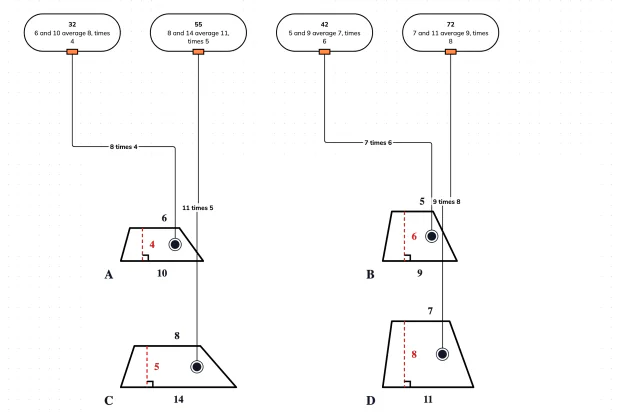
How Do You Find the Area of a Trapezium?
A trapezium's parallel sides are different lengths, so it has no single width — but the average of the two behaves exactly like one. Add them, halve, and multiply by the perpendicular height. See why that works and practise it in an interactive playground.
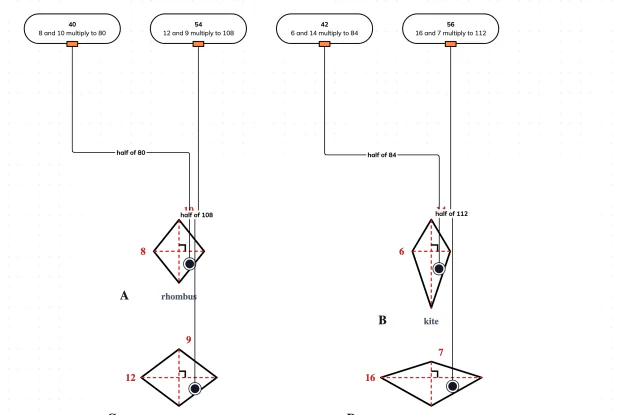
How Do You Find the Area of a Rhombus or a Kite?
Rhombuses and kites are awkward to measure by base and height, but both have diagonals that cross at right angles — and that gives a simpler route. Multiply the two diagonals and halve. See why one rule covers both shapes, in an interactive playground.
How Do You Find the Area of a Compound Shape?
Most real shapes have no area formula at all. They do not need one: cut them into rectangles and triangles, find each piece, and add. The skill is choosing the cut and working out the lengths the drawing does not give you directly. Practise both in an interactive playground.
How Do You Find the Area of a Sector?
A sector is a slice of a circle, and its area is that same slice of the circle's area. Find the fraction from the angle, then take that fraction of πr². The trap is different from the arc-length one: here the radius is used as it stands. Practise in an interactive playground.