How Do You Find the Area of a Parallelogram?
Root Concept
Cut a triangle off one end of a parallelogram and slide it to the other and you have a rectangle of the same base and height.
CodePLU Goal
Upgrading Human Mental Models
Learn how to think in Workflows

Concept Development By codeplu.com
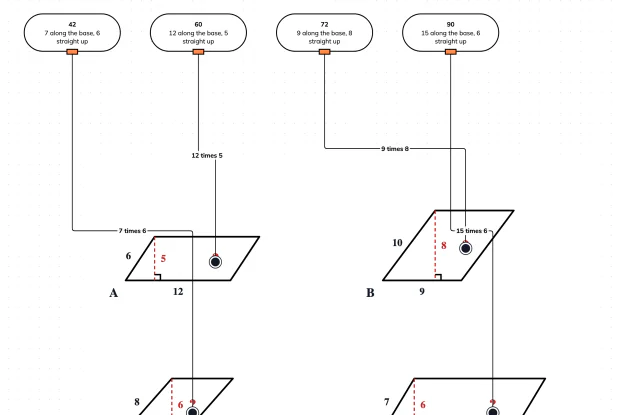
The height is the red dashed line: straight up from the base, at right angles to it. The slanting side is longer and is not what the formula wants.
Why Is a Parallelogram Just a Rectangle in Disguise?
The area of a rectangle is length times width, and that has been settled since Track 3. A parallelogram looks like a rectangle that has been pushed over, and it turns out that is exactly what it is as far as area is concerned.
Cut straight down from one top corner to the base, making a right-angled triangle at the end of the shape. Slide that triangle round to the other end and it fits exactly, because opposite sides of a parallelogram are equal and parallel. What is left is a rectangle, with the same base as the parallelogram and a width equal to the perpendicular height. So area = base × height.
Everything in this tutorial hangs on that word perpendicular. The height is the straight-up distance between the two parallel sides, not the length of the slanting side. They are different numbers, the slanting side is always the longer of the two, and using it gives an answer that is too big. The playground labels all three numbers on every shape on purpose.
Getting the Height Right
Which Number Is the Height?
The perpendicular distance between the base and the side opposite it — straight up, at right angles to the base. On a diagram it is almost always drawn as a dashed line inside the shape with a small right-angle square where it meets the base, exactly as in the playground. The slanting side is a side of the shape and is drawn solid. The two are easy to tell apart once you know to look, and they are always different unless the parallelogram happens to be a rectangle, in which case the slanting side is vertical and the two coincide. That is worth noticing, because it means the rectangle formula is not a separate rule at all — it is this one with the lean taken out.
Why Does the Slanting Side Give the Wrong Answer?
Because it measures the wrong thing. Imagine holding the top side of a parallelogram and sliding it further sideways while keeping it the same height above the base. The shape becomes more and more slanted, the slanting sides get longer and longer, and yet the area does not change at all, because neither the base nor the height has moved. If the slanting side belonged in the formula, the area would grow while the shape was doing nothing but leaning. That thought experiment is worth running once, because it makes the mistake feel wrong rather than merely being something you were told not to do. It is also why shearing a shape sideways preserves its area.
Which Side Counts as the Base?
Any of them, as long as the height is measured perpendicular to that same side. A parallelogram has two pairs of parallel sides, so it has two different base-and-height pairings, and both give the same area. A shape with a base of 12 and a height of 5 has an area of 60; turn it on its side and the other base might be 6 with a height of 10, which is also 60. The pairing is what matters, not which side you pick. The mistake to avoid is mixing them — taking the base from one pairing and the height from the other. Whenever a question gives more numbers than you need, check that your two belong together before multiplying.
What If the Height Is Not Given?
Then it usually has to be found first, and Pythagoras is the standard route. The perpendicular height, the slanting side, and the horizontal run between them form a right-angled triangle, so knowing two of those gives the third. A parallelogram with a slanting side of 10 whose top corner sits 6 across from the bottom one has a height of √(100 − 36) = 8. Questions that do this are testing two topics at once and are common at the top end of a paper. It is also the reason the slanting side is given at all in many diagrams: not as a distraction, but because it is the raw material for finding the height when nobody has handed it to you.
Real World Example
How Much Turf Does a Slanted Lawn Need?
Turf is sold by the square metre, so the shape on the plan has to become an area before anything can be ordered.
What the plan shows
12 m base, 6 m side
A garden plan shows a strip of lawn between two parallel paths. The strip runs 12 metres along the lower path, and its ends are cut at an angle rather than square, so each end measures 6 metres. That makes the lawn a parallelogram with a base of 12 and slanting sides of 6. Both numbers are on the plan because both were measured on site with a tape along the ground, which is the only way to measure anything in a garden. Neither of them, on its own ground, which is the only practical way to measure anything in a garden. Neither of them, on its own or together with the other, gives the area.
The measurement that matters
5 m between the paths
The number the calculation needs is the distance between the two paths measured straight across, at right angles to them, which is 5 metres. That is the perpendicular height, and it is smaller than the 6-metre end because the end runs at a slant. So the area is 12 × 5 = 60 square metres. Using the 6 instead would have given 72, and the gardener would have ordered twelve square metres of turf more than the job needs — a twenty per cent overspend caused by picking the wrong one of two numbers on the same drawing.
Why the lean costs nothing
Still 60 either way
Suppose the ends were cut at a sharper angle, so each end measured 8 metres instead of 6 while the paths stayed 5 metres apart and the lawn still ran 12 metres along the lower path. The lawn would look noticeably more slanted and would need exactly the same 60 square metres of turf. Leaning a shape sideways stretches its slanting sides and changes nothing about the space inside it. Once that is believed rather than merely known, using the about the space inside it. Once that is believed rather than merely known, reaching for the slanting side in an area calculation stops being a tempting mistake and starts looking obviously wrong.
FAQs
Final Words
A parallelogram is a rectangle that has been pushed over, and cutting a triangle off one end and sliding it to the other proves it: the area is base × perpendicular height. The slanting side plays no part, because leaning a shape stretches that side while leaving the space inside it alone.
The same picture explains the triangle formula, which is half of this one, and it is the starting point for the rest of this track. The next tutorial takes a shape whose two parallel sides are different lengths — a trapezium — and shows that averaging them turns it back into a problem you have already solved.
Continue This Track
This concept is part 1 of Area Beyond the Basics.
How Do You Find the Area of a Parallelogram?
A parallelogram's area is its base multiplied by its perpendicular height, and the reason is a single cut: slice a triangle off one end, slide it to the other, and you have a rectangle. The one thing to get right is which number is the height. Practise in an interactive playground.
How Do You Find the Area of a Trapezium?
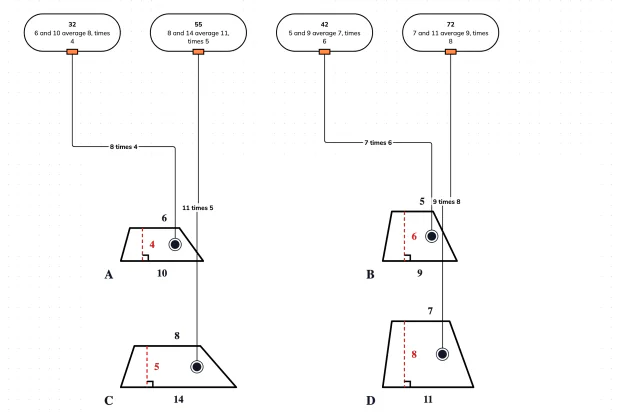
A trapezium's parallel sides are different lengths, so it has no single width — but the average of the two behaves exactly like one. Add them, halve, and multiply by the perpendicular height. See why that works and practise it in an interactive playground.
How Do You Find the Area of a Rhombus or a Kite?
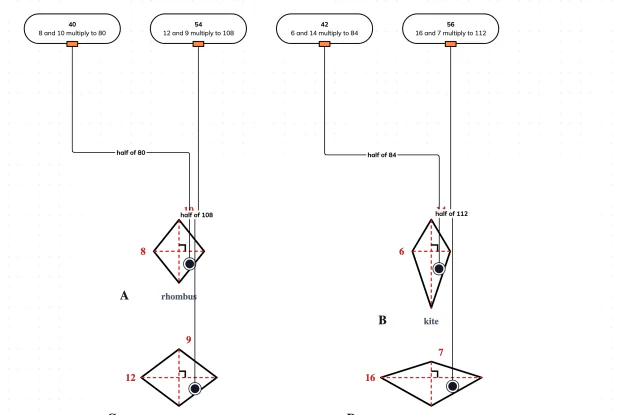
Rhombuses and kites are awkward to measure by base and height, but both have diagonals that cross at right angles — and that gives a simpler route. Multiply the two diagonals and halve. See why one rule covers both shapes, in an interactive playground.
How Do You Find the Area of a Compound Shape?
Most real shapes have no area formula at all. They do not need one: cut them into rectangles and triangles, find each piece, and add. The skill is choosing the cut and working out the lengths the drawing does not give you directly. Practise both in an interactive playground.
How Do You Find the Area of a Sector?
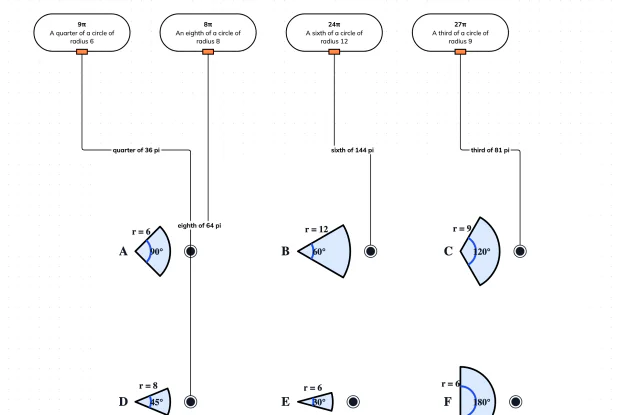
A sector is a slice of a circle, and its area is that same slice of the circle's area. Find the fraction from the angle, then take that fraction of πr². The trap is different from the arc-length one: here the radius is used as it stands. Practise in an interactive playground.