Through the Intestines
Six parts following a meal through seven metres of tube. The small intestine is where almost all absorption happens, and the problem it solves is surface area: it opens with the organ whole, then the duodenum where bile and pancreatic juice arrive, then a zoom into the villi — folds upon folds upon folds — that turn a narrow tube into a surface the size of a room. The fourth part is the movement itself, which is not a simple push but a squeezing that mixes as much as it moves. Then the large intestine, whose job is water rather than food, and finally the rectum, where the body holds the result until it is convenient.
CodePLU Goal
Upgrading Human Mental Models
Learn how to think in Workflows
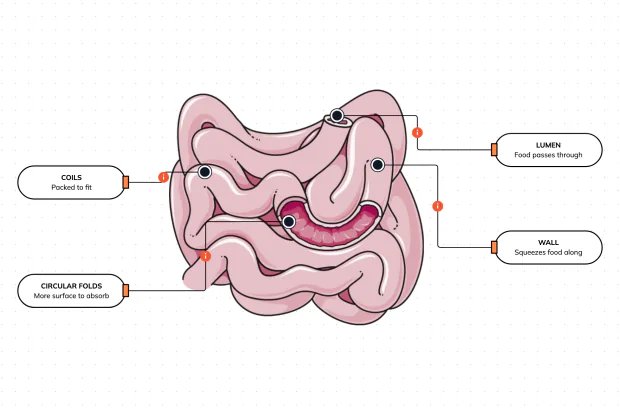
Why Is Your Small Intestine So Long and Folded?
The small intestine is where nutrients are absorbed — and everything about it is built to maximise that. Label the coils, circular folds, lumen and wall, and learn why the small intestine is so long, so coiled and so folded — in an interactive playground.
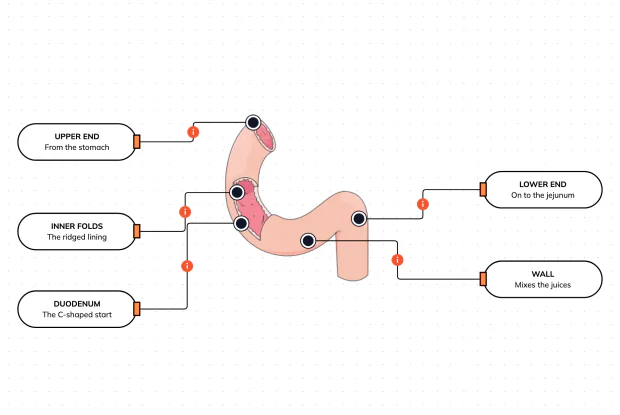
What Is the Duodenum, the Gut's Mixing Bowl?
The duodenum is the C-shaped first part of the small intestine, where stomach acid is neutralised and bile and pancreatic juice go to work. Label the duodenum, its upper end, inner folds, wall and lower end, and learn why this short stretch is digestion's busiest crossroads — in an interactive playground.
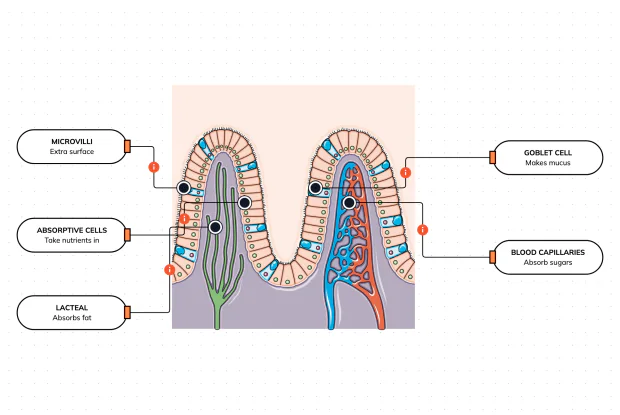
How Does Your Gut Absorb Food Into Your Blood?
The small intestine's lining is carpeted with tiny fingers called villi, where nutrients finally cross into the body. Label the microvilli, absorptive cells, lacteal, blood capillaries and goblet cell, and see how a digested meal is absorbed — in an interactive playground.
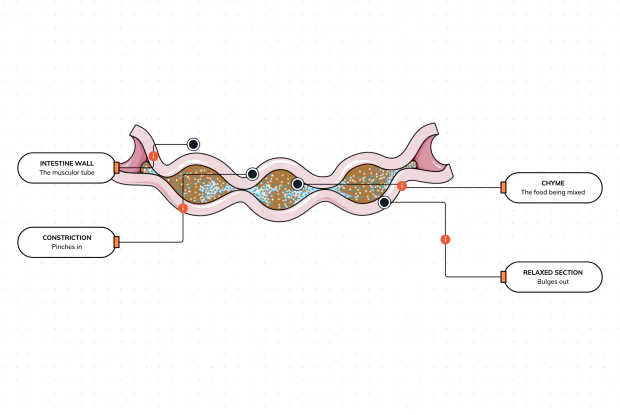
How Does Your Intestine Mix Your Food?
The intestine mixes food with a movement called segmentation — pinching it into pockets and churning it in place. Label the intestine wall, a constriction, a relaxed section and the chyme, and see how the gut mixes a meal rather than just pushing it along — in an interactive playground.
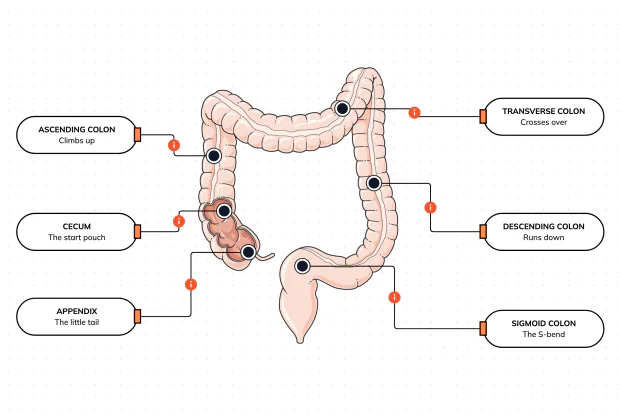
What Are the Parts of Your Large Intestine?
The large intestine, or colon, is the final stretch of the gut — it absorbs water and forms waste. Label the cecum, appendix, ascending, transverse, descending and sigmoid colon, and follow the leftovers around its path — in an interactive playground.
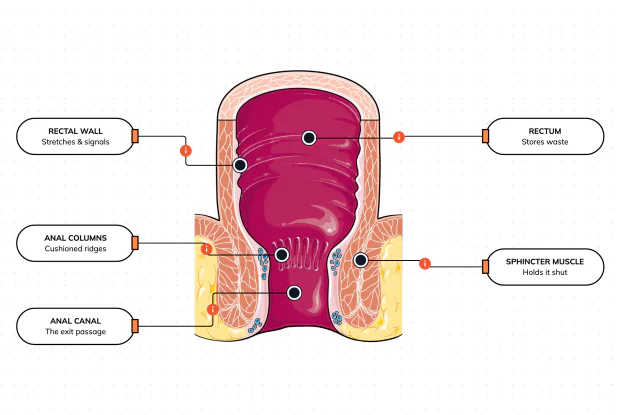
How Does Your Body Hold and Release Waste?
The rectum stores waste, and two sphincter muscles decide when it leaves. Label the rectum, rectal wall, anal columns, anal canal and sphincter muscle, and learn how your body holds and releases waste — in an interactive playground.