Why Does Salt Melt at 801 °C and Ice at 0 °C?
Root Concept
Melting separates particles from each other rather than breaking bonds within them, so a giant ionic lattice — where every particle is held by strong attractions to its neighbours in all directions — melts at a very high temperature, while a simple molecular substance melts low however strong the bonds inside its molecules are.
CodePLU Goal
Upgrading Human Mental Models
Learn how to think in Workflows

Concept Development By codeplu.com
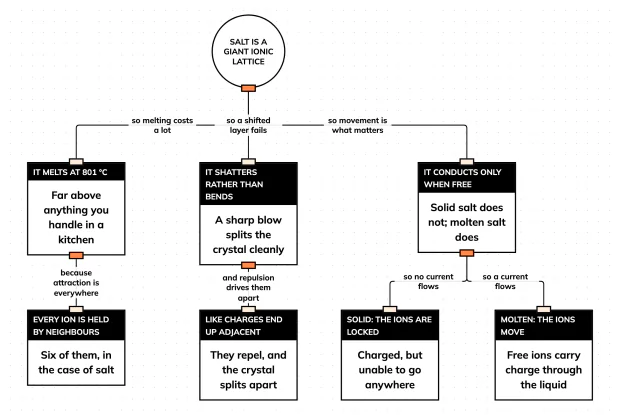
None of the four observations leads to another. They are four separate consequences of the same structure.
The Trap Almost Everyone Falls Into
Sodium chloride melts at 801 °C. Water melts at 0 °C. The obvious conclusion is that the bonds in salt must be much stronger than the bonds in water, and it is wrong — the O–H bonds inside a water molecule are among the stronger bonds in ordinary chemistry, and breaking one costs about 464 kilojoules per mole.
The error is in what melting does. Melting does not break molecules open. Ice becomes water and every single H₂O molecule survives the process completely intact, which is why the liquid is still water and not a mixture of hydrogen and oxygen. What melting actually does is separate particles from one another so they can move past each other, and the only thing that has to be overcome is whatever holds one particle to the next.
In ice, that is the weak attraction between neighbouring water molecules, and it gives way at 0 °C. In salt there are no molecules to separate: the whole crystal is one continuous lattice of ions, each held by strong electrical attraction to every oppositely charged ion around it. Melting it means overcoming those attractions throughout the structure, which is why it takes 801 °C.
So the melting point tells you about the structure, not about the strength of the bonds inside a molecule. That one distinction explains a great deal, and the playground traces four observable consequences back to the same structural fact.
What the Structure Explains
What exactly is being broken when something melts?
Whatever holds one particle to the next, and nothing else. For a simple molecular substance the particles are molecules, so melting overcomes the attractions BETWEEN molecules and leaves the bonds WITHIN them untouched. That is why steam, water and ice are all still H₂O: the covalent bonds survive all three states, and you would need far more energy to break those. For a giant ionic structure there is no between — the attractions holding one ion to the next are the bonds, so melting has to overcome the bonding itself. Two different things are being measured by the same word, which is exactly why comparing melting points across the two kinds of structure misleads people.
Why does an ionic crystal shatter instead of bending?
Because of what happens to the charges when a layer slides. In an undisturbed lattice every ion sits next to ions of the opposite charge, and the attractions hold in every direction. Strike the crystal hard enough to push one layer sideways by a single ion and the arrangement inverts: positive ions now face positive ions and negative face negative, all along the plane. Attraction becomes repulsion in an instant and the crystal splits cleanly along that plane. This is why salt crystals break into smaller cubes rather than deforming, and it is the sharpest difference between an ionic solid and a metal, where sliding a layer causes no such problem.
Why does salt conduct when molten but not when solid?
Because conduction needs charged particles that are free to move, and in solid salt only the first half of that is satisfied. The ions are charged — that is what an ion is — but each is locked into position by the attractions around it and cannot travel anywhere, so no charge flows. Melt the salt, or dissolve it in water, and the ions become free to move about; now they can carry charge from one place to another and the liquid conducts. The physics category covers what an electric current is and why pure water insulates while salty water does not. The chemistry here is simply that the structure decides whether the carriers can move.
Is a high melting point always a sign of ionic bonding?
No, and diamond is the standing counter-example. Diamond is pure carbon held together entirely by covalent bonds, with no ions anywhere, and it melts above 3500 °C. The reason is the same structural one: every carbon atom is covalently bonded to four others, and those bonds continue unbroken through the whole crystal, so melting means breaking covalent bonds throughout. What decides the melting point is whether the strong forces run through the entire structure or stop at the edge of a molecule. Giant structures melt high whether they are ionic or covalent; simple molecular substances melt low whatever is inside them. Asking which kind of bond a substance has is a different question from asking how far that bonding extends, and only the second one predicts a melting point.
Real World Example
Four Substances and What Their Melting Points Say
Lined up together, the numbers stop looking arbitrary. Each one reports the structure rather than the strength of any individual bond.
Step 1
Oxygen melts at −219 °C, and its bond is a double one
An O₂ molecule is held together by a double covalent bond that costs 498 kilojoules per mole to break — stronger than the single bond in hydrogen. Yet oxygen has to be cooled to −219 °C before it will freeze, because freezing and melting are about the attraction between whole O₂ molecules, and that attraction is feeble. The molecule is never touched by the process. If melting point measured bond strength, oxygen would be a solid at room temperature and this would be a very different planet. The strength of the bond and the temperature at which the substance freezes are measuring two unrelated things.
Step 2
Magnesium oxide beats salt by two thousand degrees
Sodium chloride melts at 801 °C and magnesium oxide at about 2850 °C, and both are giant ionic lattices, so the structure is not what separates them. The charges are. Salt pairs 1+ with 1−, while magnesium oxide pairs 2+ with 2−, and the electrical attraction between larger charges is far stronger. That is why magnesium oxide is used to line furnaces: it is an ionic solid chosen specifically because the lattice will not come apart at temperatures that would destroy almost anything else. The charge on the ions is the only difference between the two compounds, and it is worth two thousand degrees.
Step 3
Diamond and candle wax are both covalent
Both substances are held together by covalent bonds and nothing else, and one melts above 3500 °C while the other melts in your hand. Diamond is a giant covalent structure in which the bonding runs unbroken through the whole crystal. Wax is a collection of separate molecules with only weak attractions between them, so the molecules part company at body temperature while every bond inside each one survives. Same type of bond, opposite behaviour, and the structure is the entire explanation It is the clearest demonstration there is that the kind of bond and the reach of the bonding are separate questions.
FAQs
Final Words
Melting separates particles from one another; it does not break molecules open. That single distinction is what makes the numbers make sense. Ice melts at 0 °C because only the weak attractions between whole water molecules have to give way, and every O–H bond inside survives the process. Salt melts at 801 °C because there are no molecules to separate — the whole crystal is one lattice, and melting has to overcome strong electrical attractions running through all of it.
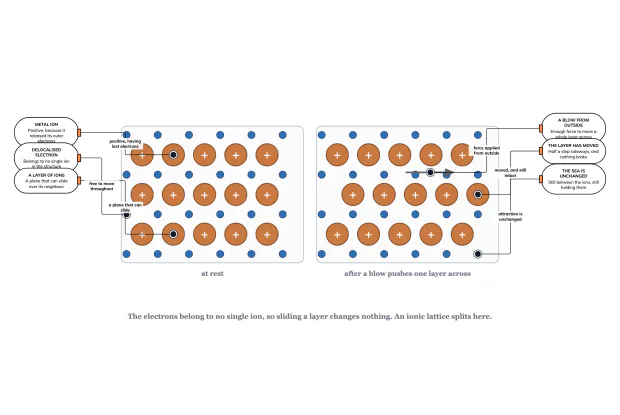
The same structural fact explains three other things at once, and none of them follows from the others. The lattice shatters rather than bends, because sliding a layer brings like charges face to face and attraction becomes repulsion. It insulates as a solid, because its charged particles cannot move. And it conducts once molten or dissolved, because then they can. The last tutorial in this track takes the structure that bends instead of shattering.
Continue This Track
This concept is part 4 of How Atoms Join.
Why Do Atoms Bond at All? Ask the Ones That Do Not
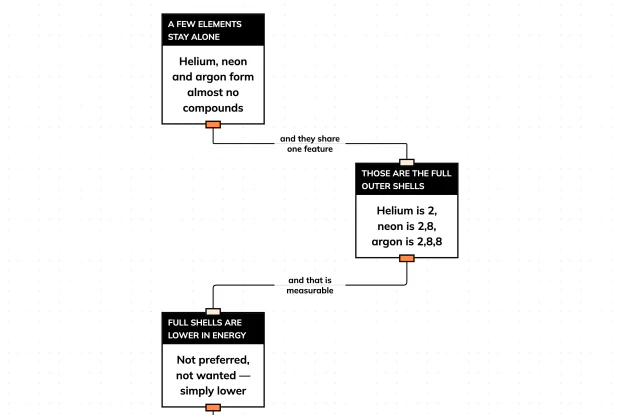
Almost every element forms compounds and a handful do not. Work out what the exceptions have in common, and the reason atoms bond follows, in an interactive playground.
What Charge Does an Ion Take? Read the Group
An ion’s charge is not a fact to memorise: it follows from the outer electrons, and the formula of the compound follows from the charges. Work it through in an interactive playground.

Ionic or Covalent? What Decides Which Happens
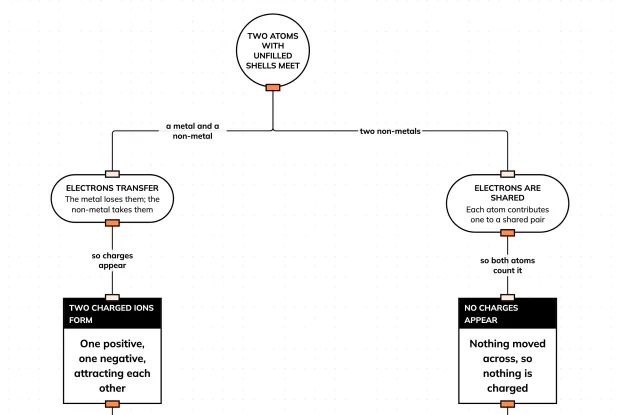
Two atoms meet with unfilled shells, and what happens next depends on whether either can give electrons away. Follow both routes from one starting point in an interactive playground.
Why Does Salt Melt at 801 °C and Ice at 0 °C?
Water has strong covalent bonds and melts at 0 °C; salt melts at 801 °C. The answer is that melting never breaks a bond inside a molecule. Trace what a lattice explains in an interactive playground.
What Makes a Metal a Metal? Label the Structure
A metal is a lattice of positive ions sitting in electrons that belong to no single atom — which is why it bends where salt shatters. Label the structure in an interactive playground.