What Charge Does an Ion Take? Read the Group
Root Concept
When electrons transfer between atoms the charge each ion carries is set by how many it lost or gained, which the group number predicts, and because a compound must be electrically neutral overall the ratio in which the ions combine is forced — so the formula can be worked out rather than remembered.
CodePLU Goal
Upgrading Human Mental Models
Learn how to think in Workflows

Concept Development By codeplu.com
The last step is arithmetic, not recall. Two charges that must cancel leave only one possible ratio.
Formulae You Can Work Out Instead of Learn
Sodium chloride is NaCl, one sodium to one chlorine. Magnesium chloride is MgCl₂, one magnesium to two chlorines. Presented as facts these are two things to remember, and there are hundreds more where they came from. Presented as consequences they are two results of the same short piece of reasoning, and so are the hundreds.
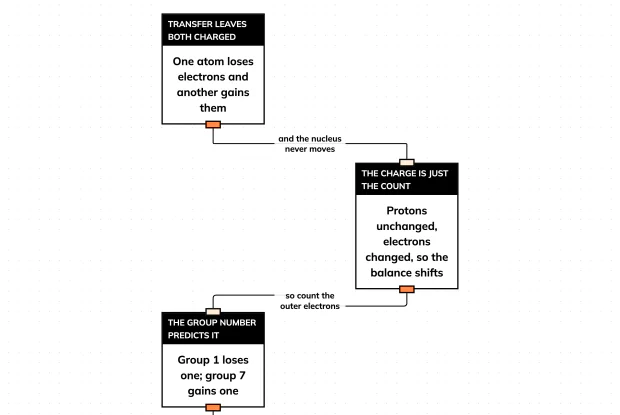
The reasoning starts where the last tutorial finished. One way for atoms to reach a lower-energy arrangement is to move electrons across: one atom gives up its outer electrons and another takes them. The moment that happens, neither particle is neutral any more. The one that lost an electron has more protons than electrons and carries a positive charge; the one that gained has the opposite. Charged atoms like these are called ions, and the previous track met the word in passing.
What makes this useful is that the charge is not arbitrary. It is simply how many electrons moved, and how many move is set by how many the atom had to spare or was short of — which is exactly what the group number tells you. Sodium is in group 1 and loses one, so it becomes Na⁺. Magnesium is in group 2 and loses two, so it becomes Mg²⁺. Chlorine is in group 7 and gains one, so it becomes Cl⁻.
After that it is arithmetic. A compound carries no overall charge, so the ions must combine in whatever ratio makes the charges cancel. The playground walks the chain from transfer to formula.
From Outer Electrons to a Formula
Why does transferring an electron produce a charge?
Because the protons stay put and the electrons do not. A neutral sodium atom has 11 protons and 11 electrons, which cancel exactly. Lose one electron and it still has 11 protons but only 10 electrons, so there is one unit of positive charge left unmatched — hence Na⁺. A chlorine atom with 17 protons and 17 electrons that gains one now has 18 electrons and one unit of negative charge spare, hence Cl⁻. The charge is nothing more mysterious than the difference between two counts. And because the nucleus is untouched throughout, the element does not change: Na⁺ is still sodium, which is the point the atomic number tutorial made.
How does the group number tell you the charge?
Because the group number is the number of outer electrons, and the number that move is whatever gets to a filled arrangement by the shortest route. Group 1 has one outer electron and losing it leaves a filled shell beneath, so the charge is +1. Group 2 loses two, giving +2. Coming from the other end, group 7 is one short, so it gains one and the charge is −1; group 6 gains two, giving −2. Group 0 is already filled and forms no ions at all. The pattern is +1, +2 on the left and −2, −1 on the right, which is a rule you can rebuild from the shells rather than a table to learn.
Why is magnesium chloride MgCl₂ rather than MgCl?
Because the charges have to cancel and one chloride ion cannot cancel a magnesium ion. Magnesium is in group 2, so it loses two electrons and becomes Mg²⁺. Chlorine is in group 7, so each atom gains one and becomes Cl⁻. One Mg²⁺ and one Cl⁻ would leave an overall charge of +1, which is not a compound. Two chloride ions give a total of −2, which cancels the +2 exactly, so the formula is MgCl₂ — read aloud, one magnesium to two chlorines. Sodium chloride works out as 1:1 for the same reason, because +1 and −1 already cancel. The ratio is forced by the arithmetic, not chosen. The same arithmetic settles every ionic formula on this page, and it never needs the compound to have been seen before.
Is this the same as the formula of a covalent compound?
No, and it is worth keeping the two apart. An ionic formula is a ratio rather than a count of particles: NaCl does not describe a molecule of one sodium and one chlorine, it says the lattice contains equal numbers of the two kinds of ion. There is no such thing as a single NaCl molecule sitting on its own. A covalent formula such as H₂O does count particles, because a water molecule really is two hydrogen atoms and one oxygen joined together. Same notation, two different meanings, and the next tutorial is about where the split comes from. Reading an ionic formula as a molecule is a quiet error that causes trouble later, because it suggests a particle that could be weighed, melted or dissolved on its own, and no such particle exists.
Real World Example
Three Formulae Worked Out From Scratch
The test of the method is whether it produces a formula you have never seen. Each of these is built from nothing but the group each element sits in.
Step 1
Potassium and oxygen give K₂O
Potassium sits in group 1, so it has one outer electron, loses it, and becomes K⁺. Oxygen sits in group 6, so it is two short, gains two, and becomes O²⁻. One K⁺ carries +1 and one O²⁻ carries −2, which does not cancel. Two potassium ions give +2, which does, so the formula is K₂O — read aloud, two potassium to one oxygen. Nothing about potassium oxide had to be known in advance. The two group numbers were enough, and the same two steps would work for an element discovered tomorrow. That is the difference between a method and a list.
Step 2
Aluminium and oxygen need a common multiple
Aluminium is in group 3, loses three electrons and becomes Al³⁺. Oxygen becomes O²⁻ as before. Here neither charge is a multiple of the other, so the arithmetic takes one more step: the smallest number both 3 and 2 divide into is 6, which needs two aluminium ions for +6 and three oxide ions for −6. The formula is Al₂O₃. This is the compound that coats every piece of aluminium within seconds of exposure to air, and the reason a metal that is genuinely reactive behaves as though it is not. The oxide layer is tough, unreactive and stuck fast, so the metal beneath is sealed off.
Step 3
Calcium and chlorine, and a road in winter
Calcium is in group 2 and becomes Ca²⁺; chlorine becomes Cl⁻, so two chloride ions are needed and the formula is CaCl₂. That compound is spread on roads in cold countries because a solution of it freezes well below zero, so ice does not form. It is worth noticing what the method does and does not give you: the formula, reliably, from two group numbers — and nothing at all about the melting point, the colour, or what the compound is good for. Those come from structure, which the rest of this track covers. The method is narrow and reliable, which is a good combination as long as you know its edges.
FAQs
Final Words
When electrons transfer, the charge left behind is nothing more than the difference between two counts: the protons stay as they were and the electrons do not. How many move is set by the outer shell, which is what the group number records — group 1 loses one and becomes +1, group 2 loses two and becomes +2, group 7 gains one and becomes −1, group 6 gains two and becomes −2.
The formula then follows without being learned. A compound carries no overall charge, so the ions combine in whatever ratio cancels: +1 with −1 gives NaCl, +2 with −1 gives MgCl₂, and +3 with −2 gives Al₂O₃ once you find the number both divide into. One caution worth carrying forward is that an ionic formula is a ratio in a lattice rather than a count inside a molecule. Where that split comes from is the next tutorial.
Continue This Track
This concept is part 2 of How Atoms Join.
Why Do Atoms Bond at All? Ask the Ones That Do Not
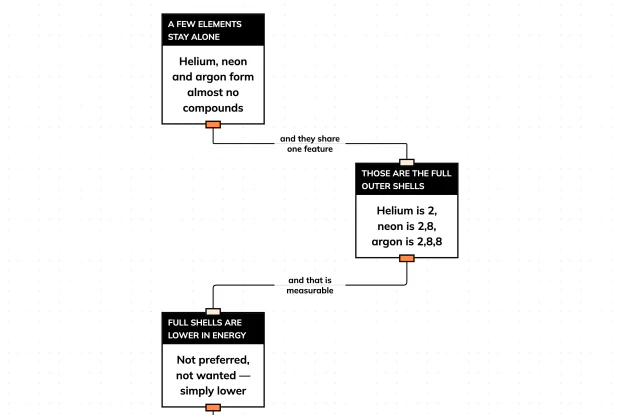
Almost every element forms compounds and a handful do not. Work out what the exceptions have in common, and the reason atoms bond follows, in an interactive playground.
What Charge Does an Ion Take? Read the Group
An ion’s charge is not a fact to memorise: it follows from the outer electrons, and the formula of the compound follows from the charges. Work it through in an interactive playground.
Ionic or Covalent? What Decides Which Happens
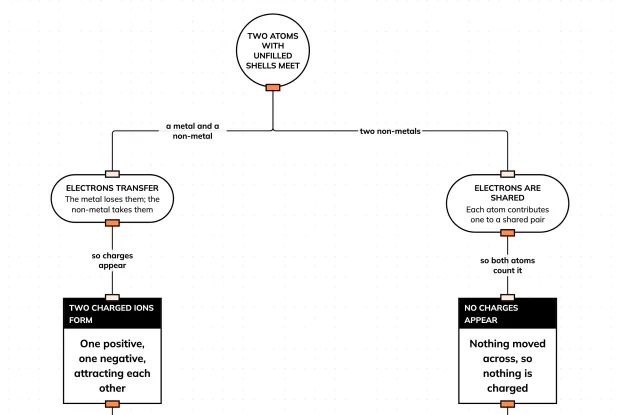
Two atoms meet with unfilled shells, and what happens next depends on whether either can give electrons away. Follow both routes from one starting point in an interactive playground.
Why Does Salt Melt at 801 °C and Ice at 0 °C?
Water has strong covalent bonds and melts at 0 °C; salt melts at 801 °C. The answer is that melting never breaks a bond inside a molecule. Trace what a lattice explains in an interactive playground.
What Makes a Metal a Metal? Label the Structure
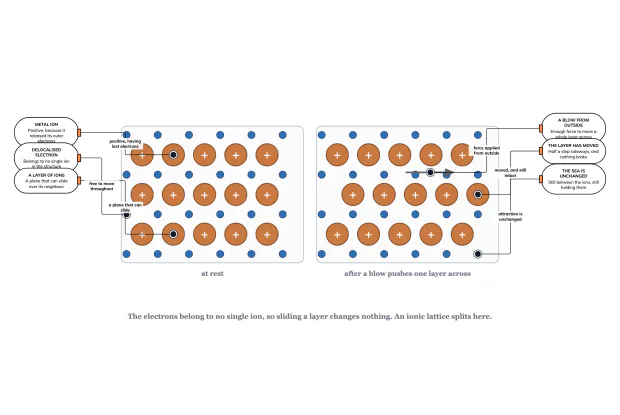
A metal is a lattice of positive ions sitting in electrons that belong to no single atom — which is why it bends where salt shatters. Label the structure in an interactive playground.