What Makes a Metal a Metal? Label the Structure
Root Concept
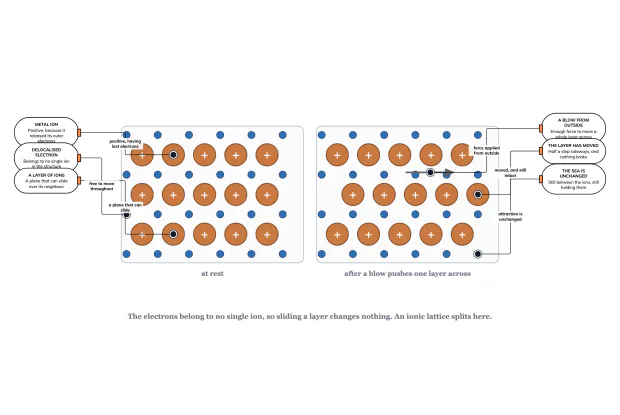
In a metal the atoms release their outer electrons into a pool shared across the whole structure, leaving a lattice of positive ions held together by their attraction to those delocalised electrons — an arrangement that survives a layer sliding, which is why metals bend where ionic solids shatter.
CodePLU Goal
Upgrading Human Mental Models
Learn how to think in Workflows

Concept Development By codeplu.com
Both panels hold the same ions and the same electrons. Only one layer has moved, and nothing has broken.
The Third Way of Reaching a Filled Shell
Two atoms can transfer electrons, giving ions that attract each other, or they can share a pair. A great many metal atoms together do something else again. Each one has only a small number of outer electrons and holds them loosely, and with nothing present that particularly wants to take them, they are released into a pool spread across the whole structure instead of being handed to any specific neighbour.
What is left is a regular lattice of positive ions sitting in that pool. The electrons are described as delocalised, which simply means they belong to no particular ion and are free to move anywhere in the metal. Every positive ion is attracted to the electrons around it and the electrons are attracted to every ion, and that mutual attraction is the metallic bond. It is strong, which is why most metals melt at high temperatures.
The part worth dwelling on is what happens when you hit it. The previous tutorial showed an ionic crystal splitting cleanly, because sliding a layer brings like charges face to face and attraction turns into repulsion. Do the same to a metal and nothing of the sort occurs. The ions are all positive and the electrons are everywhere, so a layer that has moved half a step sideways finds exactly the same situation it left. The structure holds, and the metal has simply changed shape.
That single difference explains why metal can be hammered, rolled, drawn into wire and bent without breaking, and the playground labels the structure that allows it.
What the Structure Explains
Why do metal atoms release their electrons at all?
Because they have few to release and losing them reaches a lower-energy arrangement, exactly as in ionic bonding. A metal sits on the left of the periodic table with one, two or three outer electrons over a filled shell, and shedding those few exposes the filled shell beneath. What is different here is that there is no non-metal present to take them. Every atom in the lump is in the same position and none is any more willing to accept electrons than to give them up, so rather than transferring to a partner the electrons end up in a pool belonging to all of them. The result is the same filled arrangement for every ion, reached by a route that only works when a great many identical atoms are present together.
Why does a metal bend where an ionic solid shatters?
Because nothing about the arrangement changes when a layer moves. In an ionic lattice the ions alternate in charge, so pushing one plane sideways puts positive next to positive and the crystal splits along that plane. In a metal every ion carries the same positive charge and the electrons are spread everywhere rather than sitting between particular pairs, so a layer that slides arrives somewhere indistinguishable from where it started. The attraction between ions and the electron sea is unaffected, and the metal keeps its new shape. This is the whole of malleability, and it is why a blacksmith can work iron and a sheet of aluminium can be rolled thin enough to wrap food.
Why are alloys harder than the pure metals in them?
Because sliding depends on the layers being regular, and an alloy deliberately spoils that. Mixing in atoms of a different size disrupts the neat planes, so a layer can no longer slip past its neighbour cleanly and the metal resists being deformed. Pure iron is soft enough to be of limited use; adding a small amount of carbon gives steel, which is far harder. Pure gold is too soft for jewellery that gets worn, so it is alloyed with copper or silver, which is what a carat figure records. Note what an alloy is not: a mixture, not a compound, with no fixed ratio — which is the test from the second track in this category.
What about conducting electricity?
That follows from the same structure, and the physics category already covers it properly — `conductors-and-insulators` explains why a material conducts when it contains charged particles free to move, and why pure water insulates while salty water does not. The chemistry worth adding here is only the origin: the mobile charges in a metal are the delocalised electrons, and they are mobile because no ion owns them. Heat travels the same way, which is why a metal spoon in hot soup warms along its length so quickly. The useful comparison is with the ionic solid of the previous tutorial, which has charged particles but cannot move them until it melts.
Real World Example
Three Properties Traced to the Same Arrangement
Each of these is a consequence of positive ions in a shared pool of electrons, and each is something you can see without equipment.
Step 1
Gold can be beaten into a film you can see through
Gold leaf is hammered to about a ten-thousandth of a millimetre, thin enough to transmit a greenish light, and it is still gold throughout. Nothing could be done to a salt crystal that was remotely similar — it would have shattered at the first blow. The difference is entirely the one in the playground: layers of gold ions slide over one another and the electron sea follows, so the metal thins instead of splitting. Gold is especially good at this because it is soft and unreactive, but every metal does it to some degree, which is why metals are shaped by hammering and rolling.
Step 2
Steel is iron with its layers deliberately spoiled
Iron on its own is soft, because its layers are regular and slide readily. Adding a small proportion of carbon — often well under one per cent — puts atoms of a different size into the structure and obstructs that sliding, and the result is steel, hard enough to build with. The proportion is chosen rather than fixed, which is what makes steel a mixture rather than a compound, and different proportions give different steels for different jobs. An entire industry rests on making a metal worse at the one thing this structure is good at.
Step 3
Mercury is a metal that is liquid at room temperature
Metallic bonding is strong, so most metals melt high — iron at 1538 °C and tungsten at 3422 °C, which is why tungsten was used for lamp filaments. Mercury melts at −39 °C and is liquid in your hand, and it is still a metal: it conducts, it is shiny, and it has the same kind of structure. Its outer electrons are held unusually tightly for a metal, so less of the pool forms and the attraction holding the ions is correspondingly weaker. Strong is a typical case rather than a rule, and mercury is the standing reminder.
FAQs
Final Words
A metal is the third answer to the same question. Its atoms have few outer electrons, hold them loosely, and with nothing present to take them release them into a pool shared across the whole structure. What remains is a lattice of positive ions sitting in that pool, held together by attraction between the two — and the electrons belong to no particular ion, so they move freely through the metal.
Nearly everything a metal does follows from that. A layer pushed sideways finds exactly the arrangement it left, so the metal changes shape instead of shattering — hence hammering, rolling and wire. Spoiling those layers with atoms of a different size obstructs the sliding, which is what an alloy is for. That is all three kinds of bonding: transfer, share and pool. What none of them explains is what happens when a bond is broken and a different one made, which is what a reaction is — and where the next track starts.
Continue This Track
This concept is part 5 of How Atoms Join.
Why Do Atoms Bond at All? Ask the Ones That Do Not
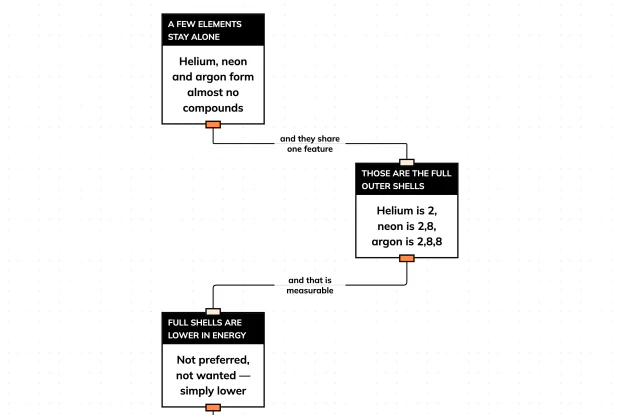
Almost every element forms compounds and a handful do not. Work out what the exceptions have in common, and the reason atoms bond follows, in an interactive playground.
What Charge Does an Ion Take? Read the Group
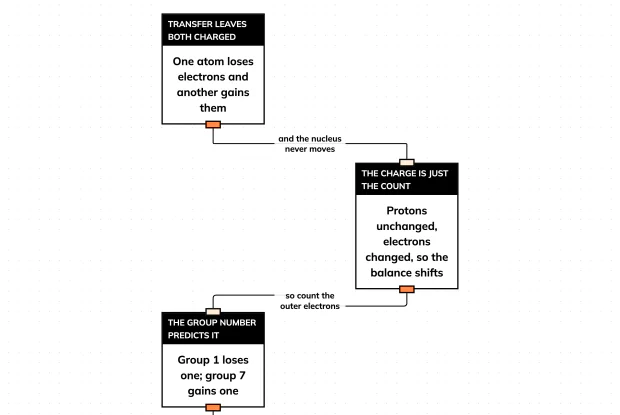
An ion’s charge is not a fact to memorise: it follows from the outer electrons, and the formula of the compound follows from the charges. Work it through in an interactive playground.
Ionic or Covalent? What Decides Which Happens
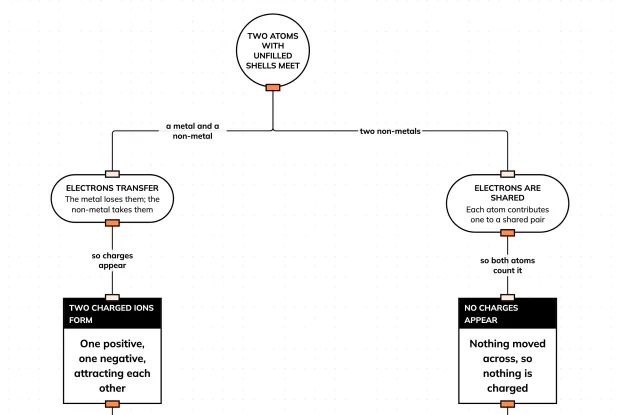
Two atoms meet with unfilled shells, and what happens next depends on whether either can give electrons away. Follow both routes from one starting point in an interactive playground.
Why Does Salt Melt at 801 °C and Ice at 0 °C?
Water has strong covalent bonds and melts at 0 °C; salt melts at 801 °C. The answer is that melting never breaks a bond inside a molecule. Trace what a lattice explains in an interactive playground.
What Makes a Metal a Metal? Label the Structure
A metal is a lattice of positive ions sitting in electrons that belong to no single atom — which is why it bends where salt shatters. Label the structure in an interactive playground.