Why Do Atoms Bond at All? Ask the Ones That Do Not
Root Concept
Atoms bond because an arrangement in which outer shells are filled — by transferring, sharing or pooling electrons — is lower in energy than the separate atoms were, and systems settle into lower-energy arrangements; the noble gases already have that arrangement, which is why they form almost no compounds.
CodePLU Goal
Upgrading Human Mental Models
Learn how to think in Workflows

Concept Development By codeplu.com
The chain never says an atom wants anything. The last step follows from the energy claim, not from a motive.
The Question Usually Answered Wrongly
Ask why atoms bond and the answer that comes back is almost always the same: atoms want a full outer shell. It is in textbooks, it is in revision guides, and it is wrong in a way that matters. An atom has no wants. It is not trying to achieve anything, it does not know what its outer shell contains, and nothing about it is aiming at an outcome.
That phrasing survives because it is memorable and because it gets the right answer to exam questions. The cost is hidden but real: it replaces a mechanism with a motive, and a reader who has been given a motive stops looking for a mechanism. Everything later — why some reactions release heat and others absorb it, why a catalyst works, why some bonds are stronger than others — needs the mechanism.
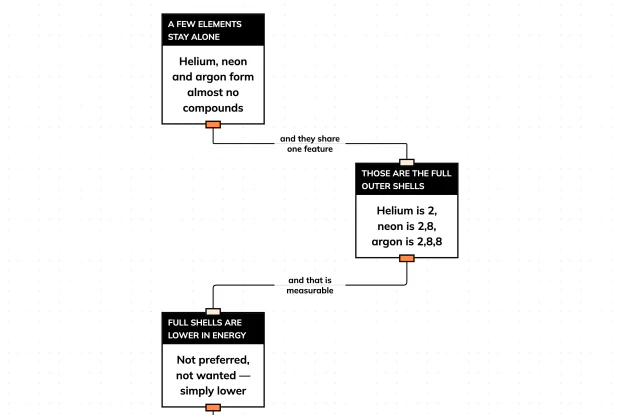
The honest version is no harder. Start from the elements that do not bond. Helium, neon and argon form almost no compounds at all, and the previous track showed what they have in common: 2, and 2,8, and 2,8,8 — outer shells that are full. So a full outer shell is the arrangement that comes with not reacting. That is a fact about energy: such an arrangement is lower in energy than the alternatives, and systems settle into lower-energy arrangements the way water runs downhill.
Everything else in this track is about the three ways atoms get there. The playground builds the argument one step at a time.
Building the Argument Honestly
Why do the noble gases hardly react?
Because they are already in the arrangement that other atoms reach by reacting. Helium has 2 electrons and a first shell that holds 2. Neon has 2,8 and argon has 2,8,8, both with a filled outer shell. There is no lower-energy arrangement available to them, so there is nothing for a reaction to achieve and they take part in almost none. Note the word almost. The heavier members of the group do react under forcing conditions — xenon forms several compounds with fluorine, first made in 1962 — which is why the old name inert gases was dropped. They are unreactive, which is a statement about how readily something happens, not incapable, which would be a statement about whether it can happen at all.
What does "lower in energy" actually mean?
It means that if the atoms end up in that arrangement, energy is left over and released to the surroundings. A ball at the top of a slope has more energy than the same ball at the bottom, and it rolls down without wanting to, intending to, or preferring the bottom. Nothing in the ball is aiming at anything; the arrangement at the bottom is simply lower, and systems left to themselves end up in lower arrangements. Two hydrogen atoms joined as H₂ are in the same situation relative to two separate hydrogen atoms. The joined arrangement is lower, so energy comes out when it forms, and that released energy is the reason the bonded state is the one you find in the world.
Does breaking a bond release energy?
No — and this is the single most damaging thing people get backwards in chemistry. Breaking a bond always costs energy. Making a bond always releases it. The confusion comes from loose talk about energy stored in bonds, which sounds as though snapping one lets the energy out, like cutting a stretched elastic band. The opposite is true: a bond is the low arrangement, so getting out of it means putting energy in, exactly as lifting the ball back up the slope does. A reaction gives out heat when the bonds made release more than the bonds broken cost, and takes heat in when they do not. Every explanation of exothermic and endothermic depends on having this the right way round.
What are the three ways of getting there?
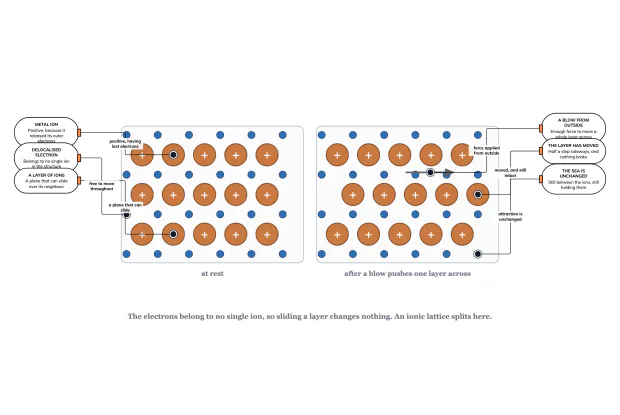
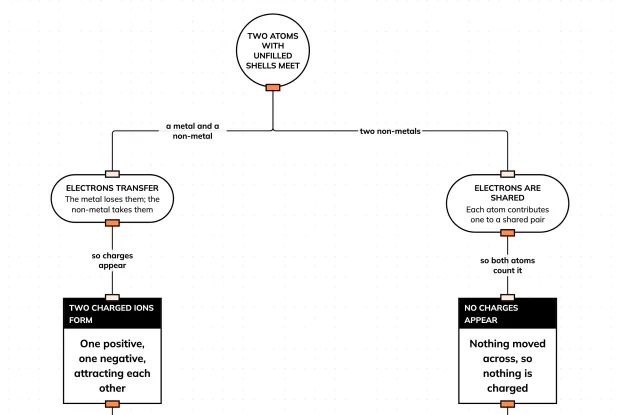
Transferring, sharing, and pooling — and which one happens depends on what the atoms involved have to work with. An atom with one or two outer electrons and an atom that is one or two short can settle it by moving electrons across, leaving two charged particles that attract each other: that is ionic bonding. Two atoms that are both short can each contribute to a shared pair, so the pair counts for both: that is covalent bonding. And a great many atoms with few outer electrons can release them into a common pool spread across the whole structure: that is metallic bonding. Three mechanisms, one reason, and the rest of this track takes them in turn.
Real World Example
Counting the Energy, Rather Than Asserting It
The energy argument is not a story told to make the rule memorable. Bond energies are measured quantities, and the sums come out.
Step 1
Hydrogen never turns up as lone atoms
Hydrogen gas is H₂, never H, and the reason is the whole argument in miniature. A lone hydrogen atom has one electron in a shell that holds two. Two of them sharing a pair gives each a share in two, which is the filled arrangement for that shell, and the joined state is lower in energy by a measured 436 kilojoules per mole — a mole being simply a fixed, very large count of particles, the unit chemists use so quantities come out as convenient numbers. Lone hydrogen atoms can be made, and they pair up almost immediately. Nothing decided to pair; the paired arrangement is the lower one.
Step 2
Burning hydrogen: the sum that explains the heat
When hydrogen burns, 2H₂ + O₂ → 2H₂O — read aloud, two hydrogen molecules and one oxygen molecule give two water molecules. Breaking two H–H bonds costs 2 × 436, and breaking the O=O costs 498, so 1370 kilojoules go in. Four O–H bonds then form, releasing 4 × 464, which is 1856 coming out. The difference, 486 out, is why the reaction is violently exothermic. The measured figure is about 484, and the small gap is honest rather than embarrassing: tabulated bond energies are averages across many compounds, so a sum built from them predicts the heat of a reaction closely rather than exactly.
Step 3
Xenon reacts, which the old name denied
The noble gases were called inert for decades on the understanding that they could not react at all. In 1962 xenon was made to combine with platinum hexafluoride, and xenon fluorides followed quickly. The explanation fits the energy argument rather than breaking it: xenon is a large atom, its outer electrons are far from the nucleus and held comparatively loosely, and fluorine attracts electrons more strongly than anything else does. Under those conditions a bonded arrangement is lower in energy after all. The group is unreactive, not exempt, and the distinction is exactly the one between unreactive and incapable. A rule that had been stated as impossibility turned out to be a statement about how much energy it takes.
FAQs
Final Words
The argument runs from the elements that do not bond to the reason the rest do. Helium, neon and argon form almost no compounds, and what they have in common is a full outer shell. That arrangement is lower in energy, and systems settle into lower-energy arrangements — not because anything prefers them, but in the sense that water runs downhill. So atoms bond because moving or sharing electrons reaches a lower arrangement, and energy comes out when they do.
Getting the direction right matters more than it looks. Making a bond releases energy and breaking one costs it, which is the reverse of how it is usually described, and every later explanation of why a reaction warms or cools its surroundings depends on it. There are three ways atoms reach that arrangement: transferring electrons, sharing them, and pooling them across a whole structure. The next tutorial takes the first, and works out what charge an atom is left with when it transfers.
Continue This Track
This concept is part 1 of How Atoms Join.
Why Do Atoms Bond at All? Ask the Ones That Do Not
Almost every element forms compounds and a handful do not. Work out what the exceptions have in common, and the reason atoms bond follows, in an interactive playground.
What Charge Does an Ion Take? Read the Group
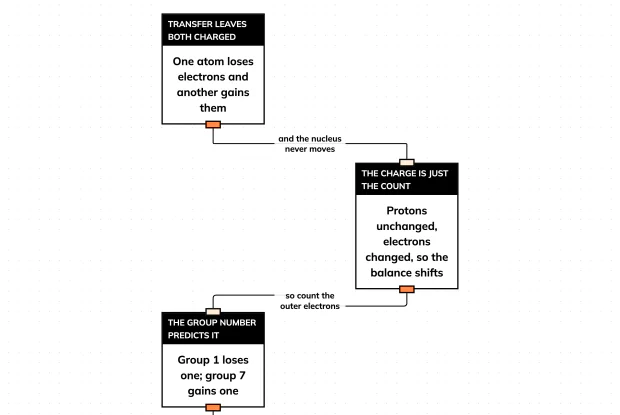
An ion’s charge is not a fact to memorise: it follows from the outer electrons, and the formula of the compound follows from the charges. Work it through in an interactive playground.
Ionic or Covalent? What Decides Which Happens
Two atoms meet with unfilled shells, and what happens next depends on whether either can give electrons away. Follow both routes from one starting point in an interactive playground.
Why Does Salt Melt at 801 °C and Ice at 0 °C?
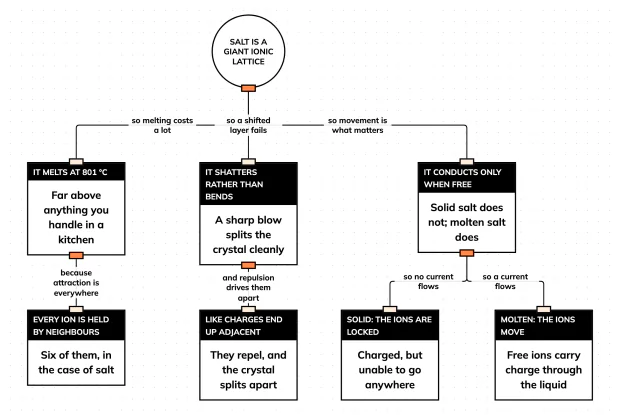
Water has strong covalent bonds and melts at 0 °C; salt melts at 801 °C. The answer is that melting never breaks a bond inside a molecule. Trace what a lattice explains in an interactive playground.
What Makes a Metal a Metal? Label the Structure
A metal is a lattice of positive ions sitting in electrons that belong to no single atom — which is why it bends where salt shatters. Label the structure in an interactive playground.