How Atoms Join
Five parts on what a chemical bond actually is, opening by refusing the sentence every textbook uses. Atoms do not want full outer shells: they have no wants, and that phrasing swaps a mechanism for a motive. The argument instead starts from the elements that form almost no compounds, notes that what helium, neon and argon share is a filled outer shell, and gets to the real reason — such an arrangement is lower in energy, and systems settle into lower arrangements the way water runs downhill. It also puts the direction the right way round: breaking a bond costs energy and making one releases it, with the hydrogen combustion sum worked through in numbers so the claim is checkable. The second part turns transfer into arithmetic, so that the charge on an ion and then the formula of the compound can be worked out from a group number rather than remembered. The third sets transfer against sharing and shows what decides between them. The fourth takes the trap almost everyone falls into — salt melts at 801 °C and ice at 0 °C, and the bonds inside a water molecule are strong — by establishing that melting separates particles and never breaks a molecule open, so a melting point reports the structure rather than the strength of any bond. The last part reaches the third kind of bonding and the one case where a blow does not shatter anything: a lattice of positive ions in a pool of electrons that belong to none of them, which is why metals bend, why alloys are harder, and why a spoon feels cold.
CodePLU Goal
Upgrading Human Mental Models
Learn how to think in Workflows
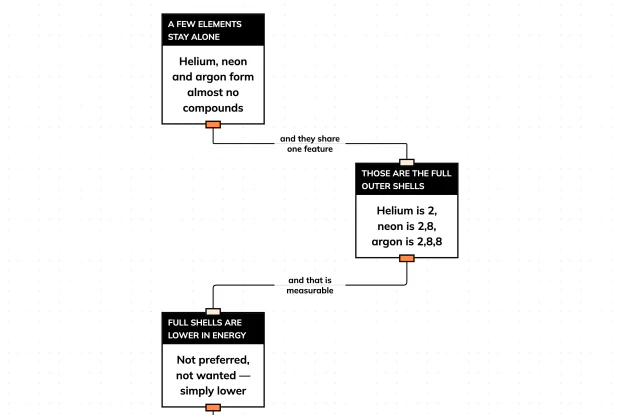
Why Do Atoms Bond at All? Ask the Ones That Do Not
Almost every element forms compounds and a handful do not. Work out what the exceptions have in common, and the reason atoms bond follows, in an interactive playground.
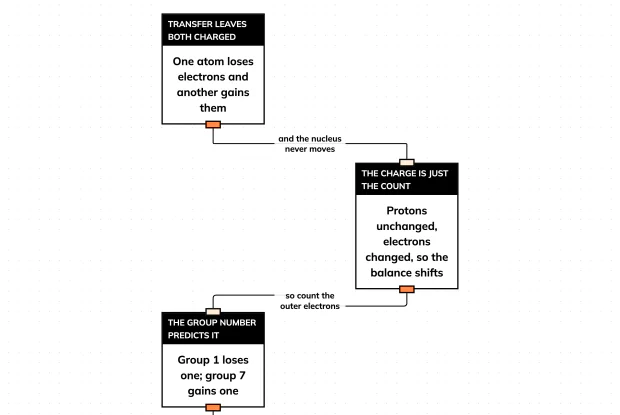
What Charge Does an Ion Take? Read the Group
An ion’s charge is not a fact to memorise: it follows from the outer electrons, and the formula of the compound follows from the charges. Work it through in an interactive playground.
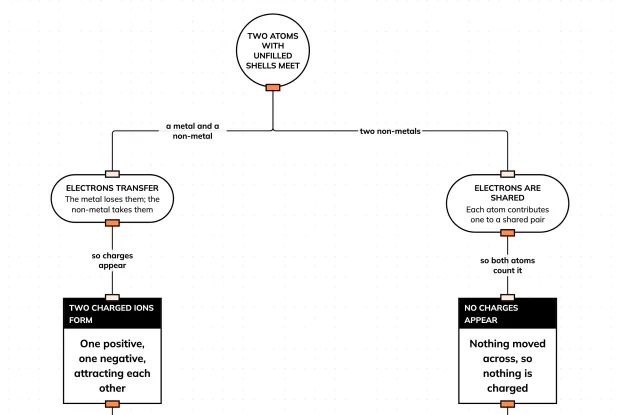
Ionic or Covalent? What Decides Which Happens
Two atoms meet with unfilled shells, and what happens next depends on whether either can give electrons away. Follow both routes from one starting point in an interactive playground.
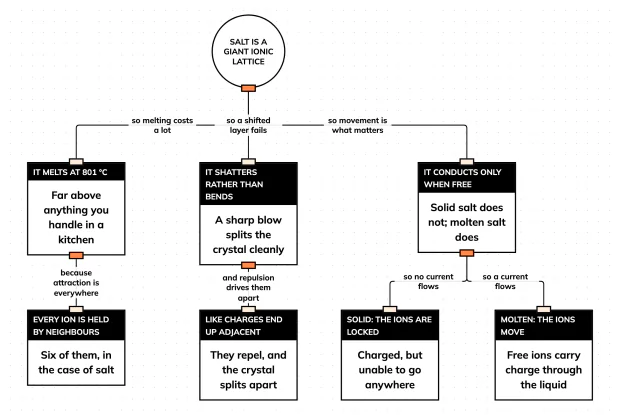
Why Does Salt Melt at 801 °C and Ice at 0 °C?
Water has strong covalent bonds and melts at 0 °C; salt melts at 801 °C. The answer is that melting never breaks a bond inside a molecule. Trace what a lattice explains in an interactive playground.
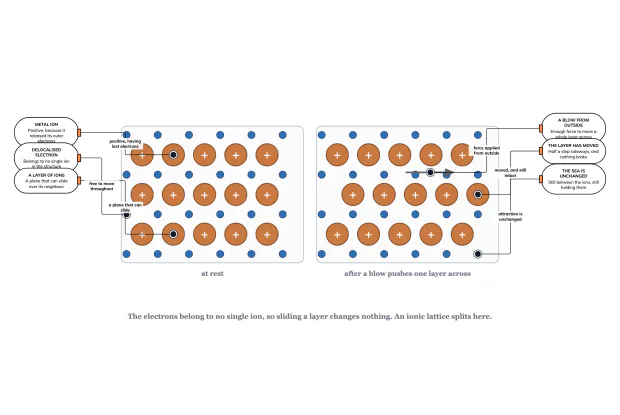
What Makes a Metal a Metal? Label the Structure
A metal is a lattice of positive ions sitting in electrons that belong to no single atom — which is why it bends where salt shatters. Label the structure in an interactive playground.