Why Do Only Some Gases Trap Heat?
Root Concept
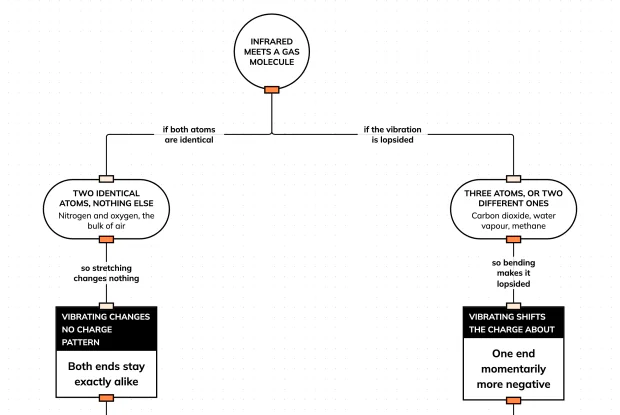
A gas absorbs infrared only if its vibrations shift the charge in the molecule so that one end becomes momentarily more negative than the other, which a molecule of two identical atoms cannot do — so nitrogen and oxygen are transparent to it and carbon dioxide, water and methane are not.
CodePLU Goal
Upgrading Human Mental Models
Learn how to think in Workflows

Concept Development By codeplu.com
Both branches are the same molecule being hit by the same radiation. What differs is whether the molecule has a lopsided way to move.
Most of the Air Does Nothing
Here is a fact that ought to be surprising. Nitrogen and oxygen together make up about ninety-nine per cent of the atmosphere, and between them they contribute almost nothing to the greenhouse effect. Carbon dioxide is well under a tenth of one per cent and does a great deal of it.
That cannot be about quantity, so it has to be about the molecules themselves. Something that carbon dioxide, water vapour and methane can do, and nitrogen and oxygen cannot, decides which gases are greenhouse gases — and it is not reactivity, not weight and not size.
The previous tutorial said a molecule absorbs infrared by starting to vibrate more vigorously, its bonds stretching and bending. Every molecule can vibrate, including nitrogen, so that cannot be the whole story either. The missing condition is about what the vibration does to the charge spread across the molecule.
Radiation is an oscillating electric field, and it can only push on something electrically lopsided. A nitrogen molecule is two identical atoms sharing electrons perfectly evenly; stretch the bond and it is still perfectly even, just longer. There is nothing lopsided for the field to grip. Carbon dioxide at rest is symmetrical too, but it can bend, and a bent carbon dioxide molecule is not symmetrical at all — which is exactly the handle the radiation needs.
Why Symmetry Decides It
Why can a nitrogen molecule not absorb infrared?
Because nothing about it is electrically uneven, in any position it can take. Nitrogen is two nitrogen atoms, identical in every respect, sharing their electrons exactly equally — neither end is more negative than the other. The only vibration available to a two-atom molecule is stretching the bond, lengthening and shortening it, and a longer symmetrical molecule is still symmetrical. Since infrared is an oscillating electric field, it needs an uneven charge distribution to push and pull on, and nitrogen never offers one. The same argument applies to oxygen, and between them that accounts for ninety-nine per cent of the atmosphere being transparent to the Earth’s outgoing heat. Abundance buys a gas nothing here; the only question is whether it can move unevenly.
Why can carbon dioxide, when it is also symmetrical?
Because it has more than one way to move, and some of those ways break the symmetry. Carbon dioxide is a straight line — oxygen, carbon, oxygen — and sitting still it is perfectly balanced. But a three-atom molecule can bend in the middle, which puts both oxygens on the same side of the carbon and makes one side of the molecule more negative than the other. It can also stretch asymmetrically, with one bond lengthening while the other shortens, which is lopsided in the same way. Those motions give the radiation something to act on, and they are the ones that absorb. The symmetrical stretch, where both bonds lengthen together, absorbs nothing at all.
What about water vapour and methane?
Both are lopsided before they even start vibrating, which makes them strong absorbers. A water molecule is bent rather than straight, with the oxygen at the point and the two hydrogens angled off it, and oxygen pulls electrons more strongly than hydrogen does — so the oxygen end is permanently more negative. That is the same unevenness the dissolving tutorial used to explain why water pulls ionic lattices apart, doing a different job here. Methane is more symmetrical at rest but has many ways to bend, several of which are uneven. Water vapour is responsible for the largest share of the natural greenhouse effect for exactly this reason. Being uneven from the start is worth far more than being abundant, which is the whole lesson of this board.
Does this explain which wavelengths are absorbed?
Yes, and that is the part that makes the explanation testable. A molecule can only absorb radiation whose frequency matches a vibration it is actually capable of, so each gas absorbs a specific set of infrared wavelengths and ignores the rest. Those sets can be measured in a laboratory and they are as characteristic as a fingerprint. It also means the gases are not interchangeable: carbon dioxide absorbs in a region where water vapour happens to be weak, so it covers a gap that would otherwise let heat straight out, which is why its small proportion matters more than the proportion suggests. A gap in the cover matters more than the total amount of it.
Real World Example
Three Molecules Tested the Same Way
The question to ask of any molecule is not how big or how reactive it is, but whether any of its vibrations make one end momentarily more negative than the other.
Step 1
Oxygen: one vibration, and it keeps the symmetry
An oxygen molecule is two identical atoms with a double bond between them, and the only thing it can do is stretch that bond. Lengthen it and you have a longer molecule with both ends still identical; shorten it and the same applies. At no point in the vibration is one end more negative than the other, so an oscillating electric field has nothing to grip. Oxygen is twenty-one per cent of the atmosphere and contributes essentially nothing to the greenhouse effect. A fifth of the air, doing none of this job. Reactivity is no guide either — oxygen reacts with almost everything and still absorbs nothing, because reacting and absorbing are unrelated abilities.
Step 2
Carbon dioxide: symmetrical until it bends
At rest, carbon dioxide is a perfectly straight and balanced molecule, which is why its symmetrical stretch absorbs nothing. The bending vibration is different: push the carbon off the line and both oxygens sit to one side, so that side is more negative and the molecule has become lopsided. The asymmetric stretch does the same. Those two motions are the entire reason carbon dioxide is a greenhouse gas, and a molecule unable to bend would not be. Three atoms are the minimum needed for that motion to exist. A two-atom molecule has only one way to move, and that way preserves the symmetry every time.
Step 3
Water: lopsided before it starts
Water does not need a special vibration to become uneven, because it already is. The molecule is bent at about 104 degrees, and oxygen attracts the shared electrons much more strongly than hydrogen, so the oxygen end carries a permanent partial negative charge. Any vibration at all shifts that unevenness around, which makes water vapour a strong and broad absorber and explains why it does more of the natural greenhouse work than anything else. Nothing else in the air is uneven to begin with. It is also the same unevenness that lets water dissolve ionic solids, described in the first electrolysis tutorial — one property doing two quite different jobs.
FAQs
Final Words
Ninety-nine per cent of the atmosphere is transparent to the heat the Earth radiates, and the one per cent that is not does nearly all the work. That cannot be about quantity, so it must be about what the molecules can do.
Infrared is an oscillating electric field, and a field can only act on something electrically uneven. Nitrogen and oxygen are two identical atoms sharing electrons evenly, and their only vibration is a stretch that leaves them just as even, so the radiation has nothing to grip. Carbon dioxide is symmetrical at rest but can bend, and a bent carbon dioxide molecule is lopsided — the handle the radiation needs. Water is uneven before it starts, which makes it the strongest natural absorber. Argon, being single atoms, has no bond to vibrate at all.
The next tutorial turns from what is already in the air to what is being added to it, starting with a car exhaust.
Continue This Track
This concept is part 3 of The Air and What We Do To It.
How Did the Air Get Its Oxygen?
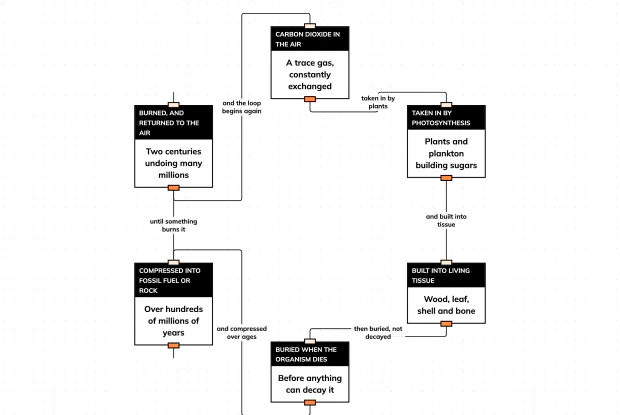
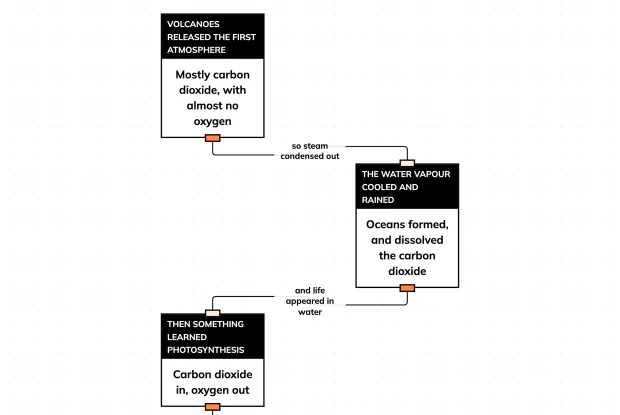
The early atmosphere was mostly carbon dioxide with virtually no oxygen. Follow how that reversed, and where all the carbon went, in an interactive playground.
What Is the Greenhouse Effect? The Actual Mechanism
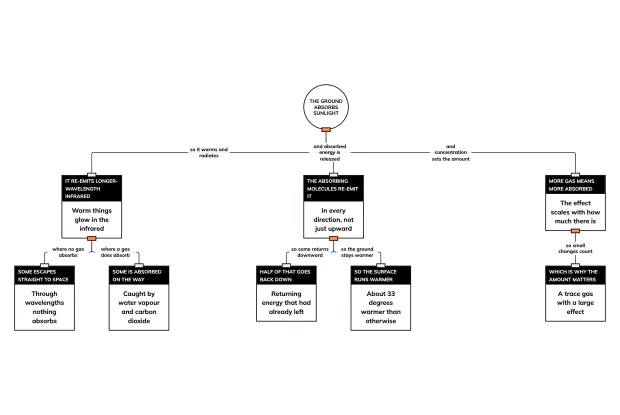
The greenhouse effect is not a blanket and not a trapped layer of warm air. Follow what actually happens to the energy, step by step, in an interactive playground.
Why Do Only Some Gases Trap Heat?
Ninety-nine per cent of the atmosphere is not a greenhouse gas. Work out what the other one per cent has that the rest does not, in an interactive playground.
What Comes Out of a Car Exhaust? Six Products
A hydrocarbon contains two elements, so a clean burn should give two products. Find out where the other four come from, in an interactive playground.
Where Does Carbon Dioxide Go? The Carbon Cycle
Carbon moves in a loop between the air, living things and rock. Follow the whole circuit, and find the step where the timings stopped matching, in an interactive playground.