Where Does Carbon Dioxide Go? The Carbon Cycle
Root Concept
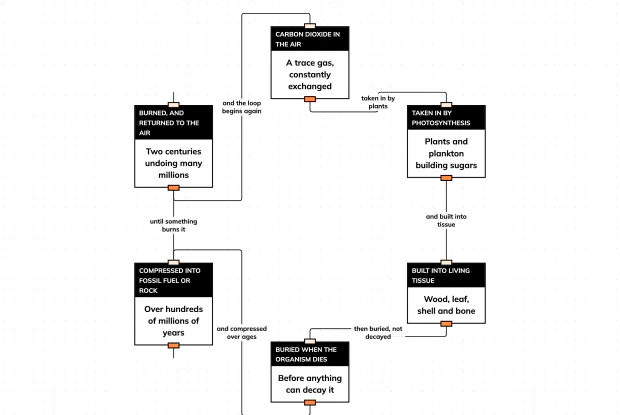
Carbon moves in a loop: taken from the air by photosynthesis, built into living tissue, buried when organisms die before they can decay, compressed into fossil fuel or carbonate rock, and returned to the air when it burns — a circuit whose two halves now run at wildly different speeds.
CodePLU Goal
Upgrading Human Mental Models
Learn how to think in Workflows

Concept Development By codeplu.com
A ring has no first step, which is the point of drawing it this way. What it cannot show is that the steps take wildly different lengths of time.
A Loop With One Very Slow Side
Carbon does not accumulate anywhere permanently. An atom of it spends time in the air as carbon dioxide, time inside a living thing, and time locked in rock or fuel underground, and it moves between those places continuously. The first tutorial of this track followed that movement over the planet’s whole history. This one draws it as the loop it actually is.
The route is straightforward. Photosynthesis takes carbon dioxide out of the air and builds it into sugars, which become wood, leaf and — once something has eaten the plant — flesh and shell. Most of that carbon returns to the air fairly quickly when the organism respires, or when it dies and decays and the organisms doing the decaying respire it out themselves.
A small fraction does not. If something is buried before it can decay — in waterlogged ground, or on a sea floor with no oxygen — the carbon in it is taken out of circulation. Compressed over hundreds of millions of years that material becomes coal, oil, gas or carbonate rock, and the carbon sits there.
That is the slow side of the loop, and the word slow is doing a great deal of work. Burying carbon as fossil fuel took something like three hundred million years. Digging it up and burning it has taken about two hundred. The loop still closes — nothing is being created or destroyed — but the two halves no longer run at anything like the same speed, and that mismatch is the whole of the problem.
Round the Loop
What takes carbon out of the air?
Photosynthesis, overwhelmingly, with the oceans doing a large share of the rest by simply dissolving it. Plants on land and plankton in the sea take carbon dioxide and water and build glucose, using energy from sunlight, and the oxygen left over is the waste product the first tutorial described. The quantity involved is enormous and seasonal: the carbon dioxide record from Hawaii shows a clear annual wobble, falling through the northern summer as plants grow and rising again through the winter as they die back. That wobble is the planet breathing, and it is visible in the data as plainly as the long-term rise it is superimposed on. Two signals in one record: a loop turning, and a store being emptied.
What puts it back quickly?
Respiration and decay, which are the same chemistry running in both cases. Every living thing, plants included, breaks down sugars to release energy and gives off carbon dioxide doing it, so carbon starts returning the moment it is captured. When an organism dies, bacteria and fungi consume what is left and respire the carbon out in turn. This is the fast half of the loop and it is roughly balanced: over a year, a forest takes in and gives back comparable amounts, which is why a mature forest stores carbon rather than continuously removing more of it. A forest is a reservoir that stays roughly full rather than a drain that keeps running, and that distinction matters a great deal when people propose planting as a remedy.
How does carbon escape the loop?
By being buried before the decomposers get to it. Decay needs oxygen and it needs access, so material that falls into a waterlogged swamp or sinks to an oxygen-poor sea floor is not broken down. Instead it accumulates, is buried under sediment, and over geological time is compressed and heated into coal, oil or natural gas. A second and much larger route is through the oceans, where dissolved carbon becomes carbonate, is built into shells, and settles as limestone and chalk. Both routes remove carbon from circulation for an extremely long time, and both are slow in a way that is hard to picture. The escape route is narrow, and that narrowness is exactly why a store had time to build at all.
Why does the speed matter if the loop still closes?
Because a loop can be perfectly closed and still produce a build-up if one half runs faster than the other. Nothing about burning a fossil fuel breaks the cycle — the carbon goes back into the air it came from and the equation balances exactly. The difficulty is purely one of rate, which is the lesson the rates track taught in a different setting: the position something settles at and the speed it gets there are separate questions. Carbon is being returned to the air far faster than photosynthesis and burial are taking it out, so the amount in the air rises, and the greenhouse tutorial explains what follows from that.
Real World Example
Three Timescales in One Loop
The steps of this cycle are drawn the same size on the board and are nothing like the same size in time, which is the one thing a ring cannot show.
Step 1
Days to years: a leaf grows and rots
Carbon taken from the air in spring can be back in it by the following autumn, having been built into a leaf, dropped, and consumed by the fungi and bacteria of the soil. This is the fast loop, and it is very nearly balanced: what a forest takes in over a year, it gives back. The seasonal wobble in the atmospheric record is this loop made visible, rising and falling by a few parts per million every twelve months as the northern hemisphere’s plants grow and die back. Nothing about this half of the loop is a problem; it has been running this way for as long as there have been plants.
Step 2
Millions of years: a swamp becomes a coal seam
Plant material that fell into waterlogged ground in the Carboniferous period, around three hundred million years ago, did not decay because the decomposers could not reach it. Buried, compressed and heated, it became coal. Every tonne of it represents carbon removed from the atmosphere over a span so long that the continents moved while it happened. That is the slow side of the loop, and it is the reason there was ever a store to dig up in the first place. There would be nothing to burn today if decay had simply kept up. The fuel exists because of a failure to rot.
Step 3
Two centuries: the store is emptied
Industrial use of coal began in earnest in the eighteenth century, and oil and gas followed. In the time since, a large fraction of what took hundreds of millions of years to bury has been dug up and burned. The carbon dioxide concentration measured continuously since 1958 has risen in every single year of that record. Nothing in the chemistry is unusual — it is the same combustion the reactions track described — and the only remarkable thing about it is the rate. The chemistry was never the novelty here. The speed was. Every reaction involved was already old.
FAQs
Final Words
Carbon moves in a loop and does not accumulate anywhere for ever. Photosynthesis takes it out of the air and builds it into living tissue; respiration and decay return most of it within months or years. That fast half is very nearly balanced, which is why a mature forest stores carbon rather than endlessly removing more.
The slow half is where the store came from. A small fraction of each generation is buried before decomposers can reach it, and over hundreds of millions of years that material became coal, oil, gas and carbonate rock. Burning it returns the carbon to where it started, so nothing is created and the equation balances — the difficulty is entirely one of rate. Three hundred million years of burial is being undone in two hundred of burning, and a closed loop with one side running faster still builds up.
The next track asks how anybody knows what anything is made of.
Continue This Track
This concept is part 5 of The Air and What We Do To It.
How Did the Air Get Its Oxygen?
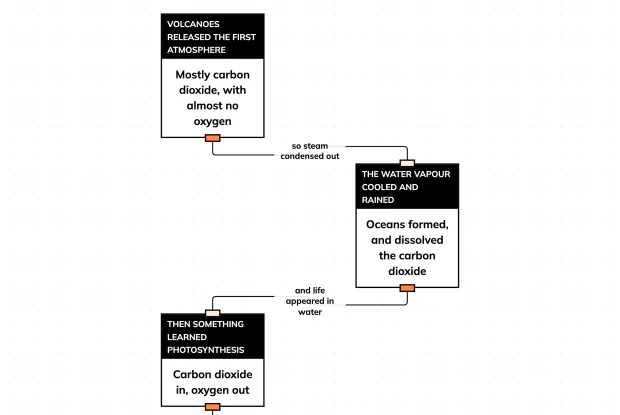
The early atmosphere was mostly carbon dioxide with virtually no oxygen. Follow how that reversed, and where all the carbon went, in an interactive playground.
What Is the Greenhouse Effect? The Actual Mechanism
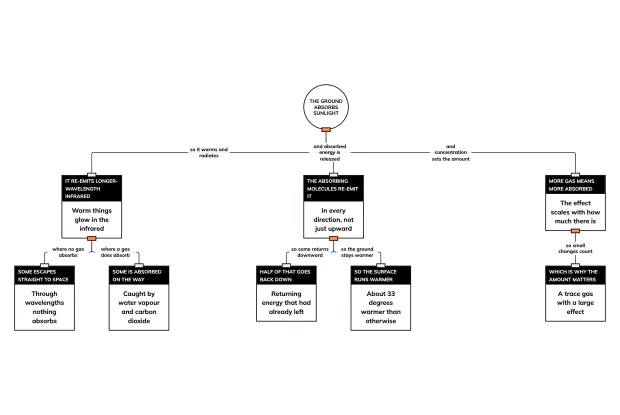
The greenhouse effect is not a blanket and not a trapped layer of warm air. Follow what actually happens to the energy, step by step, in an interactive playground.
Why Do Only Some Gases Trap Heat?
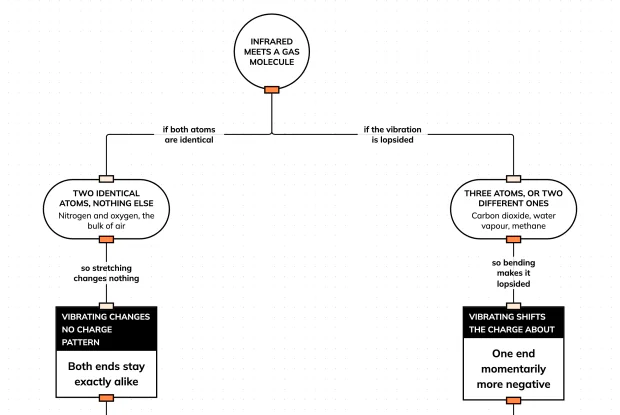
Ninety-nine per cent of the atmosphere is not a greenhouse gas. Work out what the other one per cent has that the rest does not, in an interactive playground.
What Comes Out of a Car Exhaust? Six Products
A hydrocarbon contains two elements, so a clean burn should give two products. Find out where the other four come from, in an interactive playground.
Where Does Carbon Dioxide Go? The Carbon Cycle
Carbon moves in a loop between the air, living things and rock. Follow the whole circuit, and find the step where the timings stopped matching, in an interactive playground.