What Is the Greenhouse Effect? The Actual Mechanism
Root Concept
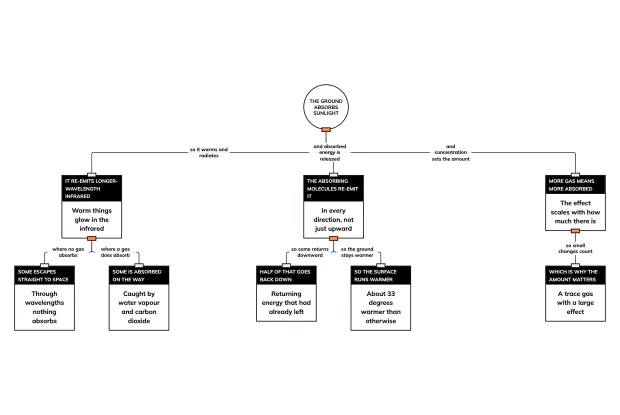
Sunlight passes through the atmosphere and warms the ground, which re-emits the energy as longer-wavelength infrared; certain gases absorb infrared and re-emit it in all directions, so some returns to the surface and the planet settles at a warmer temperature than it otherwise would.
CodePLU Goal
Upgrading Human Mental Models
Learn how to think in Workflows

Concept Development By codeplu.com
Nothing here is trapped or held. Energy is absorbed and released again almost immediately — the effect comes from which direction it is released in.
Why the Usual Picture Is Wrong
The greenhouse effect is almost always explained as heat being trapped under a blanket, or as a layer of warm air held in by the atmosphere the way glass holds warm air inside a greenhouse. Both pictures are wrong in a way that matters, because they suggest the gas is acting as a physical barrier, and a gas that was merely a barrier would block incoming sunlight just as effectively.
What actually matters is that energy arrives at one wavelength and tries to leave at another. Sunlight reaches the Earth mostly as visible light and shorter wavelengths, and the atmosphere is largely transparent to those — which is why you can see the sun. That light reaches the ground and is absorbed, warming it.
A warm surface does not keep the energy. It radiates it away again, but a surface at around fifteen degrees Celsius radiates in the infrared, at wavelengths far longer than the light that came in. And the atmosphere is NOT transparent to all of those. Certain gases absorb particular infrared wavelengths strongly, so some of the outgoing energy is intercepted on its way out.
A molecule that has absorbed infrared does not hold onto it. It re-emits almost at once — but in a random direction rather than the one the energy was travelling. Roughly half goes onwards into space and roughly half comes back down. The ground therefore receives energy from two directions instead of one, and settles at a higher temperature than sunlight alone would produce.
Following the Energy
Why does the wavelength change?
Because the wavelength something radiates at depends on how hot it is, and the Sun is far hotter than the Earth. The surface of the Sun is around 5500 °C and radiates mostly as visible light. The surface of the Earth is around 15 °C and radiates in the infrared, with wavelengths roughly twenty times longer. Everything warm radiates — you do, and a thermal camera sees it — but cooler objects radiate at longer wavelengths and less intensely. That difference is the entire basis of the effect, because the atmosphere treats the two wavelength ranges completely differently, letting one through and absorbing much of the other. Without that asymmetry there would be no effect at all.
What does "absorb" mean for a molecule?
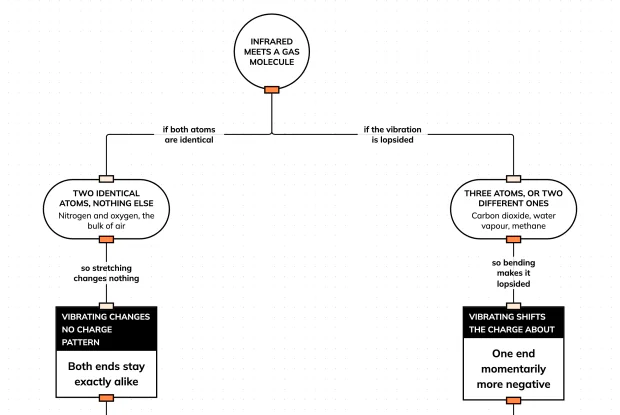
That the molecule takes the energy of the infrared and starts vibrating more vigorously — its bonds stretching and bending more than before. This is not the same as the molecule moving faster through space, though it leads to that through collisions. The key point is that a molecule can only absorb the particular wavelengths that match a vibration it is capable of, which is why different gases absorb different parts of the infrared and why some absorb none of it at all. The next tutorial takes that up directly, because it is the reason nitrogen and oxygen — which are most of the atmosphere — contribute essentially nothing to the effect.
Is the greenhouse effect a bad thing?
Not in itself — without it the planet would be uninhabitable. Calculations of what the Earth’s temperature would be with no greenhouse gases at all give around minus 18 °C rather than the observed average of about plus 15, so the effect is worth approximately 33 degrees and is the reason there is liquid water. Mars has a thin atmosphere and almost none of it; Venus has a very thick carbon dioxide atmosphere and a surface hot enough to melt lead, which is far hotter than its distance from the Sun alone would explain. The question is not whether the effect exists but what size it should be, and that depends on how much of the absorbing gases are present.
Why does a trace gas matter so much?
Because the quantity that matters is not how much of the atmosphere a gas makes up, but how strongly it absorbs at wavelengths the Earth is trying to radiate at. Carbon dioxide is well under a tenth of one per cent of the air and absorbs strongly in a part of the infrared where water vapour does not, so it covers a gap that would otherwise be open to space. A small proportion of a very strong absorber can therefore matter more than a large proportion of something that absorbs nothing. Nitrogen is seventy-eight per cent of the atmosphere and contributes essentially none of the effect. Abundance and absorbing power are separate questions, and only the second one counts here.
Real World Example
Three Planets, Three Atmospheres
Comparing planets is the cleanest test available, because the mechanism is identical and only the amount of absorbing gas differs.
Step 1
Mars: almost no atmosphere, and bitterly cold
Mars has an atmosphere about one per cent as dense as Earth’s, and although it is mostly carbon dioxide there is so little of it that the greenhouse effect is only a few degrees. Surface temperatures swing enormously between day and night, because very little of the outgoing infrared is intercepted and the heat of the day escapes almost immediately once the Sun sets. It is a planet showing what a surface does with very little of this gas present. The thin atmosphere is the whole explanation, and its composition barely enters into it. Thin air, and nothing to intercept the outgoing heat.
Step 2
Venus: a thick carbon dioxide atmosphere, and lead melts
Venus has an atmosphere about ninety times as dense as Earth’s and overwhelmingly carbon dioxide, and its surface sits at around 460 °C — hot enough to melt lead, and hotter than Mercury despite being considerably further from the Sun. Distance cannot explain that and the greenhouse effect can. It is the same mechanism as on Earth with far more of the absorbing gas, which is why Venus is cited so often in this topic. It is the clearest available demonstration that the quantity of absorbing gas sets the result, because nothing else about the comparison works.
Step 3
Earth: the quantity in between
Earth sits between the two with a moderate amount of greenhouse gas and an average surface temperature of about 15 °C, roughly 33 degrees warmer than it would be with none. Water vapour does most of the work and carbon dioxide a significant share, and the proportion of carbon dioxide has been measured rising year on year since continuous records began in 1958. The mechanism predicts that more absorber means a warmer surface, and that prediction is what makes the measurement worth taking. Three planets, one mechanism, and three very different amounts of the gas that drives it.
FAQs
Final Words
The greenhouse effect is not a blanket and nothing is trapped. Energy arrives from the Sun mostly as visible light, which the atmosphere lets through, and the ground absorbs it and warms. A surface at ordinary temperatures radiates that energy away again in the infrared, at wavelengths roughly twenty times longer than the light that came in — and the atmosphere is not transparent to all of those.
Certain gases absorb particular infrared wavelengths, because those wavelengths match vibrations their bonds can perform. A molecule that absorbs re-emits almost immediately, but in a random direction, so roughly half of what it intercepted heads back towards the ground. The surface receives energy from two directions instead of one and settles warmer — by about 33 degrees on Earth, which is the difference between this planet and a frozen one.
The next tutorial asks why only some gases can do this, when nitrogen and oxygen are most of the air and do almost none of it.
Continue This Track
This concept is part 2 of The Air and What We Do To It.
How Did the Air Get Its Oxygen?
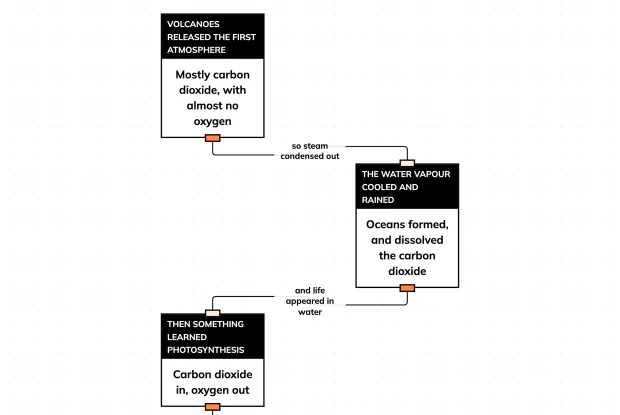
The early atmosphere was mostly carbon dioxide with virtually no oxygen. Follow how that reversed, and where all the carbon went, in an interactive playground.
What Is the Greenhouse Effect? The Actual Mechanism
The greenhouse effect is not a blanket and not a trapped layer of warm air. Follow what actually happens to the energy, step by step, in an interactive playground.
Why Do Only Some Gases Trap Heat?
Ninety-nine per cent of the atmosphere is not a greenhouse gas. Work out what the other one per cent has that the rest does not, in an interactive playground.
What Comes Out of a Car Exhaust? Six Products
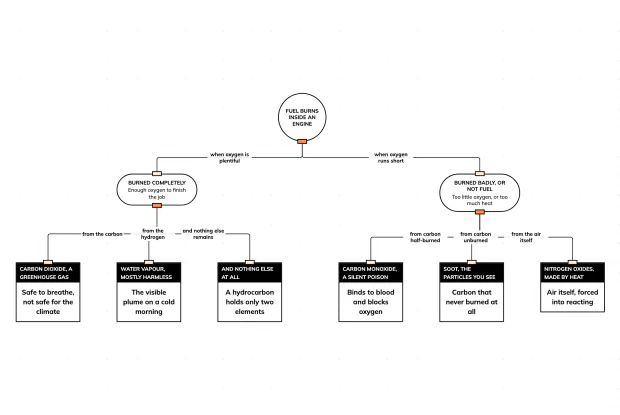
A hydrocarbon contains two elements, so a clean burn should give two products. Find out where the other four come from, in an interactive playground.
Where Does Carbon Dioxide Go? The Carbon Cycle
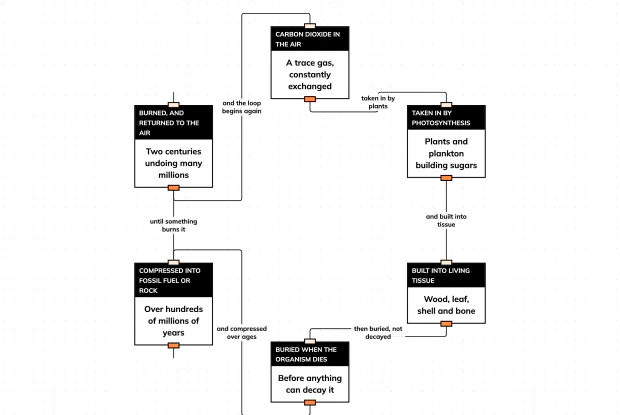
Carbon moves in a loop between the air, living things and rock. Follow the whole circuit, and find the step where the timings stopped matching, in an interactive playground.