What Comes Out of a Car Exhaust? Six Products
Root Concept
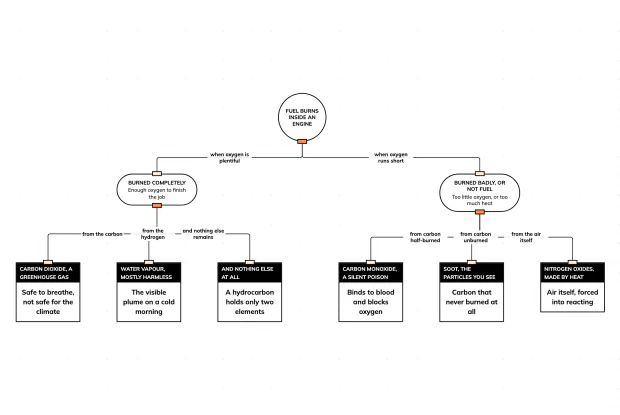
Burning a hydrocarbon completely gives only carbon dioxide and water, but a real engine also produces carbon monoxide and soot where oxygen is short, and nitrogen oxides formed from the nitrogen and oxygen of the air itself at the temperature of combustion.
CodePLU Goal
Upgrading Human Mental Models
Learn how to think in Workflows

Concept Development By codeplu.com
Five of these six come from the fuel. The sixth does not come from the fuel at all, which is why it cannot be fixed by making the fuel cleaner.
Two Elements In, Six Things Out
Petrol is a mixture of hydrocarbons, and the carbon track established what that means: molecules of carbon and hydrogen, and nothing else. Burn them completely in plenty of oxygen and there are only two things they can possibly become. The carbon ends up as carbon dioxide and the hydrogen as water, because conservation of atoms leaves no other option — whatever goes in has to come out.
A real exhaust pipe emits considerably more than that, and each additional product has a reason. Some of them come from the burn being imperfect. Inside a cylinder the fuel is injected, mixed with air and ignited in a few thousandths of a second, and in that time some of it meets too little oxygen to burn all the way.
Carbon that gets only part of the oxygen it needs becomes carbon monoxide rather than carbon dioxide, and carbon that gets essentially none stays as carbon — soot, the black particles visible in a badly tuned exhaust. Both are products of a shortage rather than of anything unusual in the fuel.
The last one is different, and it is the one worth paying attention to. Nitrogen oxides in an exhaust did not come from the petrol at all. They are made from the nitrogen and oxygen of the air that was drawn in to burn the fuel — two gases that normally ignore each other completely, forced to react by the temperature inside the cylinder.
Sorting the Products
Why do carbon monoxide and soot form at all?
Because oxygen runs short locally, even when there is plenty in the cylinder overall. Combustion in an engine happens in milliseconds, and the fuel and air do not mix perfectly in that time, so there are pockets where a carbon atom simply cannot reach enough oxygen to form carbon dioxide. With a partial supply it forms carbon monoxide, which has one oxygen instead of two. With almost none it does not oxidise at all and remains as a particle of carbon. The rates track is the right way to think about this: everything here is a competition for a reactant that is in short supply at the moment it is needed, and what comes out depends on who got there first.
Why is carbon monoxide so dangerous?
Because it attaches to the haemoglobin in blood far more strongly than oxygen does, and once attached it does not readily let go. Haemoglobin is the molecule that carries oxygen around the body, and a carbon monoxide molecule occupying one of its sites puts that site out of action. The result is a person starved of oxygen while breathing normally. What makes it genuinely dangerous rather than merely harmful is that it is colourless, odourless and does not irritate — there is nothing to notice, and the early symptoms are headache and confusion, which are not symptoms that prompt anybody to open a window. A detector on the wall exists because the human senses offer no warning whatsoever.
Where do nitrogen oxides come from?
From the air, which is the fact worth taking away from this tutorial. Nitrogen is seventy-eight per cent of the atmosphere and is famously unreactive — the equilibrium track spent a whole tutorial on how much trouble it takes to make it react with hydrogen, and the previous tutorial noted it does not even absorb infrared. But inside a cylinder at over two thousand degrees, nitrogen and oxygen do react with each other, forming nitrogen monoxide which oxidises further in the air outside. So the pollutant is manufactured from the two commonest gases in the atmosphere, by nothing but the heat of the engine, and a perfectly pure fuel would not prevent it.
What is sulfur dioxide, and why is it different?
It is the one product that comes from an impurity rather than from the fuel or the air. Crude oil contains sulfur compounds, and if they are left in, burning the fuel oxidises the sulfur to sulfur dioxide, which dissolves in cloud droplets to make acid rain. That makes it the easiest of all these problems to solve, because sulfur can simply be removed at the refinery before the fuel is sold, and in most countries it now is. Contrast that with nitrogen oxides, which cannot be removed from the fuel because they were never in it — the difference in where a pollutant comes from decides what can be done about it.
Real World Example
Three Fixes, Each Matched to a Source
Each of these engineering answers works on exactly one part of the board above, and none of them would work on another part.
Step 1
Remove the sulfur before the fuel is sold
Sulfur dioxide comes from an impurity, so the obvious fix is to take the impurity out, and refineries now do exactly that. Low sulfur diesel and petrol are standard across much of the world, and emissions of sulfur dioxide from road transport have fallen enormously as a result. It worked because the problem was in the fuel and the fuel could be cleaned. Nothing about the engine had to change at all, which is why this was the first of the exhaust problems to be largely solved. It is the cheapest kind of fix there is: one carried out once, centrally, before the problem ever reaches a road.
Step 2
A catalytic converter, to finish what the engine started
Carbon monoxide and unburned fuel are products of an incomplete burn, so the fix is to complete it afterwards. A catalytic converter is a honeycomb coated with platinum, palladium and rhodium, through which the hot exhaust passes before it leaves. Carbon monoxide is oxidised to carbon dioxide on that surface, and nitrogen oxides are reduced back to plain nitrogen. It is the rates track in a steel box: a catalyst giving reactions a workable rate at a temperature where they would otherwise be far too slow. The converter has to warm up before it works, which is why most of a journey’s emissions come from its first few minutes.
Step 3
Run the engine cooler, to make fewer nitrogen oxides
Nitrogen oxides form because the cylinder is extremely hot, so one answer is to lower the peak temperature — often by feeding some exhaust gas back into the intake, which dilutes the mixture and absorbs heat. It works, and it costs efficiency, because a hotter engine is a more efficient one. That trade-off is the same shape as the one the Haber process faced: two things you want, one lever, and the lever moves them in opposite directions. Engineers settle it the same way a chemical plant does, by choosing a figure neither side would have picked alone.
FAQs
Final Words
A hydrocarbon is carbon and hydrogen and nothing else, so burning one completely can only give carbon dioxide and water. Every other product in an exhaust is there for a reason, and the reasons are not all the same — which is why they do not all have the same fix.
Carbon monoxide and soot come from a shortage of oxygen in the milliseconds available, so a catalytic converter completes the reaction afterwards. Sulfur dioxide comes from an impurity in the crude oil, so it is removed at the refinery. And nitrogen oxides come from neither: they are made out of the nitrogen and oxygen of the air itself, forced together by the heat of the cylinder, which is why cleaning the fuel does not touch them and the remedy is a cooler engine at a cost in efficiency.
The last tutorial of this track follows the carbon dioxide after it leaves the pipe.
Continue This Track
This concept is part 4 of The Air and What We Do To It.
How Did the Air Get Its Oxygen?
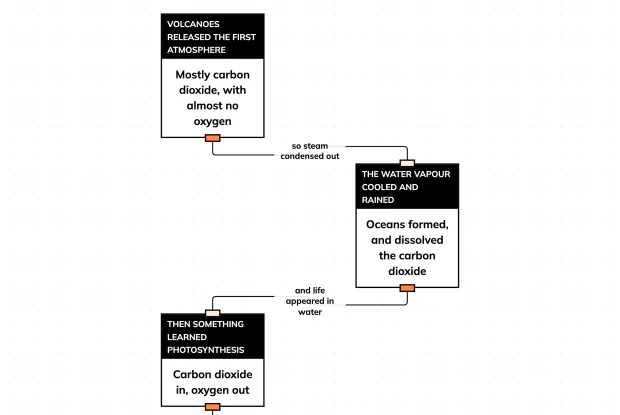
The early atmosphere was mostly carbon dioxide with virtually no oxygen. Follow how that reversed, and where all the carbon went, in an interactive playground.
What Is the Greenhouse Effect? The Actual Mechanism
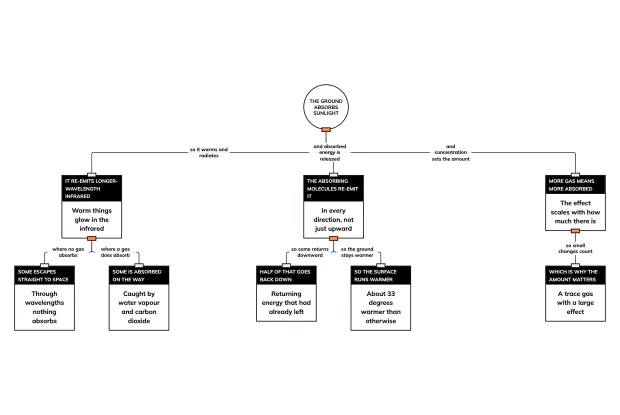
The greenhouse effect is not a blanket and not a trapped layer of warm air. Follow what actually happens to the energy, step by step, in an interactive playground.
Why Do Only Some Gases Trap Heat?
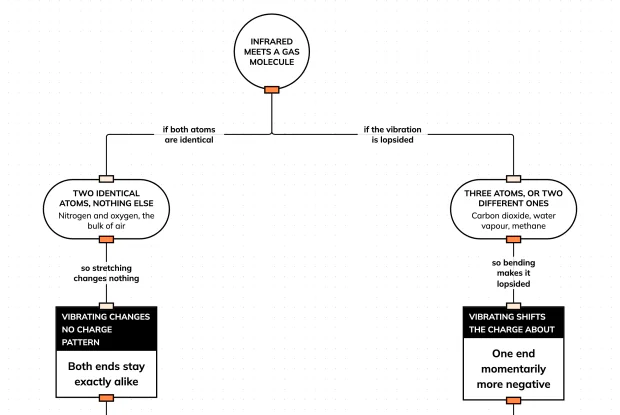
Ninety-nine per cent of the atmosphere is not a greenhouse gas. Work out what the other one per cent has that the rest does not, in an interactive playground.
What Comes Out of a Car Exhaust? Six Products
A hydrocarbon contains two elements, so a clean burn should give two products. Find out where the other four come from, in an interactive playground.
Where Does Carbon Dioxide Go? The Carbon Cycle
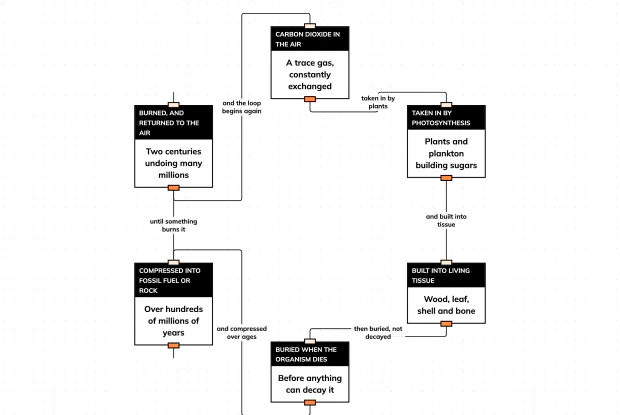
Carbon moves in a loop between the air, living things and rock. Follow the whole circuit, and find the step where the timings stopped matching, in an interactive playground.