How Did the Air Get Its Oxygen?
Root Concept
Earth’s early atmosphere came from volcanoes and was mostly carbon dioxide with almost no oxygen; photosynthesising organisms then released oxygen as a waste product over billions of years while the carbon dioxide dissolved into the oceans and was locked into carbonate rock and fossil fuels.
CodePLU Goal
Upgrading Human Mental Models
Learn how to think in Workflows

Concept Development By codeplu.com
The last two steps happened together and over an enormous span of time. Neither is a quick event, and the order shown is logical rather than a sequence of dates.
An Atmosphere That Was Swapped Over
The air you are breathing is roughly four-fifths nitrogen and one-fifth oxygen, with argon at about one per cent and carbon dioxide at well under a tenth of one per cent. Those proportions feel permanent, and a reasonable assumption would be that the planet has always had an atmosphere much like this.
It has not. For most of Earth’s history there was virtually no oxygen in the air at all, and carbon dioxide was not a trace gas but a major component. The composition has been more or less turned inside out, and the thing that did it was life.
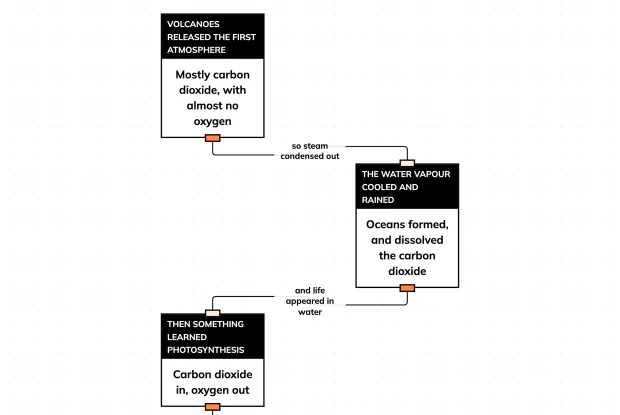
The first atmosphere came out of the ground. The early Earth was intensely volcanic, and volcanoes release mostly carbon dioxide and water vapour, with smaller amounts of nitrogen, ammonia and methane. Oxygen is not on that list, because oxygen is reactive enough that it does not survive free in such conditions.
Then the planet cooled enough for the water vapour to condense, which gave oceans, and oceans dissolve carbon dioxide. Something in those oceans later began photosynthesising — taking carbon dioxide and water and building sugars, with oxygen left over as a waste product it had no use for. Over around two billion years that waste accumulated into the atmosphere, while the carbon went the other way, into shells and sediment and eventually into rock and fossil fuels.
Following the Swap
Why was there no oxygen to start with?
Because oxygen is too reactive to accumulate unless something keeps making it. Free oxygen reacts readily with iron, with sulfur compounds, with methane and with almost anything else available, so any that appeared on the early Earth was consumed almost immediately. An atmosphere produced by volcanoes contains carbon dioxide, water vapour and nitrogen, and none of those will give up oxygen on their own. The presence of oxygen in an atmosphere is therefore not a neutral fact about a planet — it means something is actively replenishing it, which is why astronomers treat oxygen in a distant atmosphere as a possible sign of life rather than as ordinary chemistry. An atmosphere with oxygen in it is a maintained state, not a resting one.
What did the oceans do?
They pulled an enormous quantity of carbon dioxide out of the air and held it. Carbon dioxide dissolves in water, and once the planet had cooled enough for the water vapour to rain out, there was a very large volume of it available to do the dissolving. Dissolved carbon dioxide then reacts to form carbonates, which marine organisms used to build shells, and when those organisms died the shells settled into sediment that became limestone and chalk. Enormous amounts of carbon were removed from circulation that way, and the white cliffs you can see on a coastline are carbon that was once in the air. Rock is where most of this planet’s carbon has ended up, by a very wide margin.
Where did the oxygen actually come from?
From photosynthesis, and from nothing else in any quantity. The reaction takes carbon dioxide and water and, using energy from sunlight, builds glucose and releases oxygen. The oxygen is a waste product — the organism wanted the carbon, not the gas. The first organisms to manage it were simple single-celled life in the oceans, and for a long time the oxygen they produced was consumed as fast as it appeared, mostly by reacting with dissolved iron. Only once that iron had been used up could oxygen start building in the water and then in the air, and the banded iron formations in ancient rock record exactly that period. Oxygen had to saturate the oceans before it could begin on the sky.
Where is the carbon now?
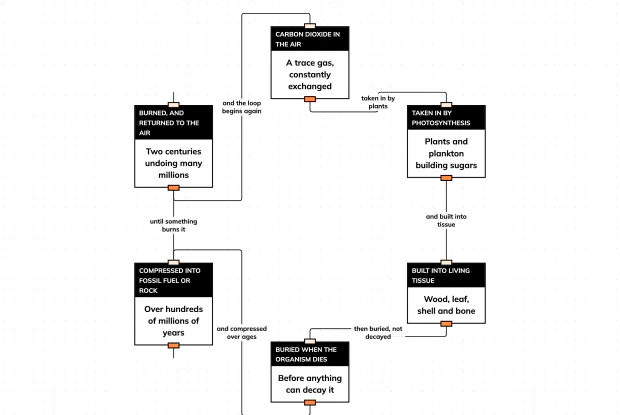
Mostly in rock, with a smaller amount in fossil fuels and a very small amount back in the air. The great majority is locked into carbonate rocks such as limestone and chalk, which represent carbon that passed through shells and settled over hundreds of millions of years. A second portion is the fossil fuels — coal from buried plant material, oil and gas from marine organisms — which are carbon that was photosynthesised and then buried before it could decay. That is the detail worth carrying forward: burning a fossil fuel is returning to the atmosphere carbon that was taken out of it a very long time ago. Nothing new is being created; something very old is being released.
Real World Example
Three Things That Record the Change
None of this is inferred from theory alone. Each of these is a physical record of a stage in the swap.
Step 1
Banded iron: rust laid down in stripes
Ancient rocks contain alternating bands of iron oxide and iron-poor sediment, laid down roughly two and a half billion years ago. They record oxygen being produced in water that still contained dissolved iron: the oxygen reacted with the iron and the resulting oxide settled out, so for a long period almost none of it reached the air. The bands stop once the dissolved iron was exhausted, which is the point at which free oxygen could finally begin to accumulate. The rock keeps the record of a chemical competition that ran for hundreds of millions of years.
Step 2
White cliffs: carbon dioxide turned into stone
Chalk is made from the microscopic shells of marine organisms that built them from dissolved carbonate, died and settled on the sea floor in such numbers that the deposit is hundreds of metres thick. Every one of those shells contains carbon that was carbon dioxide in the air before it dissolved. A chalk cliff is therefore a physical measure of how much carbon has been taken out of the atmosphere and parked, and limestone represents far more of it again. It is a store built one microscopic shell at a time, over a span nothing human compares to.
Step 3
Coal: a forest that did not rot
Coal formed from plant material that was buried in waterlogged ground before fungi and bacteria could break it down, so the carbon the plants had photosynthesised was never returned to the air. Compressed over hundreds of millions of years it became a carbon-rich rock. Burning it reverses the original photosynthesis directly: the carbon combines with oxygen again and goes back where it came from, which is what makes it a fuel and what makes it a problem. The energy released is sunlight that fell on a forest before there were dinosaurs. Nothing is created; a very old transfer is simply run backwards.
FAQs
Final Words
The air has not always looked like this. Earth’s first atmosphere came out of volcanoes and was mostly carbon dioxide and water vapour with essentially no oxygen, because oxygen is reactive enough that it cannot accumulate unless something keeps replacing it. Nothing on the early Earth did.
Two processes then swapped the composition over. The water vapour condensed into oceans, which dissolved vast quantities of carbon dioxide and turned it into carbonate that marine organisms built into shells, settling over hundreds of millions of years into limestone and chalk. And photosynthesis released oxygen as a waste product, slowly at first because dissolved iron consumed it, then steadily once that iron ran out. Nitrogen is simply what was left standing, being too unreactive for anything to remove it.
The carbon that left the air is mostly still in rock, and some of it is in fossil fuels. The next tutorial is about what happens when that is put back.
Continue This Track
This concept is part 1 of The Air and What We Do To It.
How Did the Air Get Its Oxygen?
The early atmosphere was mostly carbon dioxide with virtually no oxygen. Follow how that reversed, and where all the carbon went, in an interactive playground.
What Is the Greenhouse Effect? The Actual Mechanism
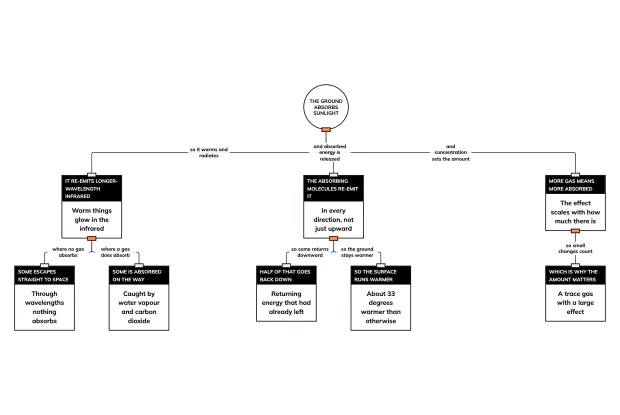
The greenhouse effect is not a blanket and not a trapped layer of warm air. Follow what actually happens to the energy, step by step, in an interactive playground.
Why Do Only Some Gases Trap Heat?
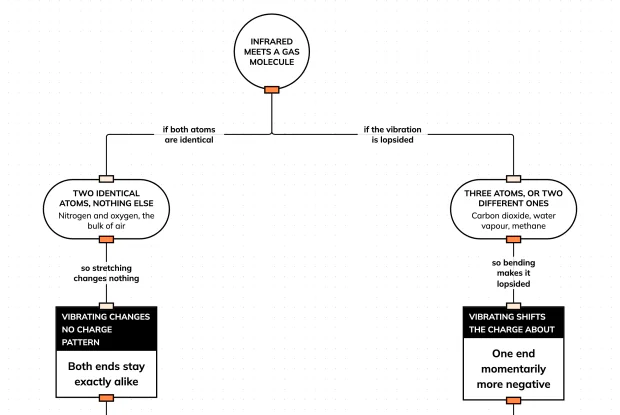
Ninety-nine per cent of the atmosphere is not a greenhouse gas. Work out what the other one per cent has that the rest does not, in an interactive playground.
What Comes Out of a Car Exhaust? Six Products
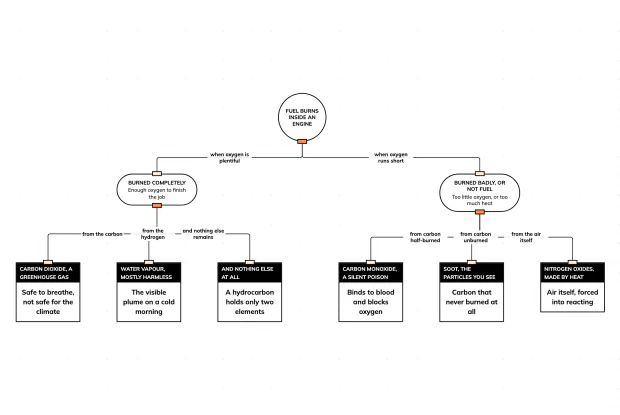
A hydrocarbon contains two elements, so a clean burn should give two products. Find out where the other four come from, in an interactive playground.
Where Does Carbon Dioxide Go? The Carbon Cycle
Carbon moves in a loop between the air, living things and rock. Follow the whole circuit, and find the step where the timings stopped matching, in an interactive playground.