Why Do Instruments Beat a Test Tube?
Root Concept
Instrumental methods use the same underlying chemistry as test-tube analysis but replace a human judgement of colour with a measurement of wavelength and intensity, which makes them far more sensitive, able to handle mixtures, and able to report a quantity rather than only an identity.
CodePLU Goal
Upgrading Human Mental Models
Learn how to think in Workflows

Concept Development By codeplu.com
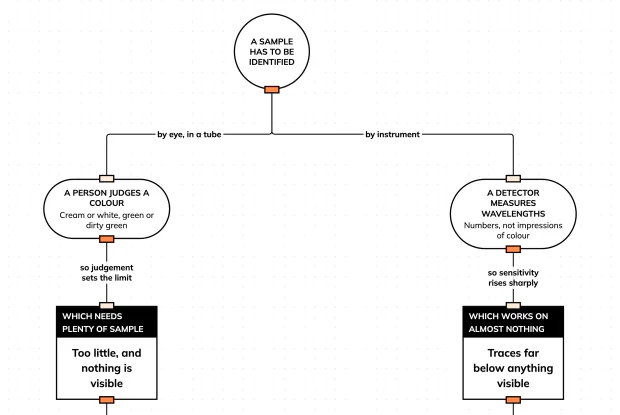
Both branches use the same chemistry. What differs is what does the reading, and every advantage on the right follows from that one change.
The Same Chemistry, Read Differently
Every test in this track works and every one is still taught, and none of them is how a modern laboratory actually identifies anything. That is not because the chemistry was wrong. The reactions are the same ones; what has changed is who or what reads the result.
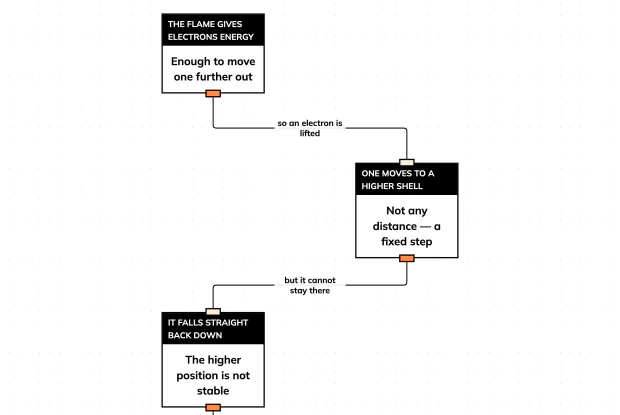
The flame test tutorial explained why a metal gives a particular colour: electrons lifted a fixed step and falling back, releasing light of exactly that energy. A person looking at the flame sees "lilac" and reaches for potassium. An instrument splits the same light and records the precise wavelengths and how bright each one is, which is a measurement rather than an impression.
That one change cascades. A person needs enough sample to produce a visible colour; a detector responds to quantities far below anything the eye could notice. A person seeing one colour cannot tell that two metals are present if one is much brighter; a detector records both sets of lines and separates them without difficulty. And a person can say what something is, while an instrument also says how much.
The test-tube methods survive because they are quick, cheap, need no power and teach what is actually happening. The instrument is better at every question that matters commercially, and it is better for reasons that have nothing to do with the chemistry being different.
Where the Difference Comes From
Why is an instrument so much more sensitive?
Because a detector responds to far less light than the eye needs, and it can integrate a weak signal over time rather than having to see it all at once. A flame test needs enough of a compound to colour a visible flame, which in practice means a reasonable pinch of solid. A flame emission spectrometer detects quantities thousands of times smaller, because it is looking for light at one specific wavelength against a dark background rather than asking a person to judge a tint in a bright orange Bunsen flame. Removing the human eye from the measurement is what buys the sensitivity, and the chemistry producing the light has not changed at all.
Why can an instrument handle a mixture?
Because it records every wavelength separately instead of combining them into one impression. A mixture of sodium and potassium looks yellow to a person, because sodium’s emission is intense enough to swamp potassium’s lilac completely — the eye adds the two together and reports the stronger. A detector scanning across wavelengths finds sodium’s lines and potassium’s lines in different places and lists both. This matters enormously in practice, because real samples are almost never one pure substance, and a method that fails on mixtures fails on most of the work there is. Purity is the exception in the world and the assumption in a school laboratory, which is one reason the two approaches part company so quickly.
Why can it report a quantity?
Because the brightness of a line depends on how much of the element is present, and brightness is something a detector measures in numbers. Run known concentrations first, plot how the signal rises with concentration, and an unknown can then be read off that line. A person cannot do this reliably — the eye is poor at judging how much brighter one colour is than another, and it adapts to what it has been looking at. Moving from "contains lead" to "contains 4 micrograms per litre of lead" is the difference between a curiosity and a legal limit that can be enforced. A regulator can write a rule around a number and cannot write one around an impression.
So why are the test-tube methods still taught?
Because they show the chemistry, which an instrument deliberately hides. A spectrometer gives a number and reveals nothing about why; a flame test makes you think about electrons and energy steps, and limewater makes you think about neutralisation and solubility. They are also genuinely useful where speed matters more than precision, need no power supply or calibration, and cost almost nothing. A geologist in the field and a technician doing a quick check both reach for the simple test, and the instrument is brought out when the answer has to be defensible. Knowing why a test works is also what tells you when it will fail, which is something a reading on a screen never volunteers.
Real World Example
Three Jobs Only an Instrument Can Do
In each of these the chemistry is familiar and the requirement is something the eye cannot supply.
Step 1
Testing drinking water for lead
The legal limit for lead in drinking water is a few micrograms per litre, which is thousands of times below anything a precipitate test could show. There is simply not enough lead present to make a visible solid, so the test-tube approach cannot answer the question at all — not imprecisely, but at all. Flame emission and related instrumental methods measure at those levels routinely, and a regulation written in micrograms per litre only became enforceable once the measurement existed. The law could not come before the instrument, which is a reasonable illustration of how often measurement sets the limits of policy.
Step 2
Finding one banned substance among hundreds
An athlete’s sample contains an enormous number of compounds, almost all of them ordinary, and the task is to find one particular molecule that may be present in tiny amounts. Chromatography separates the mixture first, as the earlier tutorial described, and a detector then identifies what emerges and when. No colour test could pick one substance out of that crowd, because every reagent would respond to several things at once. Separation first and identification second is the standard shape of real analysis, and it needs two instruments working in series. Neither stage alone would find it.
Step 3
Identifying an element in a star
The noble gases tutorial described helium being found in sunlight before anyone had it on Earth, and that remains the only way to know what distant objects are made of. The light is split, the lines are measured, and the pattern is matched against elements measured in a laboratory. No sample can be collected, no reagent can be added, and the only thing available is light — which is exactly what an instrument reads and a test tube cannot. It is the one case where there is no alternative method at all, rather than a slower one.
FAQs
Final Words
Every method in this track is still used and none of them is how a modern laboratory identifies anything, and the reason is not that the chemistry was wrong. A flame emission spectrometer excites electrons and reads the light they emit as they fall back, which is exactly what a flame test does on a wire. What changed is what does the reading.
Replacing a person with a detector cascades into everything. A detector responds to quantities thousands of times below what the eye needs, so it answers questions a precipitate test cannot answer at all. It records each wavelength separately, so a mixture gives two sets of lines rather than one blurred impression. And brightness is a number, so it reports how much as well as what.
The simple tests survive because they are fast, cheap and show the chemistry an instrument hides — which is why they are worth learning even though nobody would use them to settle anything important.
Continue This Track
This concept is part 5 of Finding Out What Something Is.
Why Does a Flame Test Have a Colour?
Lithium burns red and potassium lilac, and the reason is the same thing that makes the periodic table work. Follow the argument in an interactive playground.
How Do You Test for a Gas? Six Standard Tests
A colourless gas in a tube could be almost anything. Sort the standard tests by what they actually do, and see why each one works, in an interactive playground.
How Does Chromatography Separate a Mixture?
A black ink spot climbs a strip of paper and comes apart into several colours. Follow why each one stops where it does, in an interactive playground.
How Do You Identify an Ion in Solution?
A clear solution could contain almost any pair of ions. Follow the order of tests that narrows it down — and find out why the order matters — in an interactive playground.
Why Do Instruments Beat a Test Tube?
Every test in this track is still used, and none of them is how a real laboratory works. Compare the two approaches on what each can actually do, in an interactive playground.