How Does Chromatography Separate a Mixture?
Root Concept
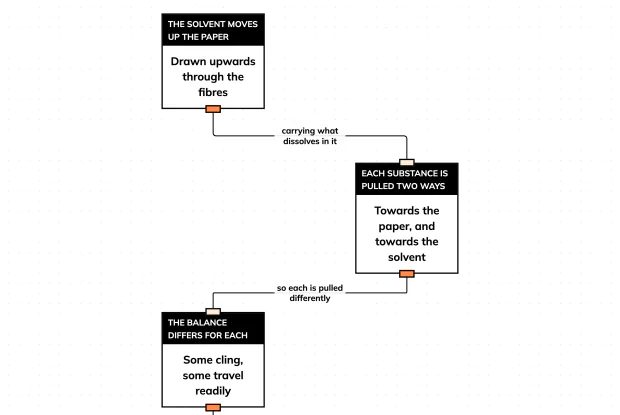
In chromatography each substance in a mixture is attracted both to the stationary paper and to the moving solvent, and the balance between those two attractions decides how fast it travels — so substances separate into spots at different heights that identify them.
CodePLU Goal
Upgrading Human Mental Models
Learn how to think in Workflows

Concept Development By codeplu.com
The second step is where the explanation lives. Everything below it follows from one substance having a different balance from another.
Why a Black Spot Comes Apart
Put a spot of black ink near the bottom of a strip of filter paper, stand the paper in a little solvent, and wait. The solvent climbs the paper, reaches the spot, and carries it upwards — but not as one spot. Within a few minutes the black has separated into bands of different colours at different heights, and what looked like one substance turns out to be several.
That is the whole technique, and it answers a question the separation track could not: not how to split a mixture, but how many things are in it and whether a sample is pure at all. A pure substance gives exactly one spot however far the solvent runs. Anything that gives more than one was a mixture.
The explanation is a competition between two attractions. The paper is the stationary phase and does not move; the solvent is the mobile phase and climbs through it. Every substance dissolved in that solvent is pulled in both directions at once — held back by its attraction to the paper, carried forward by its attraction to the solvent.
Nothing is being pushed and nothing is being filtered. A substance that clings strongly to the paper and dissolves poorly spends most of its time stuck and barely moves. One that dissolves readily and clings weakly travels nearly as fast as the solvent front. Everything else lands somewhere in between, and the height it reaches is a direct measure of where its own balance sits.
Reading the Result
What are the two phases doing?
The stationary phase is the paper, which stays where it is and offers somewhere for dissolved substances to stick. The mobile phase is the solvent, which climbs through the paper by capillary action and takes whatever is dissolved in it along. Those two names are worth learning properly, because the technique generalises far beyond paper and ink: the stationary phase can be a thin layer of silica or a column packed with beads, and the mobile phase can be a gas, but it is always one thing holding and another thing carrying. Separating a mixture by chromatography always means setting those two in competition and letting the substances sort themselves.
Why do substances travel different distances?
Because each one strikes a different balance between the two attractions. A molecule that is strongly attracted to the paper spends most of the time stuck to it, and only moves during the short periods it happens to be dissolved, so it creeps upwards slowly. A molecule that prefers the solvent is dissolved most of the time and travels almost as fast as the solvent front. What matters is the ratio of the two attractions rather than either one alone, which is why two substances that both dissolve well can still be separated — they are being compared on how much they would rather be in the solvent than on the paper.
What is an Rf value and why is it useful?
It is the distance a spot travelled divided by the distance the solvent travelled, which gives a number between zero and one. The point of dividing is that it removes the arbitrary parts of the experiment: run the same substance on a longer piece of paper for twice as long and the spot goes further, but the solvent goes proportionally further too, so the ratio is unchanged. That makes an Rf value comparable between laboratories in a way that a raw distance in centimetres never could be, and it is why results can be looked up in a table rather than having to run a known sample alongside every time.
Why must the starting line be drawn in pencil?
Because ink would run, and it would run in exactly the way the experiment is designed to detect. A pencil line is graphite — solid carbon, insoluble in anything used here — so it stays exactly where it was drawn and gives a fixed reference to measure from. An ink line would dissolve, climb the paper and produce spots of its own, contaminating every sample on the sheet. The same thinking explains the other standard precaution: the solvent level must start below the pencil line, because a spot sitting in the liquid dissolves away into it instead of being carried up the paper. Both rules protect the same thing: a fixed starting point that the experiment cannot wash away.
Real World Example
Three Questions It Answers
Chromatography is used far outside a school laboratory, and in each case it is answering one of these three questions.
Step 1
Is this pure? Count the spots
A pure substance produces exactly one spot, because there is only one kind of molecule and all of it has the same balance between paper and solvent. Two spots means two substances, no matter what the label says. This is the fastest purity check there is and it needs no calibration at all — you are not measuring anything, merely counting. A pharmaceutical sample showing a second faint spot is showing a contaminant, and that single observation is enough to reject a batch without knowing what the contaminant is. Detecting that something is wrong is a smaller problem than identifying what, and it is often the only one that has to be solved quickly.
Step 2
What is in it? Compare against knowns
Run the unknown alongside reference samples on the same sheet, in the same solvent, at the same time. A spot that travels to exactly the same height as a known substance is good evidence it is that substance, and running them side by side removes every variable that might otherwise differ between two experiments. This is how a forensic laboratory matches an ink from a questioned document against inks from particular pens, and how food colourings in a sweet are identified. Side by side on one sheet is a far stronger comparison than two runs made on two different days.
Step 3
How much is there? Measure the spot
The size and intensity of a spot relates to how much of that substance was present, so chromatography can be made quantitative as well as qualitative. On paper this is rough, but the same principle in an instrument — where the mobile phase is a gas or a pressurised liquid and a detector measures what comes off the end — gives precise numbers. Drug testing in sport works this way, and so does checking pesticide residue on food. The paper version teaches the principle; the instrument version is the same principle with a detector attached.
FAQs
Final Words
Chromatography separates a mixture without pushing, filtering or heating anything. The paper is a stationary phase that holds dissolved substances back, the solvent is a mobile phase that climbs through it and carries them forward, and every substance in the sample is pulled both ways at once.
What differs between them is the balance. A substance strongly attracted to the paper spends most of its time stuck and creeps upwards; one that prefers the solvent is carried almost as fast as the solvent front. So they separate by how much they would rather be moving than held, and the height each reaches measures exactly that. Dividing that height by the distance the solvent travelled gives an Rf value, which stays the same on a longer run and can therefore be compared between laboratories.
The next tutorial takes the same question — what is in this? — to a solution of ions, where the answer comes from what falls out of it.
Continue This Track
This concept is part 3 of Finding Out What Something Is.
Why Does a Flame Test Have a Colour?
Lithium burns red and potassium lilac, and the reason is the same thing that makes the periodic table work. Follow the argument in an interactive playground.
How Do You Test for a Gas? Six Standard Tests
A colourless gas in a tube could be almost anything. Sort the standard tests by what they actually do, and see why each one works, in an interactive playground.
How Does Chromatography Separate a Mixture?
A black ink spot climbs a strip of paper and comes apart into several colours. Follow why each one stops where it does, in an interactive playground.
How Do You Identify an Ion in Solution?
A clear solution could contain almost any pair of ions. Follow the order of tests that narrows it down — and find out why the order matters — in an interactive playground.
Why Do Instruments Beat a Test Tube?
Every test in this track is still used, and none of them is how a real laboratory works. Compare the two approaches on what each can actually do, in an interactive playground.