Finding Out What Something Is
Five parts on the question every other track assumed had been answered: given an unlabelled sample, how does anybody know what it is? It opens on the flame test, usually taught as a list of colours to memorise and actually a consequence of the shell model — heat lifts an electron a fixed step, it falls back, and the energy it returns is the colour you see, which is why the same lines appear in a street lamp, a firework and a star. The second sorts the standard gas tests by what they do rather than pairing each gas with a result, and notices that the commonest outcome is the splint simply going out, which rules out two candidates at once. The third separates a mixture without pushing or filtering anything, by setting two attractions in competition and letting each substance settle where its own balance puts it. The fourth is a procedure whose order is load-bearing: a carbonate gives a white precipitate with two different reagents and would be confidently misidentified, so the acid goes in first. And the last admits that none of this is how a real laboratory works, and explains why the chemistry is identical and the reading is not.
CodePLU Goal
Upgrading Human Mental Models
Learn how to think in Workflows
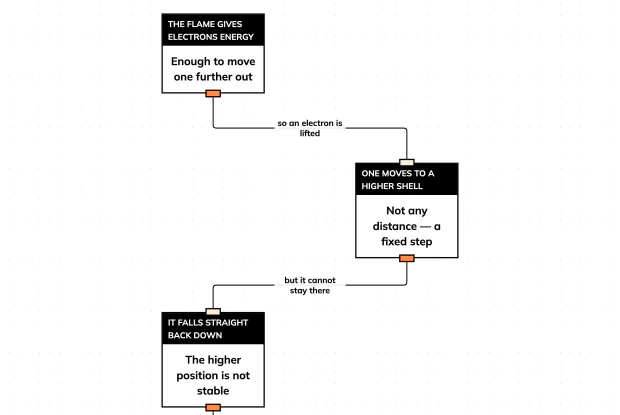
Why Does a Flame Test Have a Colour?
Lithium burns red and potassium lilac, and the reason is the same thing that makes the periodic table work. Follow the argument in an interactive playground.
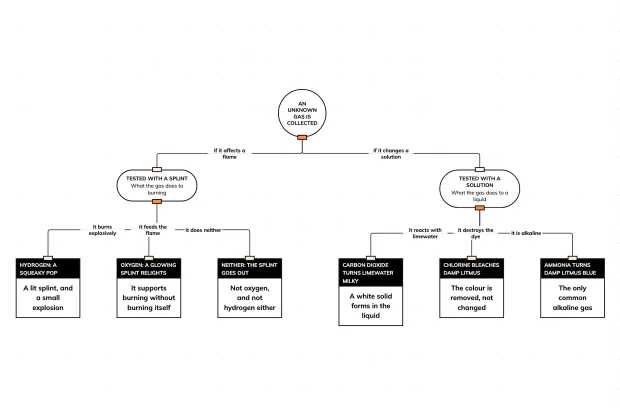
How Do You Test for a Gas? Six Standard Tests
A colourless gas in a tube could be almost anything. Sort the standard tests by what they actually do, and see why each one works, in an interactive playground.
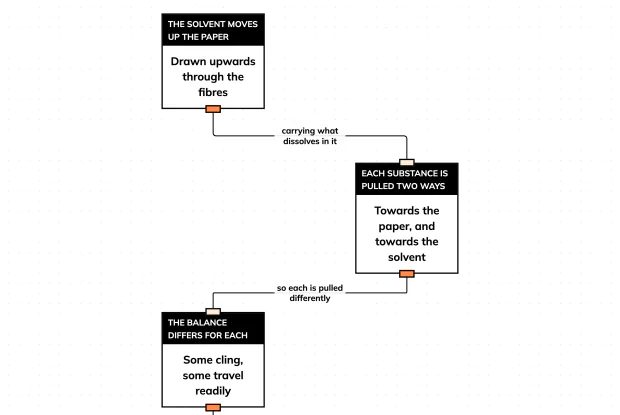
How Does Chromatography Separate a Mixture?
A black ink spot climbs a strip of paper and comes apart into several colours. Follow why each one stops where it does, in an interactive playground.
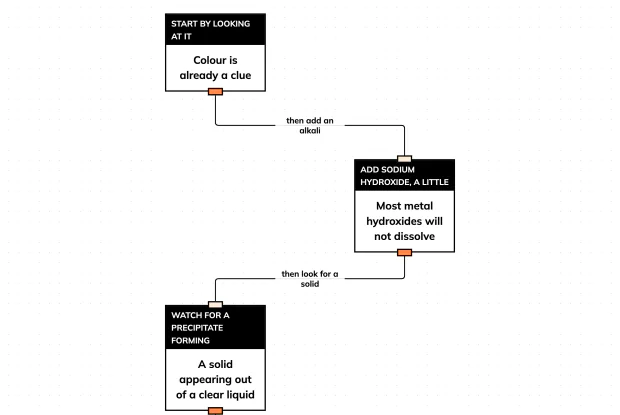
How Do You Identify an Ion in Solution?
A clear solution could contain almost any pair of ions. Follow the order of tests that narrows it down — and find out why the order matters — in an interactive playground.
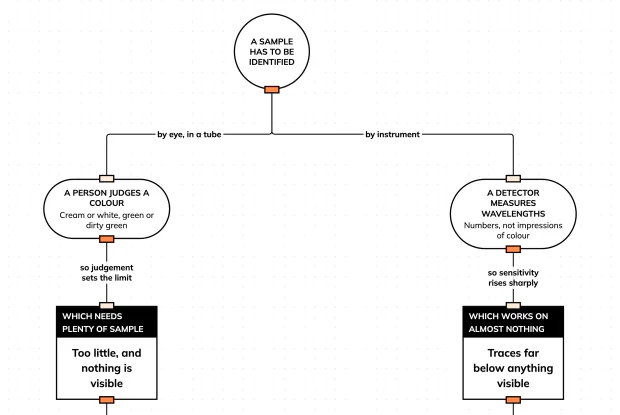
Why Do Instruments Beat a Test Tube?
Every test in this track is still used, and none of them is how a real laboratory works. Compare the two approaches on what each can actually do, in an interactive playground.