How Do You Identify an Ion in Solution?
Root Concept
A metal ion in solution is identified by adding sodium hydroxide and reading the colour of the precipitate that forms, with excess alkali distinguishing aluminium from the other whites, and the negative ion is then identified by a separate reagent chosen for the kind of ion suspected.
CodePLU Goal
Upgrading Human Mental Models
Learn how to think in Workflows

Concept Development By codeplu.com
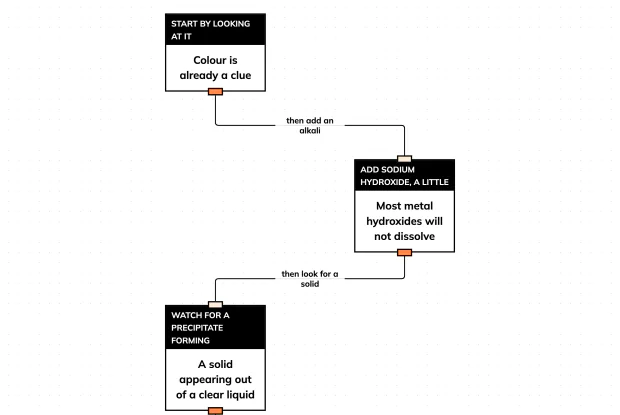
The fifth step only makes sense after the fourth has produced a white precipitate, and the sixth needs the acid added before the reagent. The order is the method.
Two Ions, Two Separate Questions
A solution of an ionic compound contains two kinds of ion, and identifying it means answering two independent questions: which metal ion, and which negative ion. Neither test tells you anything about the other, so a complete identification is always two results put together.
The metal ion comes first, and almost all of it is done with one reagent. Sodium hydroxide solution is added to the unknown, and because most metal hydroxides are insoluble a solid appears — a precipitate, forming in a liquid that was clear a moment before. The colour of that solid names the metal.
Several of them are white, though, which is where the method needs a second step: adding more sodium hydroxide. Most white precipitates simply sit there, but aluminium hydroxide dissolves again in excess alkali and the solution goes clear. That single difference separates aluminium from calcium and magnesium.
The negative ion then needs a different reagent chosen for what is suspected: acid for a carbonate, silver nitrate for a halide, barium chloride for a sulfate. And here the order inside each test matters, because a carbonate would give a precipitate with either of the other two reagents and be mistaken for them — which is why a little acid goes in first to get rid of it.
Why the Steps Are in This Order
Why does adding sodium hydroxide produce a solid?
Because most metal hydroxides are insoluble, so as soon as hydroxide ions meet metal ions in the same solution they combine and drop out as a solid. That is what a precipitate is: a product of a reaction between two dissolved substances that cannot itself stay dissolved. The sodium stays in solution throughout and takes no part, exactly as the potassium did in the displacement reactions of the metals track — it is a spectator. Group 1 is the exception that proves the rule here, since sodium and potassium hydroxides are soluble, which is why this test says nothing at all about a group 1 metal. A test that works by something failing to dissolve is useless on compounds that always do.
Why does the colour identify the metal?
Because the precipitate is a transition metal compound in most of the interesting cases, and the periodic table track explained why those are coloured: a partly filled inner level gives electrons a small energy step to make, which absorbs visible light. Copper hydroxide is blue, iron(II) hydroxide is a dirty green, and iron(III) hydroxide is orange-brown. That last pair is useful in its own right, because it tells the two charges of iron apart in a way nothing else at this level manages. The metals whose compounds are white are the ones with no partly filled level, which is exactly what the earlier track predicted. Two tracks apart, the same structural fact is doing the work.
Why add excess sodium hydroxide?
To separate the white precipitates, which otherwise look identical. Calcium, magnesium and aluminium all give a white solid, and the colour test has nothing more to offer. Aluminium hydroxide, however, redissolves when more alkali is added, and the others do not — so a white precipitate that clears on further addition is aluminium and one that stays is not. The underlying reason is that aluminium hydroxide can react as both an acid and a base, which is unusual, and it is reacting as an acid with the excess alkali. The test exists because that one oddity is the only handle available. Without it, three common metals would be indistinguishable at this level.
Why test with acid before silver nitrate or barium chloride?
Because a carbonate would ruin both tests, and this is where doing the steps out of order gives a wrong answer rather than no answer. Silver carbonate and barium carbonate are both insoluble white solids, so a solution containing carbonate gives a white precipitate with silver nitrate and is read as a chloride, or with barium chloride and is read as a sulfate. Adding dilute acid first destroys any carbonate present, fizzing as carbon dioxide comes off, and leaves the solution safe for the real test. The fizzing is also the carbonate test itself, so the precaution and the test are the same action. One drop of acid both asks a question and clears the way for the next.
Real World Example
Identifying Three Unknown Solutions
Each of these is worked by the same six steps, and the point at which they diverge is different every time.
Step 1
A blue solution giving a blue precipitate
The colour of the solution is a clue before anything is added, since a blue solution already suggests copper. Adding sodium hydroxide produces a pale blue precipitate, which confirms it: copper hydroxide. Adding more makes no difference, so there is no aluminium. For the negative ion, dilute acid gives no fizz so there is no carbonate, and barium chloride then gives a white precipitate — a sulfate. The solution was copper sulfate, named from two independent results. Neither test on its own would have named the compound, and together they leave no ambiguity. The colour of the solution was consistent throughout, which is reassurance rather than evidence.
Step 2
A colourless solution giving a white precipitate that clears
Nothing is visible to start with, so the colour step gives no information and the field is wide. Sodium hydroxide produces a white precipitate, which narrows it to calcium, magnesium or aluminium and no further. Adding excess alkali makes the precipitate dissolve and the tube go clear, which only aluminium does. The fifth step did all the work here, and without it the identification would have stopped at three candidates. A step that looks like a refinement is sometimes the only step that decides anything, and here it is the whole answer. Three candidates became one.
Step 3
A solution that fizzes before any reagent is added
Adding dilute acid produces immediate fizzing, and passing the gas through limewater turns it milky, so the negative ion is a carbonate and that question is settled at once. Notice what would have happened without this step: going straight to silver nitrate would have given a white precipitate of silver carbonate, read as a chloride, and the answer would have been confidently wrong. The precaution is what makes the later test trustworthy. It is the clearest case in the subject of a wrong answer being worse than no answer, because nothing about it would have looked wrong.
FAQs
Final Words
Identifying a solution means answering two independent questions, because it contains two kinds of ion and neither test says anything about the other. Sodium hydroxide answers the first: most metal hydroxides are insoluble, so a solid appears from a clear liquid and its colour names the metal — blue for copper, green for iron(II), orange-brown for iron(III), and the coloured ones are coloured for the reason the periodic table track gave.
Several are white, so a second step adds more alkali, and only aluminium hydroxide redissolves. Then the negative ion gets its own reagent — acid for a carbonate, silver nitrate for a halide, barium chloride for a sulfate. That is where the order stops being a convenience: a carbonate gives a white precipitate with both of the last two reagents, so the acid goes in first to remove it.
The last tutorial of this track asks what all of these tests cannot do, and what replaced them.
Continue This Track
This concept is part 4 of Finding Out What Something Is.
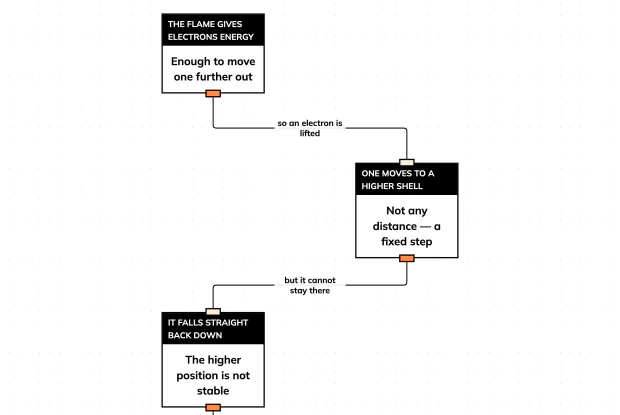
Why Does a Flame Test Have a Colour?
Lithium burns red and potassium lilac, and the reason is the same thing that makes the periodic table work. Follow the argument in an interactive playground.
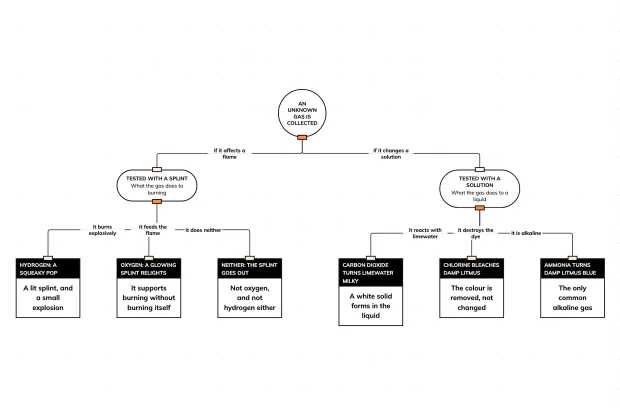
How Do You Test for a Gas? Six Standard Tests
A colourless gas in a tube could be almost anything. Sort the standard tests by what they actually do, and see why each one works, in an interactive playground.
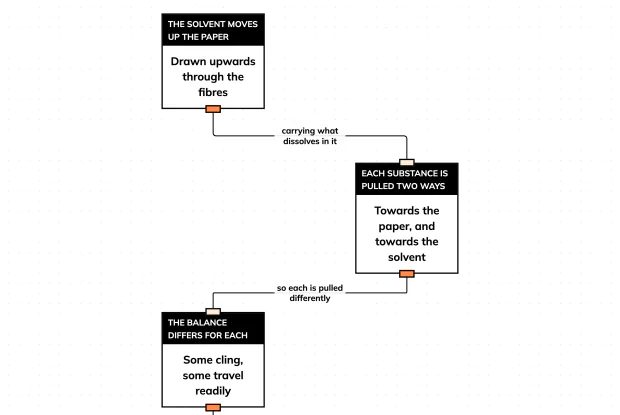
How Does Chromatography Separate a Mixture?
A black ink spot climbs a strip of paper and comes apart into several colours. Follow why each one stops where it does, in an interactive playground.
How Do You Identify an Ion in Solution?
A clear solution could contain almost any pair of ions. Follow the order of tests that narrows it down — and find out why the order matters — in an interactive playground.
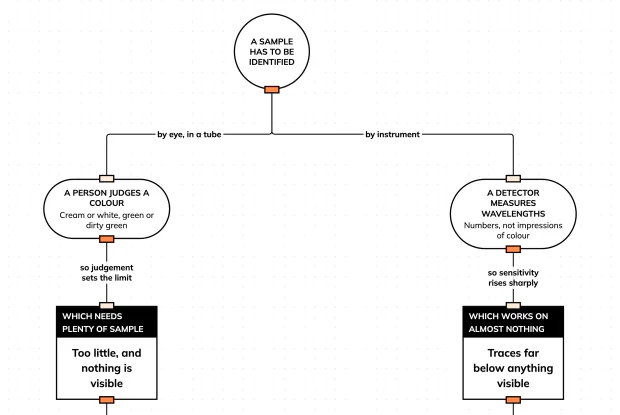
Why Do Instruments Beat a Test Tube?
Every test in this track is still used, and none of them is how a real laboratory works. Compare the two approaches on what each can actually do, in an interactive playground.