How Do You Test for a Gas? Six Standard Tests
Root Concept
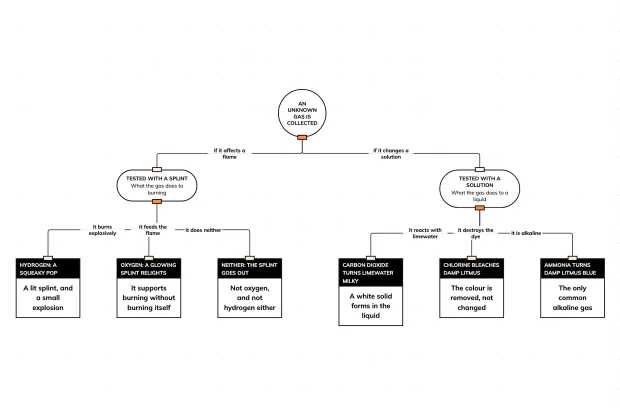
A gas is identified either by what it does to a burning splint — hydrogen pops, oxygen relights a glowing one, and most gases put it out — or by what it does to a solution, with carbon dioxide turning limewater milky, chlorine bleaching damp litmus and ammonia turning it blue.
CodePLU Goal
Upgrading Human Mental Models
Learn how to think in Workflows

Concept Development By codeplu.com
The third box in the left column is not a failure. It is the result that sends you to the right-hand column, and it is the one you get most often.
Identifying Something You Cannot See
Most of the common gases are colourless, and almost all of them look identical in a test tube: nothing to see, nothing to measure with a ruler, no obvious handle at all. The only way to tell them apart is to give each one something to react with and watch what happens.
Six tests cover the gases met at this level, and they fall into two groups. The first group uses a wooden splint and asks what the gas does to a flame — whether it burns, feeds a flame, or smothers one. The second uses a liquid, and asks what the gas does when it dissolves.
Each of these is usually taught as a pairing to be memorised: hydrogen goes with squeaky pop, carbon dioxide goes with limewater. That works for an exam and leaves you with nothing if a test gives an unexpected result, because a memorised pairing cannot be reasoned with. Every one of them is a reaction that has already been met elsewhere in this subject.
It is also worth noticing which result is most common. Most gases are not hydrogen and not oxygen, so most of the time the splint simply goes out — and that is a genuine result rather than a failed test. It rules out two possibilities at once and tells you to reach for a solution instead.
Why Each Test Works
Why does hydrogen pop?
Because it burns, and it burns extremely fast when it is already mixed with air. Hydrogen on its own in a tube does nothing until a flame reaches it, and then it reacts with the oxygen that has mixed in at the mouth of the tube, producing water. The reaction is quick enough that the gas expands abruptly rather than burning steadily, and the sharp sound is that expansion. A tube of pure hydrogen with no air in it burns quietly at the mouth with a pale flame instead, which is worth knowing because the pop depends on the mixing rather than on hydrogen doing anything unusual. The test is really about how quickly the two gases find each other.
Why does oxygen relight a glowing splint?
Because oxygen supports burning without burning itself, and a splint that has just gone out is still hot enough to restart if the supply improves. The rates track explains why the concentration matters: ordinary air is about a fifth oxygen, and a tube of pure oxygen is five times richer, so collisions between the fuel and oxygen are five times more frequent. A reaction that was dying for want of a reactant suddenly has plenty. This is the only common test where the gas is not consumed as the thing being observed — it is the fuel in the splint that burns. The gas is detected by what it enables rather than by what it undergoes.
Why does limewater turn milky?
Because a white solid forms and is not soluble, so it stays suspended as a cloudiness. Limewater is a solution of calcium hydroxide, which is an alkali, and carbon dioxide dissolves in water to give a weakly acidic solution — so this is a neutralisation of exactly the kind the acids track described. The salt produced is calcium carbonate, which is chalk, and chalk does not dissolve. The milkiness is therefore a precipitate rather than a colour change, and if you keep bubbling gas through for long enough it clears again as the excess acid dissolves the carbonate back off. Reading it at the right moment matters as much as running it.
Why do chlorine and ammonia act on litmus differently?
Because one destroys the dye and the other merely changes its colour, and the difference is visible. Ammonia dissolves to give an alkaline solution, so damp red litmus turns blue — a normal indicator response that would reverse if acid were added. Chlorine does something more drastic: it is a strong oxidising agent and it attacks the dye molecule itself, removing the colour permanently and leaving the paper white rather than any colour at all. Bleaching and changing colour look similar for a second and are different events, and the paper staying white is how you tell. One response is reversible and the other destroys the indicator for good, so a second test on the same strip tells you which happened.
Real World Example
Working Through an Unknown
A sensible order of tests rules out the most possibilities per test, rather than guessing at a likely answer first.
Step 1
Start with a lit splint, because it splits the field
A lit splint answers two questions at once. If it pops, the gas is hydrogen and you are finished. If the flame goes out, the gas is neither hydrogen nor oxygen, which removes two of the common candidates in a single action. That is why it is the right first test even though it identifies only one gas: the value of a test is how much it narrows the field, not how often it gives a positive, and a negative result that eliminates two options is worth more than a positive that confirms one. Elimination is the cheaper currency.
Step 2
A glowing splint separates oxygen from the rest
If the lit splint went out, relight a splint and blow it out so it is glowing rather than burning, then lower it in. Oxygen will restart it immediately and nothing else at this level will. The reason for using a glowing splint rather than a flame is practical: a burning splint would simply carry on burning in air, so it tells you nothing, while one that is barely alive responds visibly to a richer supply. The test is designed around making the change easy to see. Every good test is built around making one change unmistakable.
Step 3
Then go to the solutions
With hydrogen and oxygen eliminated, bubble the gas through limewater — milky means carbon dioxide. If nothing happens, hold damp litmus in it: blue means ammonia, bleached white means chlorine. By this point each test is answering a single question, which is exactly what you want once the field has been narrowed. Smell is deliberately not on the list; chlorine and ammonia are both harmful to inhale and the laboratory rule is that you never identify a gas by breathing it. The eyes do all of this work, from a safe distance. Nothing in this list requires getting close to the tube.
FAQs
Final Words
Colourless gases cannot be told apart by looking, so each test gives the gas something to react with and reads the result. A lit splint is the right place to start, not because it identifies the most gases but because it rules out the most: a pop means hydrogen, and a flame going out eliminates both hydrogen and oxygen in one action.
Each of the six is an ordinary reaction rather than an arbitrary pairing. Hydrogen pops because it burns fast in the air mixed at the mouth of the tube. Oxygen relights a glowing splint because five times the concentration means five times the collisions. Limewater goes milky because an acidic gas neutralises an alkali and the salt is insoluble chalk. Ammonia turns litmus blue as any alkali would, while chlorine destroys the dye and leaves the paper white.
The next tutorial moves to mixtures, where the question is not what something is but how many things are in it.
Continue This Track
This concept is part 2 of Finding Out What Something Is.
Why Does a Flame Test Have a Colour?
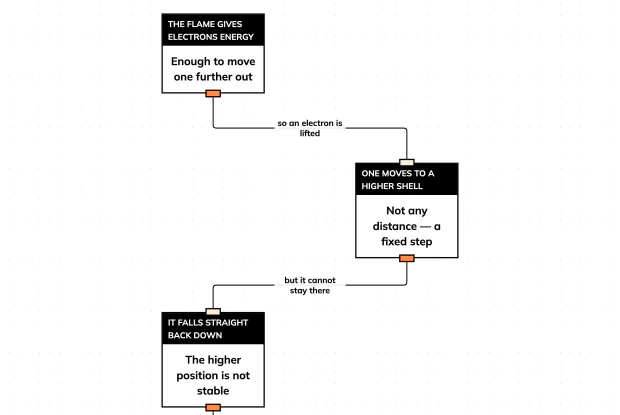
Lithium burns red and potassium lilac, and the reason is the same thing that makes the periodic table work. Follow the argument in an interactive playground.
How Do You Test for a Gas? Six Standard Tests
A colourless gas in a tube could be almost anything. Sort the standard tests by what they actually do, and see why each one works, in an interactive playground.
How Does Chromatography Separate a Mixture?
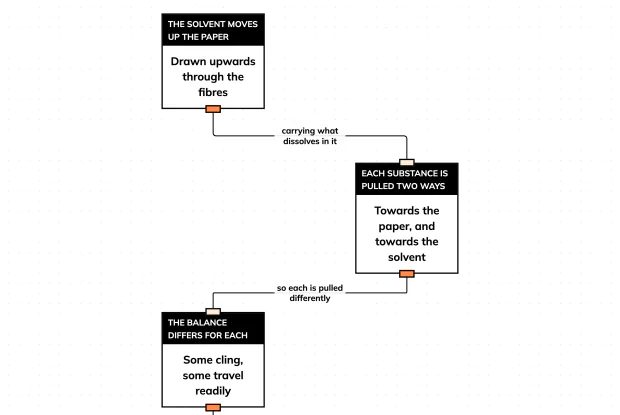
A black ink spot climbs a strip of paper and comes apart into several colours. Follow why each one stops where it does, in an interactive playground.
How Do You Identify an Ion in Solution?
A clear solution could contain almost any pair of ions. Follow the order of tests that narrows it down — and find out why the order matters — in an interactive playground.
Why Do Instruments Beat a Test Tube?
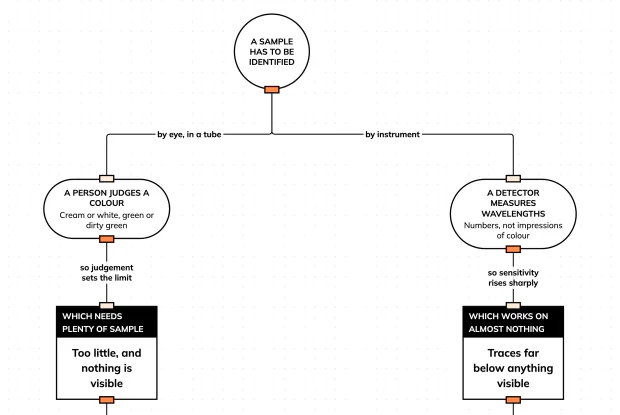
Every test in this track is still used, and none of them is how a real laboratory works. Compare the two approaches on what each can actually do, in an interactive playground.