Why Does a Cell in Pure Water Burst but a Plant Cell Does Not?
Root Concept
Osmosis decides which way water moves; the presence or absence of a cell wall decides what happens to the cell.
CodePLU Goal
Upgrading Human Mental Models
Learn how to think in Workflows

Concept Development By codeplu.com
The solution outside sets the direction. The wall, or the lack of one, sets the consequence.
The Same Move, Two Different Consequences
The last tutorial put a membrane in a glass container and watched the water level climb. A living cell is that experiment with the membrane wrapped into a bag — a concentrated inside, a partially permeable boundary, and whatever solution happens to be outside.
Which way the water moves is settled entirely by the solution outside, and it is the same rule for every cell alive. Surround a cell with something more dilute than its own contents and water moves in. Surround it with something more concentrated and water moves out. Nothing about the kind of cell changes that direction.
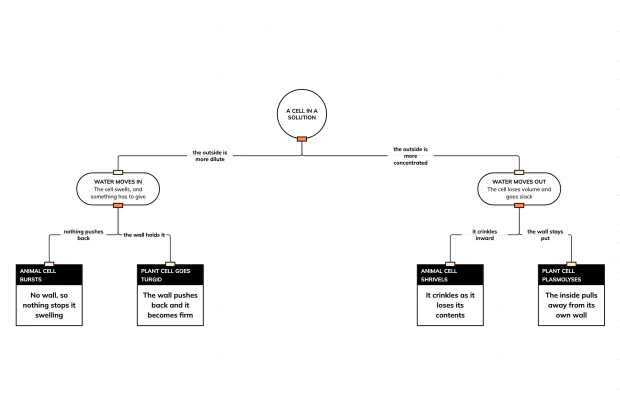
What does change, and change dramatically, is what happens next. An animal cell has nothing but its membrane, so water arriving simply makes it bigger until it fails. A plant cell has a rigid wall outside that membrane, and the wall pushes back — which is what turns an inconvenience into the mechanism that holds a plant upright. Four outcomes, two in each direction, and the playground below asks you to sort them.
Direction, Then Consequence
What decides which way the water goes?
Only the comparison between inside and outside. A cell's contents are a fairly concentrated solution of salts, sugars and proteins, so pure water is always more dilute than the inside of a cell and water will always move in. A strong salt or sugar solution is more concentrated than the inside, so water moves out. In between there is a solution of exactly matching concentration, where water crosses equally both ways and nothing changes — the word for that is isotonic, and it is why a saline drip is made up to match the concentration of blood rather than being pure water. Getting that wrong would destroy the very cells it was meant to help.
Why does an animal cell burst?
Because nothing stops it swelling. Water arrives, the cell expands, and the membrane is a flexible sheet with no strength to resist stretching. Past a certain point it tears and the contents escape. For a red blood cell this has its own name, haemolysis, and it is easy to see under a microscope as the cells vanish into a clear solution. The reverse happens in a concentrated solution: water leaves, the cell loses volume and its surface crinkles into a spiky shape. Neither outcome is recoverable, which is why animals must keep the fluid around their cells at a carefully controlled concentration. A red blood cell has no way to defend itself against either extreme.
Why does a plant cell not burst?
The cell wall takes the strain. Water moves in exactly as it would for an animal cell and the contents swell, but the wall is rigid and will not stretch much, so pressure builds inside instead. That pressure pushes the membrane hard against the wall and the cell becomes firm — turgid — and stops taking in more water once the push balances the pull. Far from being a problem, this is the mechanism that holds a plant up, as the wilting example in an earlier track showed. A plant in pure water is in its best possible state, which is the exact opposite of an animal cell in the same beaker.
What happens to a plant cell in strong salt solution?
Water leaves, the contents shrink, and because the wall cannot shrink with them the membrane peels away from it. The cell is then described as plasmolysed, and the gap between the shrunken contents and the wall is clearly visible down a microscope — it is the standard practical for this topic, usually done with red onion epidermis because the pigment makes the retreating contents easy to see. Mild plasmolysis reverses if the cell is returned to water. Severe or prolonged plasmolysis does not, which is why over-fertilised soil can kill a plant by drawing water out of its roots. The practical is also the clearest proof that a plant cell wall and its membrane really are two separate layers, because the gap that opens is the space between them.
Real World Example
What a Potato Chip Tells You
Cut identical chips of raw potato, soak them in solutions of different strength, and weigh them afterwards. The change in mass is a direct measurement of which way water went.
Step 1
In pure water, the chip gains
Potato cells hold a concentrated solution of sugars and salts, so pure water is the more dilute side and water moves into the cells. Each cell becomes turgid, pressing against its wall, and the chip gains mass and becomes noticeably stiffer — a chip that was floppy when cut will stand up on its own after an hour. That stiffness is thousands of individual cells each pushing outwards against its own wall, which is the same effect that holds a whole plant upright, scaled down to something you can hold between two fingers. The gain in mass is small but easily measured on a kitchen balance.
Step 2
In strong sugar solution, it loses
Now the outside is more concentrated than the cell contents, so water moves out. The chip loses mass and goes limp, because each cell has lost the pressure that was holding it firm. Leave it long enough and the cells plasmolyse, their contents pulling clear of the walls. The chip is not dead in any dramatic sense and will recover a good deal of its firmness in fresh water, which is a neat demonstration that nothing has been destroyed — the water has simply been somewhere else for a while. Recovery is never quite complete, which is a hint that some cells went too far.
Step 3
Somewhere in between, nothing happens
Between those two is a concentration at which the chip neither gains nor loses mass, and finding it is the point of the experiment. At that concentration the solution outside matches the cell contents, water crosses equally both ways, and the net movement is zero — the same dynamic balance that diffusion and osmosis both end in. Plotting mass change against concentration and reading off where the line crosses zero gives a real measurement of how concentrated the inside of a potato cell is, without ever opening one or needing any equipment beyond a balance.
FAQs
Final Words
Which way water moves across a cell membrane is decided by one comparison only: is the solution outside more dilute or more concentrated than the contents inside? More dilute and water moves in; more concentrated and it moves out. That rule is identical for every cell that exists.
What differs is the consequence, and the whole difference is the cell wall. An animal cell swells until it bursts or shrivels until it crinkles, with no recovery either way. A plant cell swells until its wall pushes back and becomes firm, or loses water until its membrane peels away from a wall that stays where it is. Both of those are routine rather than fatal. The last tutorial in this track asks what happens when a cell needs something moved the wrong way up the gradient — which is the one case where none of this works.
Continue This Track
This concept is part 3 of What Gets In and Out of a Cell.
What Is Diffusion, and Why Does It Stop?
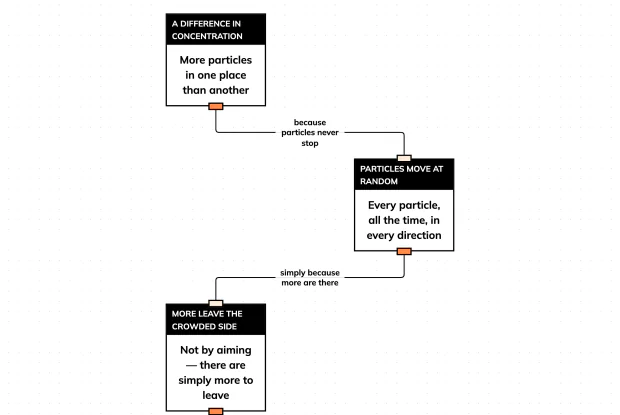
Diffusion is the net movement of particles from where they are crowded to where they are not, caused by nothing but random motion. Follow the five stages in an interactive playground, including the one most people get wrong.
What Is Osmosis, and Why Does It Only Move Water?
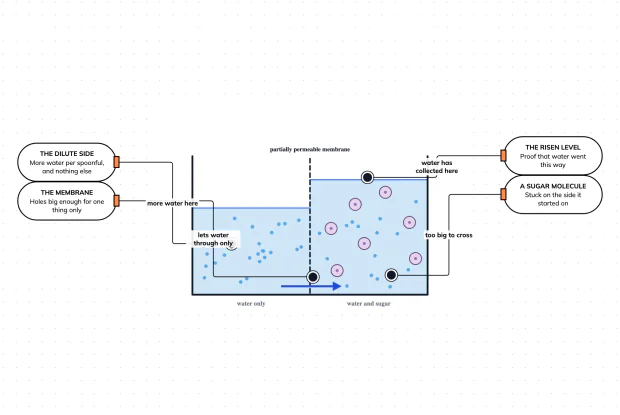
Osmosis is the diffusion of water across a membrane that the dissolved substance cannot cross. Water moves towards the more concentrated side. Label the classic demonstration in an interactive playground.
Why Does a Cell in Pure Water Burst but a Plant Cell Does Not?
Put a cell in pure water and water moves in; put it in a strong solution and water moves out. What happens next depends entirely on whether there is a cell wall. Sort four outcomes in an interactive playground.
When Does a Cell Have to Spend Energy to Move Something?
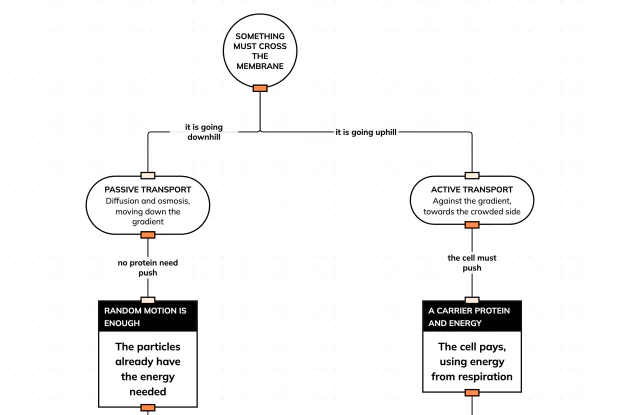
Diffusion and osmosis move substances down a gradient for nothing. Moving something the other way needs a carrier protein and energy from respiration. Compare the two routes in an interactive playground.