What Is Osmosis, and Why Does It Only Move Water?
Root Concept
Osmosis is the diffusion of water across a partially permeable membrane, from the dilute side to the concentrated one.
CodePLU Goal
Upgrading Human Mental Models
Learn how to think in Workflows

Concept Development By codeplu.com
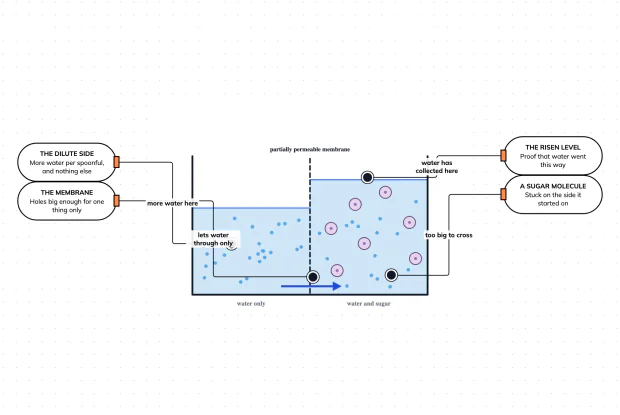
The sugar cannot move, so only the water can. The risen level is the evidence of which way it went.
What Happens When Only One Thing Can Move
Diffusion spreads everything out until the differences are gone. That is what happens when both substances in a mixture are free to wander. Osmosis is what happens when one of them is not.
Put a membrane between two liquids, with holes large enough for water molecules and too small for anything dissolved in it. Now the sugar on one side is trapped: it cannot spread out to even up the concentrations, however much its own diffusion "wants" to. The only particle that can do any evening up is the water, so the water does all of it, and the whole result follows from that single restriction.
The direction catches people out every time, so it is worth stating bluntly before the explanation: water moves towards the more concentrated side. Towards the sugar, not away from it. The container in the playground below has sugar on the right only, and the water level on the right has risen — that risen level is the evidence, and it is the whole demonstration in one picture.
One Restriction, and Everything That Follows
What makes a membrane partially permeable?
Holes of a particular size, or more precisely a barrier that passes some things and refuses others. Water molecules are tiny and cross freely; a sugar molecule is far bigger and does not fit. The same idea was met in the last track as selective permeability, and a living cell membrane behaves this way for its own reasons. In the laboratory the usual stand-in is visking tubing, a plastic film with holes in that size range, and the phrase you will meet in exams is partially permeable — older books say semi-permeable, meaning the same thing. Without this one restriction there is no osmosis, only ordinary diffusion. The holes are not neat round channels either; the barrier is a mesh, and size is what decides.
Why does water move towards the sugar?
Because the dilute side has more water per spoonful than the concentrated side does. That sentence is the whole explanation and it is worth reading twice. On the sugary side, some of the volume is taken up by sugar, so there is less water packed into the same space. Water therefore has its own concentration gradient, running from the dilute side to the concentrated one — and water simply diffuses down it, exactly as the last tutorial described. Nothing new is happening. Osmosis is water doing ordinary diffusion in the only direction left open to it, because the sugar cannot come the other way to meet it. Saying water moves "towards the sugar" is a shortcut for saying it moves away from where water is crowded.
Why does the level rise, and when does it stop?
Water arriving on the sugary side has to go somewhere, so that side gains volume and its surface climbs. The risen level is not a side effect — it is the measurement, and the classic school experiment is built entirely around watching it. It does not rise forever. As the column grows its weight pushes back, and when that pressure exactly balances the tendency of water to keep arriving, the level settles. As with diffusion, settling does not mean stopping: water continues to cross both ways, and the two flows have simply become equal. In a cell the balancing push comes from a wall, or from the cell bursting instead, which is what the next tutorial is about.
Is osmosis just diffusion with another name?
Very nearly, and saying so is a good way to understand it — but the distinction is worth keeping because the answer to a question depends on it. Osmosis is the diffusion of water specifically, across a membrane that the solute cannot cross. Drop the word water and the definition is wrong; drop the membrane and there is no reason for the water to end up anywhere in particular. Examiners mark both parts. The useful consequence is that everything true of diffusion is true here: it costs no energy, it is faster when the difference is bigger, and it reaches a balance rather than an end. Learning osmosis as a special case rather than a new rule is also far less to remember.
Real World Example
Why Salt Preserves Food
Salting and sugaring kept food edible for thousands of years before refrigeration, and the reason is osmosis acting on the cells of whatever is trying to spoil it.
Step 1
Salt makes the outside concentrated
Pack meat or fish in salt and the surface liquid becomes an extremely concentrated solution — far more concentrated than the inside of any bacterial or fungal cell sitting in it. Those cells have partially permeable membranes, so they are in exactly the situation the playground shows, except that they are the dilute side. The salt cannot get in through the membrane, which means the only thing that can move to even up the difference is water, and the water is on the inside. The microbes are, in effect, standing in the playground's left-hand compartment.
Step 2
Water leaves the microbes
Water diffuses out of the bacterial cells towards the concentrated salt, and they lose so much of it that their contents can no longer work. A cell needs water as the medium for every reaction inside it, so a cell that has been drained is not killed by poisoning but simply stopped. The food is not sterile — many of the microbes are still there — but they cannot grow, and growth is what spoils food. The same logic is why honey and jam keep: sugar does the job instead of salt. Drying works the same way by removing the water directly rather than drawing it out.
Step 3
The food loses water too
The meat's own cells are in the same bath and lose water by the same route, which is why salted fish and cured ham end up firm and dry rather than merely salty. That texture change is the visible proof that osmosis has been at work on everything present, not only on the microbes. Soaking cured food in fresh water before cooking reverses part of it, because the gradient now runs the other way and water moves back in. That the process reverses so readily is itself evidence that nothing was destroyed, only moved. Osmosis has no preferred direction of its own; it follows whichever gradient exists.
FAQs
Final Words
Osmosis is diffusion with one thing held back. Water crosses a partially permeable membrane freely, the dissolved substance cannot, and so water does all the evening up on its own. It moves from the dilute side to the concentrated one — towards the sugar, which is the direction people most often get backwards — because the dilute side is where the water is most crowded.
Everything true of diffusion stays true: it costs nothing, it is faster when the difference is bigger, and it ends in a balance rather than a halt. What makes it worth its own name is that a cell is exactly this situation, with a partially permeable membrane and a concentrated inside. The next tutorial puts real cells into water and into salt solution, and the two kinds behave very differently.
Continue This Track
This concept is part 2 of What Gets In and Out of a Cell.
What Is Diffusion, and Why Does It Stop?
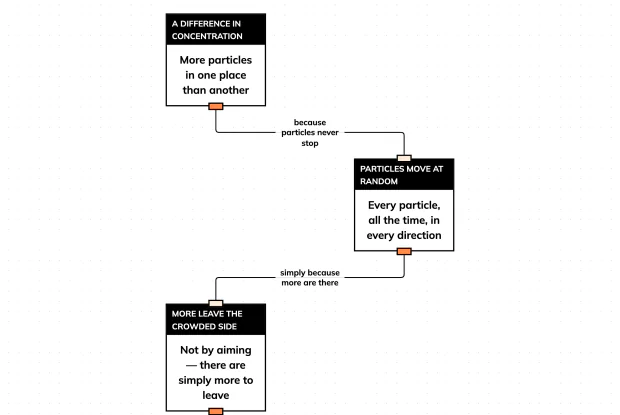
Diffusion is the net movement of particles from where they are crowded to where they are not, caused by nothing but random motion. Follow the five stages in an interactive playground, including the one most people get wrong.
What Is Osmosis, and Why Does It Only Move Water?
Osmosis is the diffusion of water across a membrane that the dissolved substance cannot cross. Water moves towards the more concentrated side. Label the classic demonstration in an interactive playground.
Why Does a Cell in Pure Water Burst but a Plant Cell Does Not?
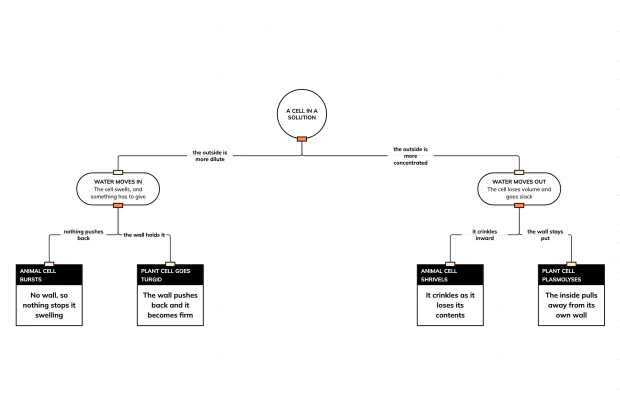
Put a cell in pure water and water moves in; put it in a strong solution and water moves out. What happens next depends entirely on whether there is a cell wall. Sort four outcomes in an interactive playground.
When Does a Cell Have to Spend Energy to Move Something?
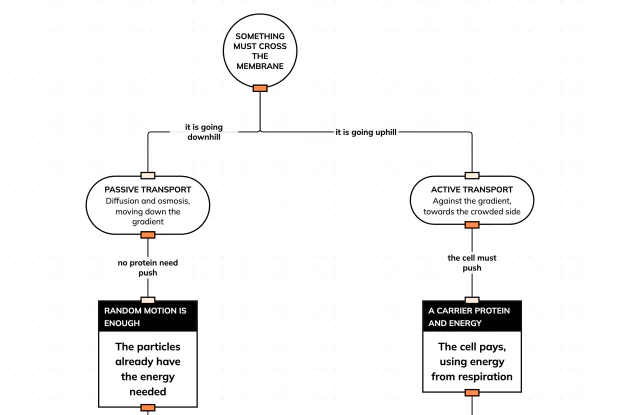
Diffusion and osmosis move substances down a gradient for nothing. Moving something the other way needs a carrier protein and energy from respiration. Compare the two routes in an interactive playground.