When Does a Cell Have to Spend Energy to Move Something?
Root Concept
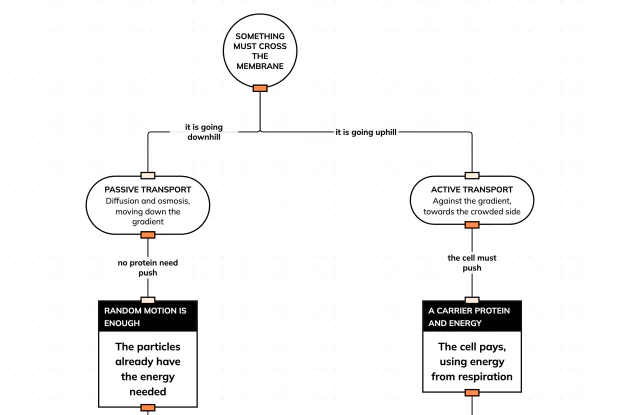
Active transport moves a substance against its concentration gradient, which requires a carrier protein and energy from respiration.
CodePLU Goal
Upgrading Human Mental Models
Learn how to think in Workflows

Concept Development By codeplu.com
Downhill movement needs nothing. Uphill movement needs a protein and a supply of energy, and only then can a cell build a difference.
Why Free Movement Is Not Enough
Everything in this track so far has been free. Diffusion and osmosis both run on the random motion particles already have, cost the cell nothing, and happen just as well in dead tissue as in living. They are described as passive for exactly that reason.
There is a catch, and it is a serious one. Passive movement can only ever flatten a difference. It runs downhill, from crowded to empty, and stops when the two sides match. A cell that relied on it alone could never end up holding more of anything than its surroundings do — and cells need to do precisely that all the time. A root hair takes up minerals from soil where they are far more dilute than inside the root. Your gut absorbs the last of the glucose from food when there is already more glucose in your blood.
Doing that means moving a substance uphill, against its own gradient, and nothing in nature does that for free. The cell has to pay, in energy from respiration, and it needs a protein in the membrane to do the pushing. That is active transport, and the playground below sets it beside the passive route so the fork between them is clear.
Uphill, and What It Costs
What exactly does "against the gradient" mean?
It means moving a substance towards the side where there is already more of it. Diffusion carries particles from crowded to empty because more happen to wander that way; going the other direction means working against that statistical tendency, and it will not happen by itself any more than water flows uphill. The comparison is worth taking literally. Water running downhill needs nothing; getting it back up needs a pump and a power supply. A cell is in the same position, and the pump is a protein in its membrane while the power comes from respiration. That is why active transport stops the moment respiration does, and passive movement does not.
How does a carrier protein actually do it?
By changing shape. A carrier protein has a binding site shaped for one particular substance; the substance attaches on one side of the membrane, the protein changes shape using energy the cell supplies, and the substance is released on the other side. Then the protein returns to its original shape and the cycle repeats. Two consequences follow from the binding site. First, active transport is specific — a carrier built for one mineral will not move another, so a cell controls exactly what it takes up. Second, the number of carriers sets a ceiling: once every carrier is working flat out, supplying more of the substance outside makes no further difference.
Where does the energy come from?
From respiration, which the first track in this subject placed in the mitochondria. This makes a prediction that is easy to test and is a standard exam question: cells that do a lot of active transport should contain unusually many mitochondria, and they do. The cells lining your small intestine and the root hair cells of a plant are both packed with them. It also predicts that anything stopping respiration should stop active transport while leaving diffusion untouched, which is exactly what happens — a root deprived of oxygen takes up water perfectly well and stops taking up minerals. That single observation separates the two kinds of transport more cleanly than any definition does.
Why does the cell bother?
Because passive movement cannot build anything. It can only remove a difference, and living things depend on holding differences that the surroundings are constantly trying to even out. Active transport is what lets a root concentrate nitrate from dilute soil, lets your gut strip the last glucose out of food rather than leaving it behind, and lets a nerve cell maintain the sodium imbalance it later spends to send a signal. Every one of those is a cell deliberately moving something the wrong way and paying for the privilege, and none of them would be possible with diffusion alone. Being alive, chemically speaking, largely means holding differences that would otherwise disappear.
Real World Example
How a Root Hair Collects Minerals
A root hair is a single cell drawn out into a long thin projection, and it is doing two completely different jobs through the same membrane at the same time.
Step 1
Water comes in for free
The inside of a root hair cell is a far more concentrated solution than the water held between soil particles, so water moves in by osmosis without the plant spending anything at all. The long thin shape of the hair is there to make this as fast as possible: it gives an enormous surface area for the volume of the cell, and surface area is one of the factors that sets the rate of any passive movement. A plant grows thousands of these hairs for that reason alone, and replaces them constantly as they are worn away by the soil.
Step 2
Minerals have to be pulled in
Nitrate and other minerals are the opposite case. Soil water holds them very dilutely, far more dilutely than the root cell already contains, so diffusion would carry them out of the root rather than in. The plant moves them inwards anyway, against the gradient, using carrier proteins in the root hair membrane and energy from respiration. This is why root hair cells are packed with mitochondria, and why a plant needs oxygen at its roots even though it makes oxygen in its leaves. The leaves cannot supply the roots quickly enough, so the roots take theirs from air held between soil particles.
Step 3
Waterlogged soil kills by suffocation
A plant in flooded ground has plenty of water and often dies anyway, which looks paradoxical until the two mechanisms are separated. Standing water fills the air spaces in soil, so oxygen cannot reach the roots; respiration slows, the energy supply fails, and active transport stops. Water keeps arriving by osmosis because that was never the plant's to pay for, but mineral uptake ends. The plant starves in the middle of plenty, and the difference between a passive and an active process is the whole explanation, and it is why gardeners worry about drainage as much as about watering.
FAQs
Final Words
Passive movement is free and strictly one-directional: diffusion and osmosis run on the random motion particles already have, and they can only ever flatten a difference. That is enough for oxygen reaching a cell and water entering a root, and it is not enough for a cell that needs to hold more of something than its surroundings do.
Active transport is the answer, and it costs. A carrier protein binds the substance, changes shape and releases it on the far side, powered by energy from respiration — which is why cells that do a lot of it are crowded with mitochondria, and why it stops the moment oxygen runs out while osmosis carries on regardless. That closes this track: you can now say, for any substance crossing any membrane, which way it will go and whether the cell has to pay for it.
Continue This Track
This concept is part 4 of What Gets In and Out of a Cell.
What Is Diffusion, and Why Does It Stop?
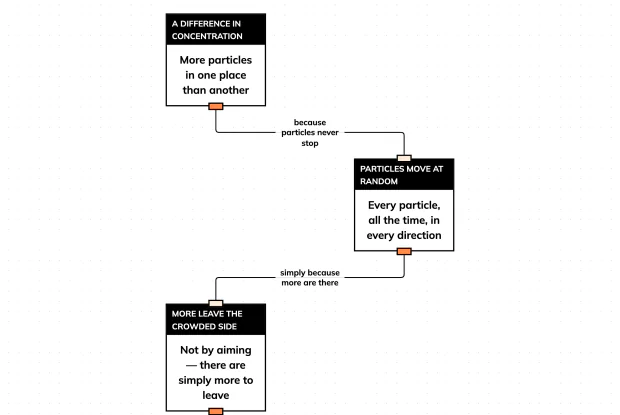
Diffusion is the net movement of particles from where they are crowded to where they are not, caused by nothing but random motion. Follow the five stages in an interactive playground, including the one most people get wrong.
What Is Osmosis, and Why Does It Only Move Water?
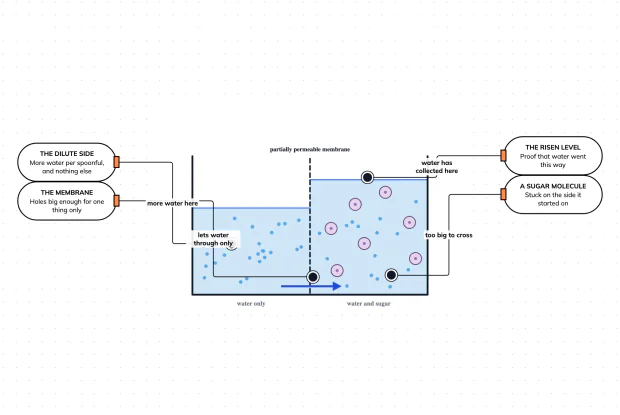
Osmosis is the diffusion of water across a membrane that the dissolved substance cannot cross. Water moves towards the more concentrated side. Label the classic demonstration in an interactive playground.
Why Does a Cell in Pure Water Burst but a Plant Cell Does Not?
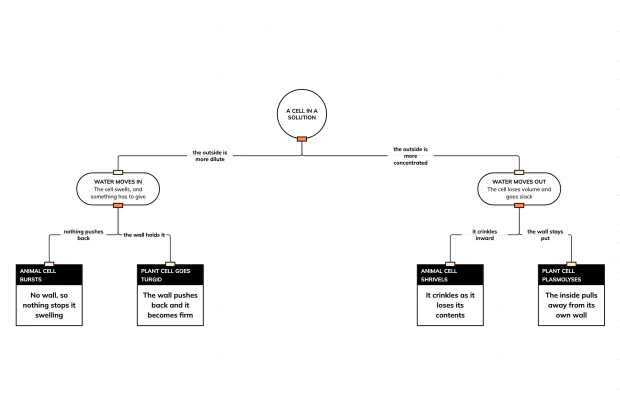
Put a cell in pure water and water moves in; put it in a strong solution and water moves out. What happens next depends entirely on whether there is a cell wall. Sort four outcomes in an interactive playground.
When Does a Cell Have to Spend Energy to Move Something?
Diffusion and osmosis move substances down a gradient for nothing. Moving something the other way needs a carrier protein and energy from respiration. Compare the two routes in an interactive playground.