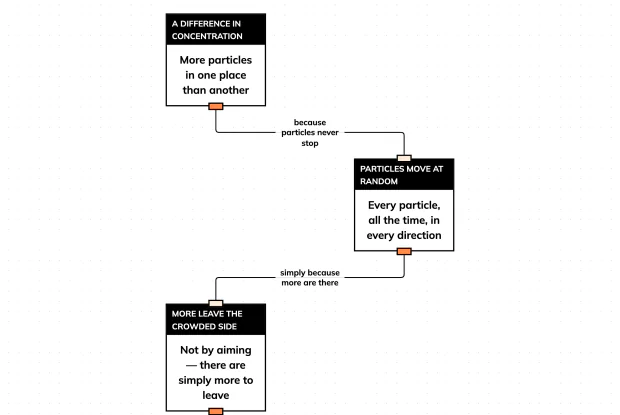
What Is Diffusion, and Why Does It Stop?
Root Concept
Diffusion is the net movement of particles from high to low concentration, produced entirely by random motion.
CodePLU Goal
Upgrading Human Mental Models
Learn how to think in Workflows

Concept Development By codeplu.com
Each stage follows from the one before. Nothing in the chain requires a particle to know where it is going.
A One-Way Result From Aimless Movement
The last track ended with a membrane that lets oxygen through and keeps starch out. It said oxygen crosses because there is more of it on one side than the other, and left that hanging. This track picks it up: why does a difference in amount make anything move at all?
The answer is diffusion, and it is strange enough to be worth slowing down for. Particles in a liquid or a gas are never still — they move constantly, in random directions, bouncing off one another. No particle has any idea where it is or where the crowded region is. There is no force pushing them apart and nothing is steering.
And yet the result is completely reliable: given a crowded region and an empty one, particles always end up spread evenly. This is one of the few places in school science where a definite, predictable outcome comes out of pure randomness, and understanding how is worth more than memorising the definition. The playground below sets out the five stages, and the one at the end is where most of the marks are lost.
Randomness, Direction, and the Stage Everyone Misses
What is actually moving, and why?
Every particle in a gas or a liquid, all the time, because they have energy. At any temperature above absolute zero the particles of a substance are in constant motion, colliding and rebounding in unpredictable directions. That motion is free in the sense that matters here: nothing has to supply it, which is why diffusion costs a cell no energy at all. A particle of oxygen in your lungs is not travelling towards your blood. It is jittering about, and the jittering is enough. This is the detail that makes diffusion a passive process, and it is the contrast the last tutorial of this track depends on. Nothing in the process cares whether the substance is useful to the cell or not.
Why does the net movement have a direction?
Because of counting, not intention. Imagine a boundary with a thousand particles on the left and ten on the right. Each particle wanders at random, so roughly half the particles near the boundary on either side will happen to cross it. Half of a thousand is a great many; half of ten is almost none. So far more cross from left to right than from right to left, and the crowded side empties — not because anything was pushed, but because there was more of it available to wander across. The word net matters here: particles go both ways throughout, and the difference between the two flows is what we observe.
What does it mean to say diffusion stops?
It means the net movement stops, and the movement itself does not. Once the particles are evenly spread, the same argument still applies: half of those near the boundary cross each way, but now there are equal numbers on both sides, so the two flows are equal and cancel. Nothing settles down and nothing comes to rest. The proper name for this balance is equilibrium, and it is dynamic rather than static. Writing "the particles stop moving" is the single commonest error in the topic, and it is worth being precise: what stops is the change, not the motion. A dye evenly spread through water is still being carried about in every direction; it simply has nowhere left to go that it is not already.
What makes diffusion faster or slower?
Four things, and they all follow from the explanation above. A bigger difference in concentration means a bigger imbalance between the two flows, so a faster net movement. A higher temperature means faster particles and more crossings per second. A larger surface area between the two regions gives more places to cross. And a shorter distance matters enormously, because diffusion is quick across a micrometre and hopelessly slow across a centimetre — random wandering covers ground very inefficiently. That last point is why cells are small and why lungs and intestines are folded into vast thin surfaces. Every one of those four factors is a way of increasing how many crossings happen per second, which is the only thing the rate ever depends on.
Real World Example
A Tea Bag in a Cup
Drop a tea bag into hot water and leave it completely alone. What happens next is diffusion at a scale you can see, including the part about why it is so slow.
Step 1
Colour leaves where it is most crowded
The moment the bag is wet, dissolved tea compounds are packed tightly inside it and entirely absent from the water around. Particles wander out through the paper in every direction, and because there are so many more inside than outside, far more cross outward than inward. A dark cloud spreads from the bag. Nothing is pushing the colour out and the bag is not squeezing: the imbalance in numbers is doing all the work, which is why the cloud forms even in perfectly still water. Hot water speeds the whole thing up, because faster particles cross the paper more often.
Step 2
Left alone, it takes a very long time
Without stirring, a cup takes many minutes to colour evenly, and that slowness is the most instructive part. Diffusion over a few centimetres is genuinely sluggish, because a randomly wandering particle makes very poor progress in any one direction — it covers ground roughly in proportion to the square root of the time rather than to the time itself. Doubling the distance therefore costs about four times the wait. This is exactly why a cell a hundred micrometres across would struggle to supply its own middle, and why nothing that relies on diffusion alone ever grows large.
Step 3
Stirring is not diffusion
A spoon colours the cup in seconds, but it has not sped diffusion up. Stirring carries whole regions of liquid bodily from one place to another, which is mixing, and it works by moving the water rather than the particles within it. Diffusion still does the final fraction of a millimetre everywhere the stirring leaves off. Your body uses both tricks for the same reason: blood circulation is the stirring that carries oxygen across the body, and diffusion does the last short step into each cell. Neither mechanism could do the other's job, and together they cover every distance scale in a body.
FAQs
Final Words
Diffusion is the net movement of particles from where they are crowded to where they are not, and the whole of it comes from random motion. No particle aims anywhere. The direction appears because a fraction of a large number is bigger than the same fraction of a small one, so more wander out of the crowded region than back into it.
When the spreading is finished the movement is not: particles keep crossing in both directions at equal rates, which is why it is the net change that stops rather than the motion. It costs a cell nothing, it is quick over tiny distances and hopeless over large ones. The next tutorial takes one particular substance — water — and shows why its diffusion is given a name of its own.
Continue This Track
This concept is part 1 of What Gets In and Out of a Cell.
What Is Diffusion, and Why Does It Stop?
Diffusion is the net movement of particles from where they are crowded to where they are not, caused by nothing but random motion. Follow the five stages in an interactive playground, including the one most people get wrong.
What Is Osmosis, and Why Does It Only Move Water?
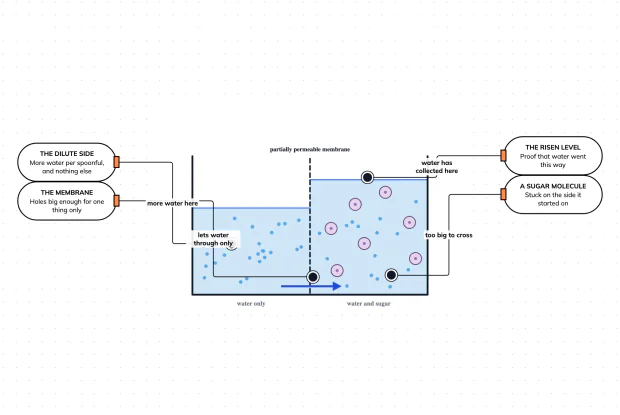
Osmosis is the diffusion of water across a membrane that the dissolved substance cannot cross. Water moves towards the more concentrated side. Label the classic demonstration in an interactive playground.
Why Does a Cell in Pure Water Burst but a Plant Cell Does Not?
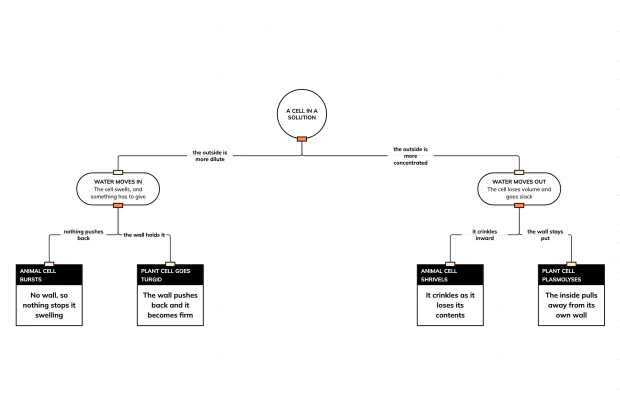
Put a cell in pure water and water moves in; put it in a strong solution and water moves out. What happens next depends entirely on whether there is a cell wall. Sort four outcomes in an interactive playground.
When Does a Cell Have to Spend Energy to Move Something?
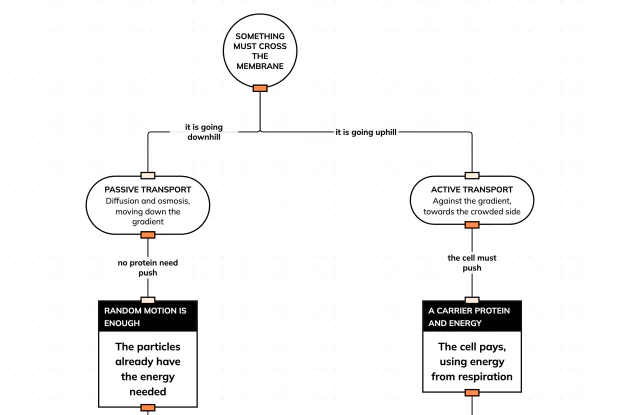
Diffusion and osmosis move substances down a gradient for nothing. Moving something the other way needs a carrier protein and energy from respiration. Compare the two routes in an interactive playground.