What Gets In and Out of a Cell
The last track ended with a membrane that admits some substances and refuses others. This one asks why anything crosses it at all, and the answer begins with movement that has no direction of its own. Particles in a liquid or gas never stop moving and never aim anywhere, yet a crowded region always empties into an empty one — not because anything is pushed, but because a fraction of a large number is bigger than the same fraction of a small one. That is diffusion, it costs a cell nothing, and the stage people miss is the last one: when the spreading finishes the movement does not, because equal flows in both directions cancel. Osmosis is the same process with one restriction added. Put a membrane between two solutions that water can cross and the dissolved substance cannot, and water does all the evening up by itself, moving towards the more concentrated side — the direction nearly everyone gets backwards at first. A living cell is exactly that arrangement, which is why a cell in pure water gains water and one in strong salt solution loses it. What happens next is decided by the cell wall: an animal cell swells until it bursts or shrivels until it crinkles, while a plant cell becomes firm against its wall or peels away from it, both of them recoverable. The track closes on the one case none of this covers. Passive movement can only ever flatten a difference, and cells must constantly build differences instead — concentrating minerals from dilute soil, stripping the last glucose out of food. Doing that means moving a substance against its own gradient, which needs a carrier protein and energy from respiration, and stops the moment respiration does.
CodePLU Goal
Upgrading Human Mental Models
Learn how to think in Workflows
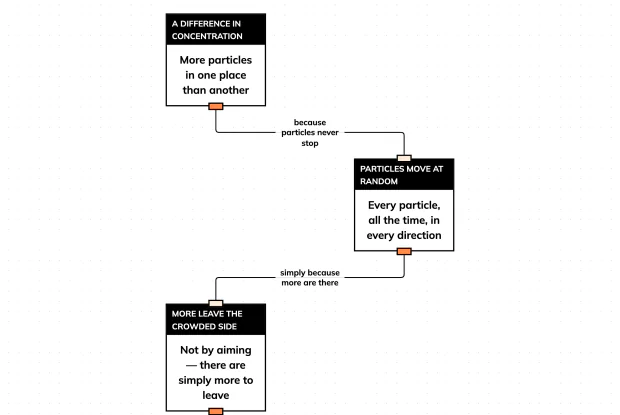
What Is Diffusion, and Why Does It Stop?
Diffusion is the net movement of particles from where they are crowded to where they are not, caused by nothing but random motion. Follow the five stages in an interactive playground, including the one most people get wrong.
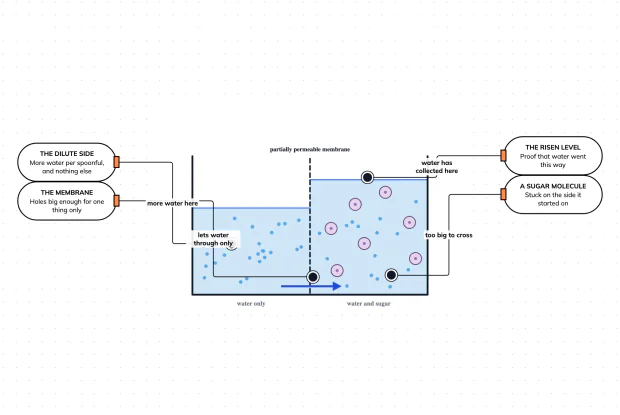
What Is Osmosis, and Why Does It Only Move Water?
Osmosis is the diffusion of water across a membrane that the dissolved substance cannot cross. Water moves towards the more concentrated side. Label the classic demonstration in an interactive playground.
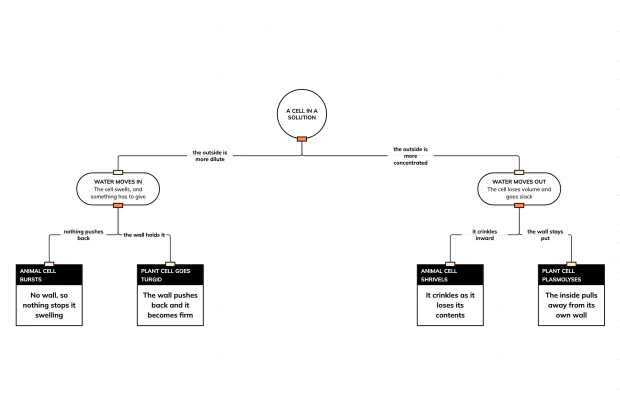
Why Does a Cell in Pure Water Burst but a Plant Cell Does Not?
Put a cell in pure water and water moves in; put it in a strong solution and water moves out. What happens next depends entirely on whether there is a cell wall. Sort four outcomes in an interactive playground.
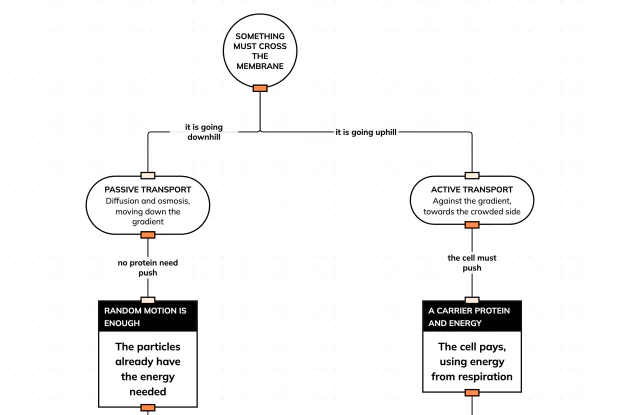
When Does a Cell Have to Spend Energy to Move Something?
Diffusion and osmosis move substances down a gradient for nothing. Moving something the other way needs a carrier protein and energy from respiration. Compare the two routes in an interactive playground.