Where Does Pi Come From?
Root Concept
π is the ratio of any circle's circumference to its diameter, and the ratio is the same for every circle.
CodePLU Goal
Upgrading Human Mental Models
Learn how to think in Workflows

Concept Development By codeplu.com
Round the rim divided by across the middle gives π every time, so dividing a measured rim by π recovers the width.
What Is π, Really?
The last tutorial used π as though it were a given. It is worth knowing where it actually comes from, because it is not a definition handed down or a formula someone chose. It is the result of a measurement, and anyone can take it.
Draw any circle, run a tape round the rim, then measure straight across through the centre, and divide the first by the second. The answer is a little over three. Do it again with a bigger circle and you get the same answer. Do it with a coin, a dinner plate and a wheel and you keep getting it. That number, about 3.14159, is π, and the fact that it does not change from circle to circle is the whole reason a single formula works for all of them.
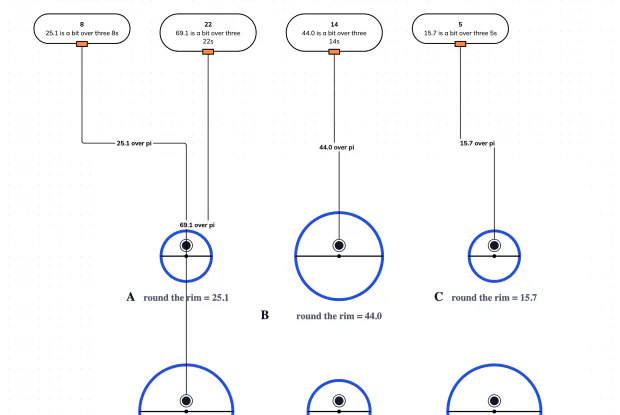
This tutorial practises the relationship in reverse, because that is where it earns its keep. Measuring round something is easy; measuring across it usually is not, since you have to guess where the middle is. Dividing a measured rim by π gives the width without ever having to find the centre.
Why the Ratio Is Always the Same
Why Does Every Circle Give the Same Answer?
Because all circles are the same shape. Any circle can be turned into any other simply by scaling it up or down, and scaling multiplies every length in a figure by the same factor. Double a circle's diameter and its circumference doubles too, so the ratio between them cannot change. This is the same reason all squares have a perimeter of four times their side, and all equilateral triangles three times theirs — for a family of shapes that are all scaled copies of one another, any ratio of two lengths is a constant. What makes π famous rather than ordinary is that the constant for circles is not a whole number, or a fraction, or anything that can be written down exactly.
How Accurately Can You Measure It?
By hand, to about two decimal places, which is enough to see that it is a bit over 3.1 and not enough to see much more. A tape round a dinner plate might give 94.2 cm and a ruler across it 30.0 cm, which divides to 3.14. That is a genuinely good result for a kitchen, and it is roughly how the value was first pinned down. Archimedes did better by a cleverer route: instead of measuring, he drew polygons inside and outside a circle and calculated their perimeters, which trap the circumference between two values he could work out exactly. With 96-sided polygons he showed π lies between 3.1408 and 3.1429, which is correct to three decimal places and needed no tape at all.
Why Can π Not Be Written Down Exactly?
Because it is irrational, which means it cannot be written as one whole number divided by another, and its decimal expansion never ends or repeats. The familiar 22/7 is a decent approximation and not the value: 22/7 is 3.142857 recurring, which goes wrong at the third decimal place. 3.14159 is closer and also not exact. This is why leaving π in an answer matters — writing 14π is exact while 43.98 is not, and there is no decimal you could write instead that would be. Proving π irrational took until 1761, more than two thousand years after people first started calculating with it, and the proof says nothing about how to compute the digits — only that no fraction will ever land on it exactly.
How Do You Use the Ratio Backwards?
Divide the circumference by π to get the diameter, then halve it if you want the radius. A tree trunk with a tape reading 220 cm round it has a diameter of 220 ÷ 3.14159, which is about 70 cm. This is how foresters, coopers and engineers work, because wrapping a tape round something is quick and reliable while finding its exact centre is neither. Some tapes are even printed with the division already done, so the scale reads diameter directly while the tape goes round the outside. The playground below is this diameter directly while the tape goes round the outside, so the user never divides anything. The playground below is that calculation repeated: each circle hands you the rim and asks for the width.
Real World Example
How Does a Forester Measure a Tree's Diameter?
The diameter is the number the trade works in, and it is the one measurement nobody can take directly on a standing tree.
The measurement you can take
220 cm round the trunk
A forester valuing standing timber needs the diameter of each trunk, because that is what decides how much usable board a tree will yield and therefore what it is worth. The diameter is also the one measurement that cannot be taken, since it runs through the middle of a solid tree. What can be taken, in a few seconds and with no judgement involved, is the distance round the trunk: a tape passed round at chest height reads 220 cm. That measurement is repeatable by anybody and does not depend on guessing where the centre is.
The division that follows
220 ÷ π ≈ 70 cm
Because the rim of any circle is π times its width, dividing the tape reading by π gives the width back: 220 ÷ 3.14159 is about 70 cm. No part of that calculation cares what kind of tree it is or how big it is, because the ratio is the same for every circle there has ever been. The one assumption being made is that the trunk's cross-section is roughly circular, which for most species is close enough for the purpose — and where it is not, foresters take two measurements at right angles and average them.
Doing it without the arithmetic
A tape marked in diameters
Foresters use a diameter tape, which is an ordinary tape measure with its scale stretched by a factor of π. Wrapped round a trunk it reads 70 where an ordinary tape would read 220, so the division has been built into the printing and never has to be done on site. It is a small thing, but it shows how completely the ratio is trusted: an entire industry sizes its raw material with an instrument whose only clever feature is that every centimetre on its raw material with an instrument whose only clever feature is that every centimetre printed on it is really π centimetres of tape, so the ratio does the arithmetic on the user's behalf.
FAQs
Final Words
π is a measurement rather than a rule: the distance round any circle divided by the distance across it. Every circle gives the same answer because every circle is a scaled copy of every other, and scaling cannot change a ratio. That the answer happens to be a number with no exact decimal or fractional form is what makes it worth a symbol of its own.
Used backwards, the ratio turns the easy measurement into the hard one, which is how tapes round tree trunks and pipes become diameters. The last tutorial in this track takes the circumference apart instead of the whole: how to find the length of just a slice of the rim.
Continue This Track
This concept is part 4 of Circles, Measured.
What Are the Radius and Diameter of a Circle?
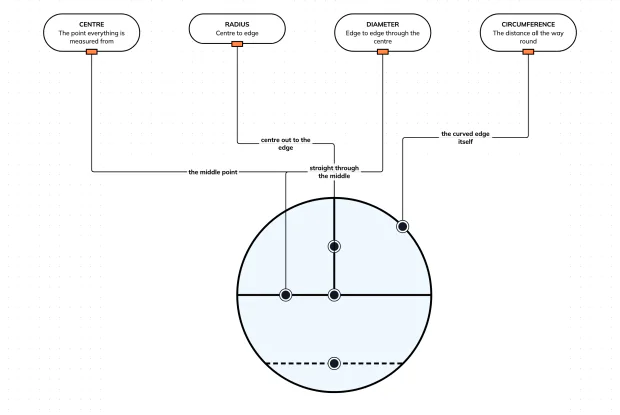
A circle has no sides to measure, so everything is measured from its centre instead. The radius reaches out to the edge, the diameter crosses the whole way through, and telling them apart is what every circle calculation depends on. Place each name on a real circle in an interactive playground.
What Are a Chord, an Arc, a Sector and a Segment?
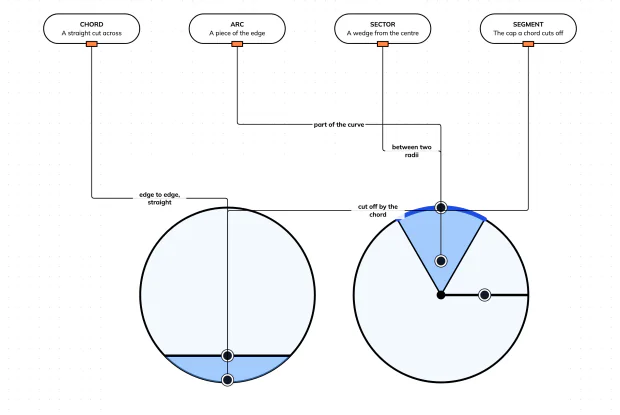
Once a circle has a centre and a radius, the rest of its vocabulary describes pieces: a straight cut across it, a stretch of its edge, a wedge from the middle and the cap left over. Place all four on real circles in an interactive playground.
What Is the Circumference of a Circle?
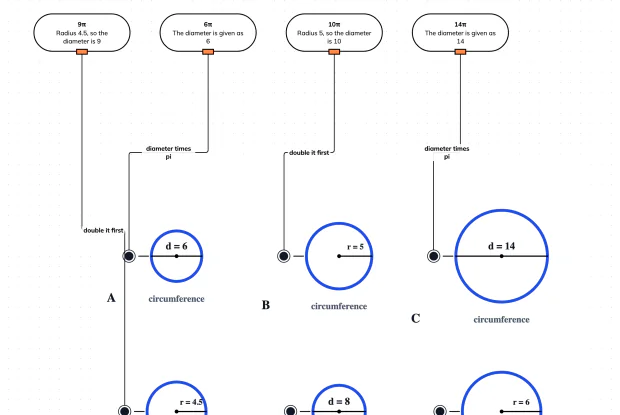
The circumference is the distance all the way round a circle, and it is always π times the diameter — a little over three diameters, whatever the size. The only decision is whether you were given the diameter or the radius. Practise both in an interactive playground.
Where Does Pi Come From?
π is not a rule someone invented; it is what you get when you measure round a circle and across it and divide. Every circle gives the same answer, which is why one number works for all of them. Use it in reverse to find a circle's width in an interactive playground.
How Long Is an Arc?
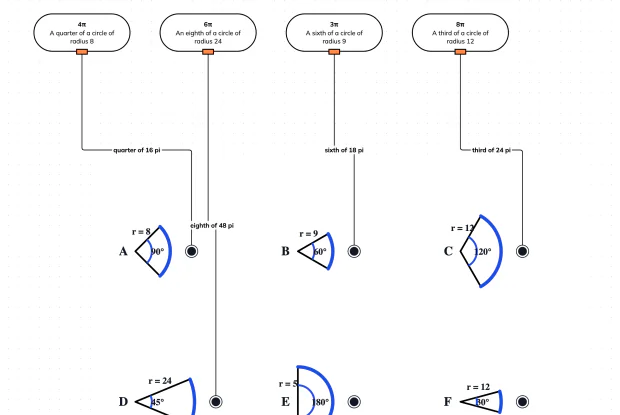
An arc is part of a circle's rim, and its length is that same fraction of the whole circumference. Find the fraction from the angle at the centre, then apply it — two steps, no new formula to learn. Practise on six sectors in an interactive playground.