What Is the Circumference of a Circle?
Root Concept
The circumference is π diameters, so C = πd and, since d = 2r, C = 2πr.
CodePLU Goal
Upgrading Human Mental Models
Learn how to think in Workflows

Concept Development By codeplu.com
Check what you were given before calculating. A radius must be doubled to reach the diameter the formula asks for.
How Do You Measure Round a Curve?
A circle has no straight sides, so the perimeter work from earlier in this chapter does not apply — you cannot add up the lengths of edges that do not exist. The distance round a circle gets its own name, the circumference, and its own way of being found.
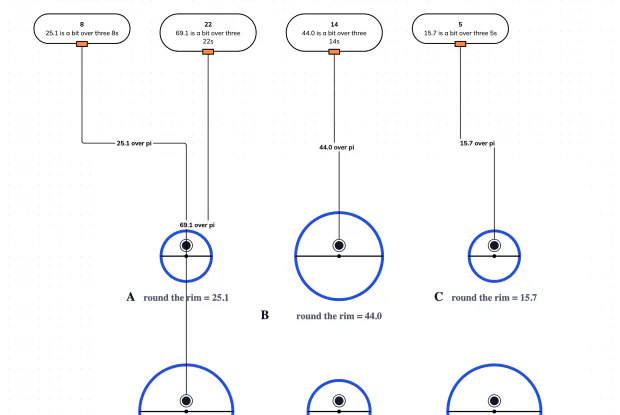
It turns out to depend on nothing but the width of the circle. Whatever size a circle is, the distance round it is always the same multiple of the distance across it, and that multiple is the number called π, a little over three. So the circumference of any circle is π times its diameter: C = πd.
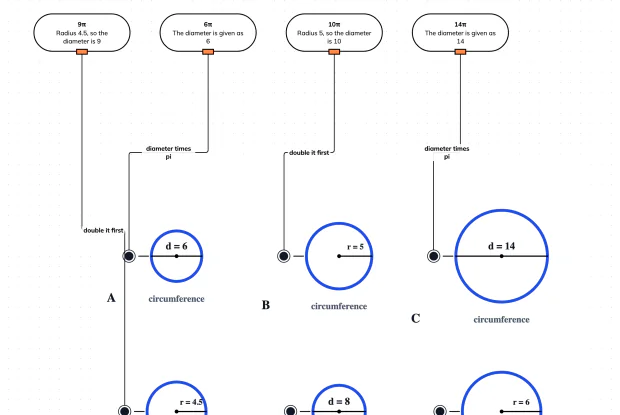
Because the radius is half the diameter, the same formula can be written C = 2πr, and both versions appear in textbooks. They are the same statement, and the only thing that matters in practice is noticing which measurement you have actually been given. The playground below mixes the two on purpose, because reaching for the wrong one is where nearly all the mistakes come from.
Using the Formula Properly
Which Version Should You Use?
Whichever matches what you were given, because they are the same formula. If the diameter is known, multiply it by π and you are finished: a diameter of 14 gives a circumference of 14π. If the radius is known, either double it first and use C = πd, or use C = 2πr directly — a radius of 5 gives 10π either way. The error worth guarding against is using the radius in the diameter formula, which halves the answer, and it is easy to make because the two words look alike in a hurry. Underline which one the question gives before you start. As a sanity check, the circumference should always come out a bit more than three times the width of the circle.
Should You Leave π in the Answer?
Usually yes, unless the question asks for a decimal. An answer of 14π is exact, while 43.98 is a rounded version of it, and rounding early then multiplying makes errors grow. Leaving π in is also easier: 14π needs no calculator at all. Questions that want a number will say so, often with a phrase like to one decimal place or take π as 3.14, and then you substitute at the very end rather than at the start. The exception is anything practical, where a length of fencing or a strip of edging has to be a real number — and there you round up rather than to the nearest value, because coming up short is worse than having offcuts.
How Do You Work Backwards?
Divide instead of multiplying. If a circle's circumference is 36π, then its diameter is 36 and its radius is 18. With a decimal circumference, divide by π: a circumference of 44 cm gives a diameter of 44 ÷ 3.14159, which is about 14 cm. This direction turns up more often in real life than the forwards one, because the distance round something is often the easy measurement to take. A tape round a tree trunk gives the circumference in seconds, while measuring its diameter means guessing where the centre is. Dividing by π turns the easy measurement into the one you actually wanted, which is why the backwards form is worth being as fluent with as the forwards one.
What About Part of a Circle?
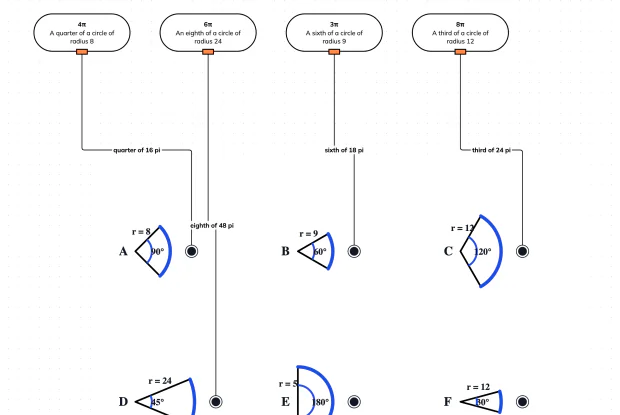
Take the same fraction of the circumference as the angle is of a full turn. A semicircular edge is half the circumference, a quarter circle is a quarter of it, and a 60° slice is a sixth. Be careful about what the question wants, though: the curved edge of a semicircle is half the circumference, but the perimeter of the semicircular shape also includes the straight diameter across the bottom. Forgetting that straight edge is the most common mistake in perimeter questions involving circles, and it is worth tracing round the shape with a finger to see every edge you are supposed to be adding up. The general version of this is the last tutorial in the track.
Real World Example
How Far Does a Bicycle Travel in One Turn of the Wheel?
Every complete turn of a wheel moves the bicycle forward by exactly the distance round its rim, which is what makes a cycle computer possible.
One turn, one rim
A 70 cm wheel
A bicycle wheel rolls along the road without slipping, so the length of rim that touches the ground during one complete revolution is laid out flat along the road. That means the bike moves forward by exactly one circumference for every turn of the wheel. A common wheel has a diameter of about 70 cm including the tyre, so one turn covers 70π centimetres, which is about 220 cm or 2.2 metres. Nothing about the rider, the gear or the speed changes this — it depends only on the size of the wheel, and a wheel of that size will always cover that distance per turn.
Counting the turns
A magnet and a sensor
A cycle computer works by counting revolutions. A small magnet on a spoke passes a sensor on the fork once per turn, and the computer multiplies the count by the circumference to get the distance travelled. That is why setting one up asks you to enter the wheel size: the electronics can count perfectly well but have no way of knowing how far each count is worth. Enter 70 cm when the wheel is really 66 cm and every distance the computer ever reports will be six per cent too high, in the same direction, for as long as it is used.
Why bigger wheels feel different
2.2 m against 1.6 m
The same reasoning explains why a child's bicycle needs so much more pedalling. A 50 cm wheel covers 50π, about 1.6 metres per revolution, against 2.2 metres for the adult wheel. To travel the same distance the smaller wheel must turn about a third more times, which is exactly what it feels like to ride one. It is also why penny-farthings had an enormous front wheel: with the pedals fixed directly to the hub, one turn of the legs covered one circumference, so a bigger wheel was the only way to go faster before gears were invented.
FAQs
Final Words
The circumference is the distance round a circle, and it is always π times the diameter. Written as C = πd or as C = 2πr, it is the same statement, and the only real decision is whether the number you have been given is the width of the circle or half of it. Leaving π in the answer keeps it exact and usually keeps it simpler.
What has been taken on trust so far is that the ratio really is the same for every circle, and that it really is that particular number. The next tutorial goes back to that — where π comes from, why it has to be a constant, and what happens when you measure it yourself.
Continue This Track
This concept is part 3 of Circles, Measured.
What Are the Radius and Diameter of a Circle?
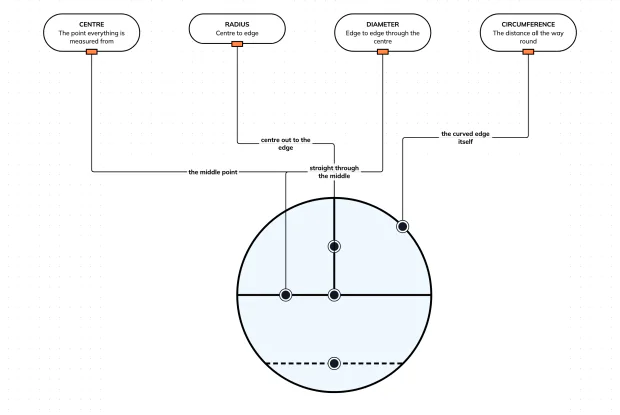
A circle has no sides to measure, so everything is measured from its centre instead. The radius reaches out to the edge, the diameter crosses the whole way through, and telling them apart is what every circle calculation depends on. Place each name on a real circle in an interactive playground.
What Are a Chord, an Arc, a Sector and a Segment?
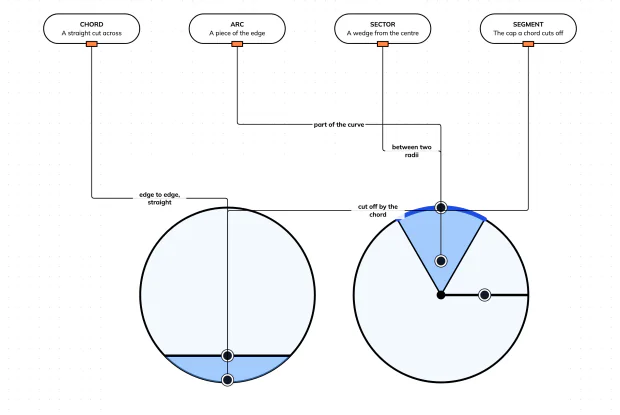
Once a circle has a centre and a radius, the rest of its vocabulary describes pieces: a straight cut across it, a stretch of its edge, a wedge from the middle and the cap left over. Place all four on real circles in an interactive playground.
What Is the Circumference of a Circle?
The circumference is the distance all the way round a circle, and it is always π times the diameter — a little over three diameters, whatever the size. The only decision is whether you were given the diameter or the radius. Practise both in an interactive playground.
Where Does Pi Come From?
π is not a rule someone invented; it is what you get when you measure round a circle and across it and divide. Every circle gives the same answer, which is why one number works for all of them. Use it in reverse to find a circle's width in an interactive playground.
How Long Is an Arc?
An arc is part of a circle's rim, and its length is that same fraction of the whole circumference. Find the fraction from the angle at the centre, then apply it — two steps, no new formula to learn. Practise on six sectors in an interactive playground.