What Are the Radius and Diameter of a Circle?
Root Concept
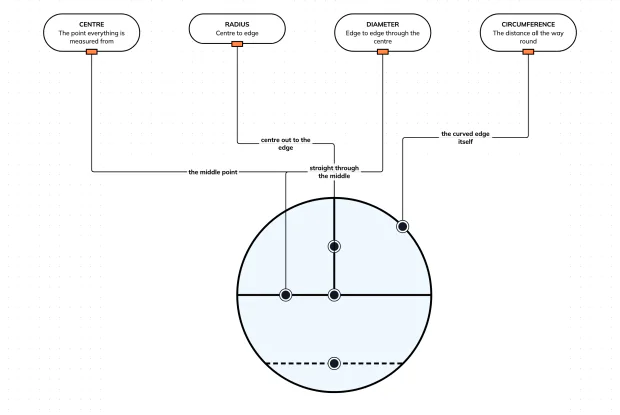
Every measurement on a circle is taken from its centre: the radius reaches from the centre to the edge, the diameter is two radii in a straight line through the centre, and a line across the circle that misses the centre is neither.
CodePLU Goal
Upgrading Human Mental Models
Learn how to think in Workflows

Concept Development By codeplu.com
Why Does a Circle Need Its Own Vocabulary?
A rectangle is easy to describe because it has sides you can point at and measure. A circle has no sides at all — it is one continuous curve, the same in every direction, with nothing to grip. So describing it needs a different starting point, and there is only one sensible candidate: the point in the middle.
Everything about a circle is defined from that centre. A circle is, in fact, nothing more than all the points that sit the same distance from one point. That distance is the radius, and it is the number that decides everything else — how big the circle is, how far around it goes, and how much space it covers.
From the radius the rest follows quickly. Go from the centre to the edge and back out the other side and you have crossed the whole circle: that is the diameter, and it is always exactly two radii. Travel all the way around the outside instead and you have the circumference. Four words, one point in the middle, and every circle you meet is described.
Four Names, All Measured From One Point
What is a radius, and why does it decide everything?
The radius is the distance from the centre of a circle out to any point on its edge. Any point — that is the part worth pausing on, because it is what makes a circle a circle rather than an egg or a blob. Every single point on the edge is exactly the same distance from the middle, and if that stopped being true the shape would stop being circular. This is also why one number is enough to describe a circle completely, where a rectangle needs two. Tell me the radius and I can draw your circle exactly: put the point of a compass down, open it to that distance, and turn. There is no second decision to make. It is the reason that every circle formula you will ever meet is written in terms of r, and why the first thing to do with any circle problem is to find out what the radius is.
How is the diameter related to the radius?
The diameter is a straight line from one edge of the circle to the other that passes through the centre, and it is always exactly twice the radius. That follows directly from what a radius is: walking from the edge to the centre uses one radius, and carrying straight on to the far edge uses another. Two radii in a line. So d = 2r, and r = d ÷ 2, and you can move between them whenever you need to. This matters practically, because the world is inconsistent about which one it quotes. Pipes, wheels, drill bits, plates and pizzas are almost always sold by diameter, because it is the measurement you can take with a ruler across the object without having to find its middle first. Mathematics prefers the radius, because the formulas are simpler in terms of it. So a great deal of real circle work begins by halving the number on the label.
What is the difference between a diameter and a chord?
A chord is any straight line joining two points on the edge of a circle. A diameter is a chord too — but a special one, the only kind that passes through the centre. Every other chord misses the middle and is shorter. This is the distinction the playground above is built around, because on a drawing the two look very similar: both are straight lines with both ends on the circle, and unless you check whether the line actually crosses the centre point there is nothing to tell them apart. It is a genuinely easy mistake to make and a costly one, because the diameter is the longest chord there is, so treating a near-miss as a diameter underestimates the circle every time. The test is simple and always works: does the line pass through the centre? If not, it is a chord and nothing more.
What is the circumference, and what has it to do with pi?
The circumference is the distance all the way around the outside of a circle — its perimeter, though the circle gets its own word for it. If you could unroll a circle into a straight line, the circumference is how long that line would be. Here is the remarkable part, and it is genuinely one of the oldest discoveries in mathematics: for every circle that has ever existed, the circumference divided by the diameter gives the same number. Not approximately the same, and not usually the same. Always. That number is a little over three, and it is called pi. It does not matter whether the circle is a coin or a running track. So the circumference is pi times the diameter, or equivalently two times pi times the radius, and pi is not an arbitrary constant someone chose — it is a ratio that was discovered sitting inside every circle.
Real World Example
Three Circles With a Number on the Label
The world measures round things across the middle, because that is what a ruler can reach. Mathematics wants the radius. Here is that gap in practice:
A bicycle wheel
26 in diameter → 13 in radius
A wheel sold as a twenty-six inch wheel is twenty-six inches across, not twenty-six inches from the hub to the rim. The radius is thirteen. This matters the moment you want to know how far the bike travels in one turn of the wheel, because that distance is the circumference — pi times the diameter, about eighty-two inches, or a little over two metres. Cycle computers work on exactly this calculation: you tell them the wheel size, they count rotations, and the arithmetic in between is the circumference. Enter a radius where the device expected a diameter and every distance it reports will be double the truth.
A pizza
12 in diameter → 6 in radius
Pizzas are sold by diameter and eaten by area, which is why comparing them by the advertised number is so misleading. A twelve-inch pizza has a radius of six inches, and an eighteen-inch has a radius of nine — only half again as much across, but more than twice the pizza, because area grows with the square of the radius. Anyone who has worked out that one large beats two smalls has done this calculation, knowingly or not. It starts, as almost every real circle problem does, by halving the number printed on the box.
A garden sprinkler
5 m radius → 10 m diameter
A sprinkler is one of the rare things quoted by radius rather than diameter, and for a good reason: what it actually does is throw water a certain distance from where it stands, which is the definition of a radius. A five metre reach waters a circle ten metres across. The distinction is not academic when you are deciding where to put it — placed in the middle of a ten-metre lawn it just covers the ground, while placed in a corner it waters a quarter of the same area and a good deal of the neighbour's path.
FAQs
Final Words
A circle has no sides, so it is described from its centre instead. The radius reaches from that centre to the edge, and because every point on the edge is equally far away, that one number fixes the entire circle.
The diameter is two radii in a line, straight through the middle — which is why halving is the first move in so much real circle work, since labels quote diameters and formulas want radii. A line across the circle that misses the centre is a chord, not a diameter, however alike they look.
The circumference is the way around the outside, and dividing it by the diameter gives the same number for every circle in existence. That number is pi, and it was found rather than invented — which is the next thing to follow, when you work out how much space a circle covers.
Continue This Track
This concept is part 1 of Circles, Measured.
What Are the Radius and Diameter of a Circle?
A circle has no sides to measure, so everything is measured from its centre instead. The radius reaches out to the edge, the diameter crosses the whole way through, and telling them apart is what every circle calculation depends on. Place each name on a real circle in an interactive playground.
What Are a Chord, an Arc, a Sector and a Segment?
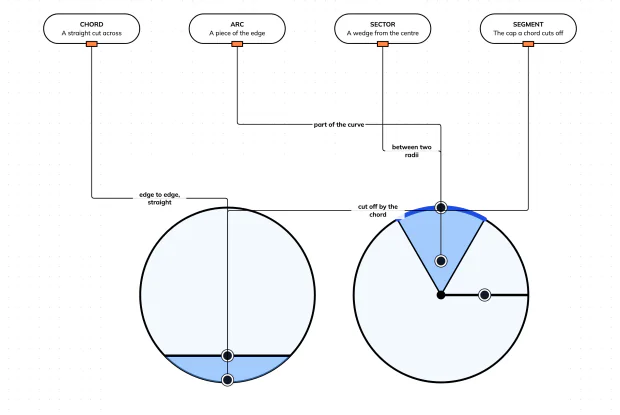
Once a circle has a centre and a radius, the rest of its vocabulary describes pieces: a straight cut across it, a stretch of its edge, a wedge from the middle and the cap left over. Place all four on real circles in an interactive playground.
What Is the Circumference of a Circle?
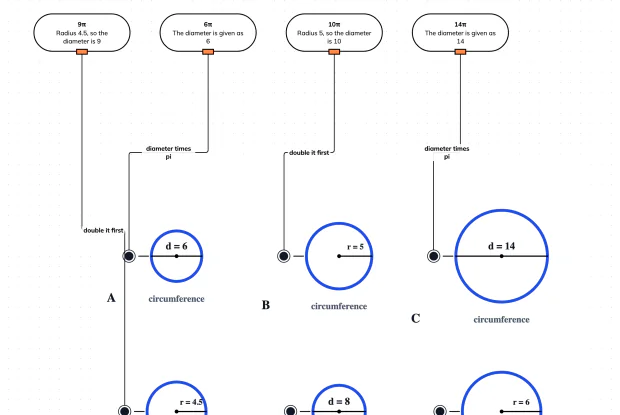
The circumference is the distance all the way round a circle, and it is always π times the diameter — a little over three diameters, whatever the size. The only decision is whether you were given the diameter or the radius. Practise both in an interactive playground.
Where Does Pi Come From?
π is not a rule someone invented; it is what you get when you measure round a circle and across it and divide. Every circle gives the same answer, which is why one number works for all of them. Use it in reverse to find a circle's width in an interactive playground.
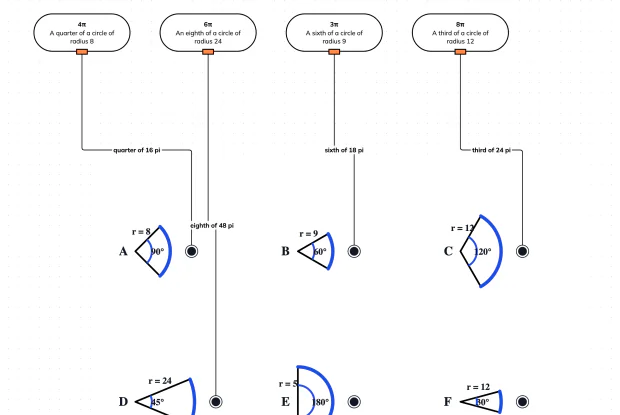
How Long Is an Arc?
An arc is part of a circle's rim, and its length is that same fraction of the whole circumference. Find the fraction from the angle at the centre, then apply it — two steps, no new formula to learn. Practise on six sectors in an interactive playground.