How Long Is an Arc?
Root Concept
An arc is the same fraction of the circumference as its central angle is of a full turn.
CodePLU Goal
Upgrading Human Mental Models
Learn how to think in Workflows

Concept Development By codeplu.com
Two steps every time: the angle over 360 gives the fraction, and the fraction times 2πr gives the arc.
What If You Only Want Part of the Rim?
The circumference is the distance all the way round a circle. Often what is wanted is only part of it — the curved edge of a slice of cake, the length of a bend in a road, the kerb round one corner of a roundabout. That part is called an arc, and the wedge it closes off is called a sector.
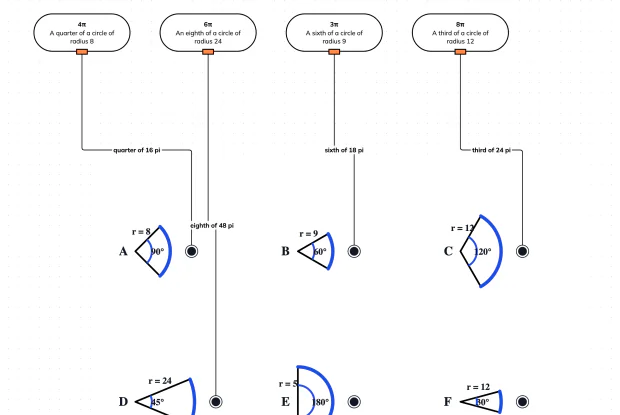
No new formula is needed. An arc takes up some fraction of the full turn round the centre, and it takes up exactly that same fraction of the rim. A quarter turn of 90° gives a quarter of the circumference; a 60° angle gives a sixth. So the method is two steps: work out the fraction, then take that fraction of the whole circumference.
That second step is where the mistakes happen, because the circumference formula needs the diameter and sectors are almost always labelled with the radius. A sector of radius 8 belongs to a circle of circumference 16π, not 8π. The playground below labels every sector with its radius on purpose, so the doubling has to be done every time.
The Two Steps, and What Goes Wrong
How Do You Find the Fraction?
Divide the angle at the centre by 360°, because 360° is a full turn. A 90° sector is 90/360, which simplifies to a quarter. A 60° sector is 60/360, a sixth. A 45° sector is an eighth, and a 120° sector is a third. Simplifying first is worth the moment it takes, because a quarter of 16π is far easier to see than 90/360 of it, and the arithmetic that follows is usually cancellable rather than decimal. Where the angle does not divide neatly — 100°, say, which gives 5/18 — leave it as a fraction rather than converting to a decimal, so nothing is rounded until the very end.
How Do You Apply It?
Multiply the fraction by the whole circumference, which is 2πr for a sector labelled with its radius. Take a 90° sector of radius 8. The full circle would have circumference 2 × π × 8 = 16π, and a quarter of that is 4π. Put together, the whole calculation is arc = (angle ÷ 360) × 2πr, and it is worth reading that as two separate ideas rather than memorising it as one string of symbols. The single most common error is stopping at πr instead of 2πr, which halves every answer, and it happens because the radius is the number in front of you while the formula wants the diameter.
What Is the Difference Between an Arc and a Perimeter?
The arc is the curved part only. The perimeter of a sector is the whole way round the shape, which means the arc plus the two straight radii. So a 90° sector of radius 8 has an arc of 4π and a perimeter of 4π + 8 + 8 = 4π + 16. Read the question carefully, because the two are different numbers and questions ask for both. The same distinction caught people out with semicircles in the last tutorial: half a circumference is not the perimeter of a semicircular shape, because the straight edge across the bottom is part of the outline too. Tracing the outline with a finger is a reliable way to see exactly which edges are involved.
Where Does This Get Used?
Anywhere something curved has to be measured or cut to length. A road engineer designing a bend needs its arc length to order the right amount of kerbing and surfacing. A tailor cutting a circular skirt needs the arc length of the waist opening. A joiner making a curved handrail for a staircase needs the length of timber before bending it. In each case the radius and the angle are the natural things to specify on a drawing, and the arc is what has to be calculated from them. Sector area works the same way, as the same fraction of πr², which is why the two are usually taught together.
Real World Example
How Much Kerbing Does a Roundabout Need?
The drawing gives a radius and an angle; the order has to be placed in metres of kerb, which means turning one into the other.
What the drawing gives
Radius 8 m, a 90° quadrant
A road drawing specifies a roundabout island as a circle of radius 8 metres, and the contractor has been asked to price one quadrant of the kerbing, the 90° stretch between two of the entry roads. Radius and angle are the natural way to draw it, because they are what a surveyor sets out on the ground with a peg and a tape. Neither of them is what the kerb supplier sells, though: kerbstones come by the metre of length, so the drawing has to be converted into a length before anything can be ordered or priced.
The fraction and the circle
A quarter of 16π
The angle is 90° out of a full 360°, so the quadrant is exactly a quarter of the island. The whole island's rim is 2 × π × 8 = 16π metres, which is about 50.3 metres. A quarter of that is 4π, or about 12.6 metres of kerb. Notice the step that has to be got right: the radius is 8 but the circumference uses 16, and dropping the doubling would have produced an order for about 6.3 metres — half of what the job needs, and not an error anybody would spot until the stone arrived.
What gets ordered
13 m, not 12.6 m
The final step is not mathematical. Kerbstones come in fixed lengths, the cuts at each end waste a little, and running short halfway through a day's work is far more expensive than having a stone left over. So the contractor rounds up rather than to the nearest value, and usually adds a margin on top. The geometry gives 12.6 metres and the order goes in for 13 or 14. That is the normal relationship between a calculated length and a real one: the calculation tells you the minimum, and practice decides how far above it to buy.
FAQs
Final Words
An arc is a slice of the rim, and its length is the same slice of the circumference. Divide the central angle by 360° to get the fraction, then take that fraction of 2πr. The step that catches people is the doubling, because sectors are labelled with a radius while the circumference is built from a diameter.
That completes the circle track. You can now name the parts of a circle, find the distance all the way round it, recover its width from that distance, and measure any slice of the rim — and the same fraction idea carries straight over to sector area, which is where the circle work continues in the area track.
Continue This Track
This concept is part 5 of Circles, Measured.
What Are the Radius and Diameter of a Circle?
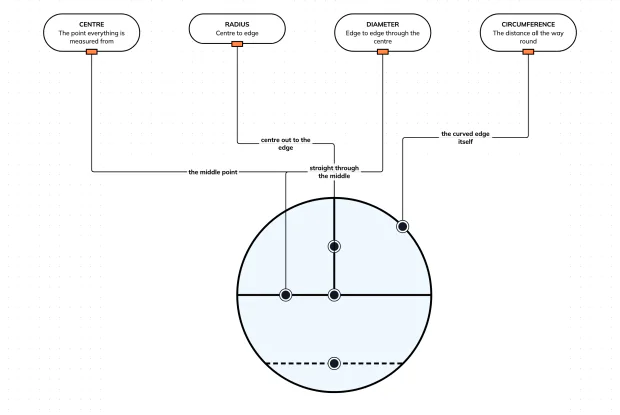
A circle has no sides to measure, so everything is measured from its centre instead. The radius reaches out to the edge, the diameter crosses the whole way through, and telling them apart is what every circle calculation depends on. Place each name on a real circle in an interactive playground.
What Are a Chord, an Arc, a Sector and a Segment?
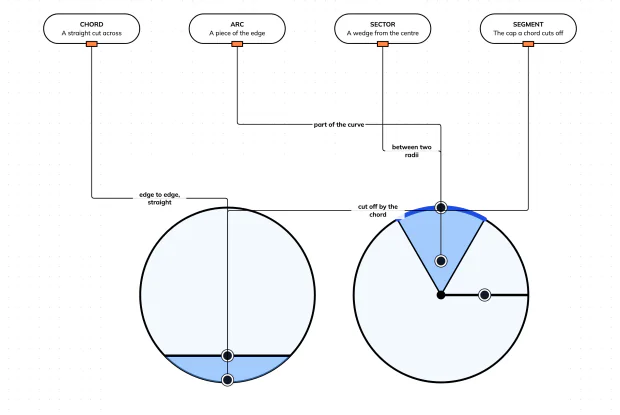
Once a circle has a centre and a radius, the rest of its vocabulary describes pieces: a straight cut across it, a stretch of its edge, a wedge from the middle and the cap left over. Place all four on real circles in an interactive playground.
What Is the Circumference of a Circle?
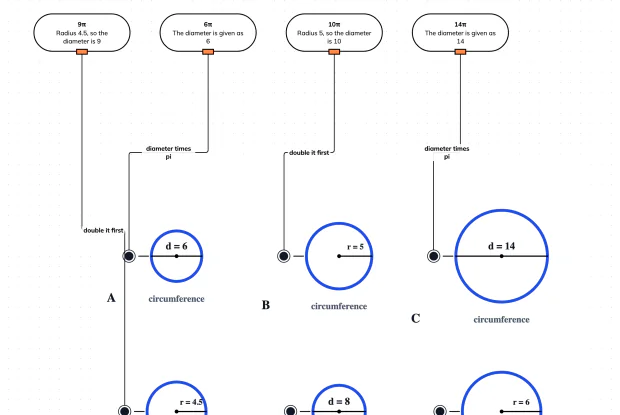
The circumference is the distance all the way round a circle, and it is always π times the diameter — a little over three diameters, whatever the size. The only decision is whether you were given the diameter or the radius. Practise both in an interactive playground.
Where Does Pi Come From?
π is not a rule someone invented; it is what you get when you measure round a circle and across it and divide. Every circle gives the same answer, which is why one number works for all of them. Use it in reverse to find a circle's width in an interactive playground.
How Long Is an Arc?
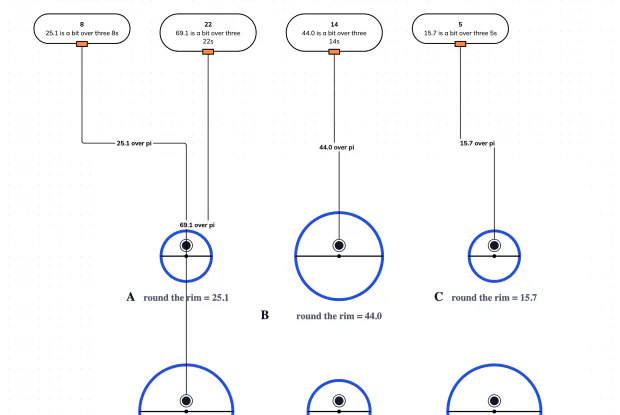
An arc is part of a circle's rim, and its length is that same fraction of the whole circumference. Find the fraction from the angle at the centre, then apply it — two steps, no new formula to learn. Practise on six sectors in an interactive playground.