What Are a Chord, an Arc, a Sector and a Segment?
Root Concept
A chord is a straight line joining two points on a circle, an arc is a piece of the circle's edge, a sector is the wedge between two radii, and a segment is the region a chord cuts off.
CodePLU Goal
Upgrading Human Mental Models
Learn how to think in Workflows

Concept Development By codeplu.com
What Do You Call the Pieces of a Circle?
The centre, the radius and the diameter describe a whole circle. These four describe what happens once you start cutting one up, and they divide neatly into two pairs — which is the easiest way to keep them straight.
The first pair comes from drawing a straight line across the circle. That line is a chord, and it cuts a cap off one side: the cap is a segment. Chord and segment always arrive together, because one is the cut and the other is what the cut leaves behind.
The second pair comes from the centre. Draw two radii and the wedge between them is a sector — a slice of pie or pizza, with its point at the middle. The curved crust of that wedge, the piece of the circle's own edge, is an arc. So: chord and segment from a straight cut, sector and arc from the middle outwards.
Two Pairs, Two Kinds of Cut
What is a chord, and how does it relate to the diameter?
A chord is any straight line joining two points on the edge of a circle. That is the whole definition, and it means a circle has infinitely many chords — pick any two points on the rim and the line between them is one. The diameter is a chord too, and a special one: the only kind that passes through the centre. It is also the longest, which follows from what a circle is. Every point on the edge sits one radius from the middle, so a line through the middle spans two radii, and any line that misses the middle must be shorter. That gives a test you can apply to any drawing: if a line across a circle does not pass through the centre, it is a chord and nothing more, however much it looks like a diameter. This is worth being firm about, because treating a near-miss as a diameter quietly understates the circle in every calculation that follows.
What is a segment, and why is it not a sector?
A segment is the region a chord cuts off — the cap of the circle lying on one side of the straight line. A sector is the wedge between two radii, with its point at the centre. The two are easy to confuse because both are regions rather than lines, and both are pieces of the circle's interior. The difference is where the straight edges come from. A sector's straight edges are radii, so they meet at the middle and the wedge is pointed. A segment's only straight edge is the chord, which does not go anywhere near the centre, so the region is a rounded cap with no point at all. The everyday test is what you are looking at: a slice of pizza cut from the middle is a sector, and the piece you get by cutting straight across a pizza off-centre — all crust and no point — is a segment.
What is an arc, and what is the difference between major and minor?
An arc is a piece of the circle's edge — part of the curve rather than part of the inside. Any two points on the rim divide the whole edge into two arcs: a shorter one and a longer one, called the minor arc and the major arc. Unless a drawing says otherwise, arc usually means the minor one, which is why the thick curve marked in the practice below is the shorter of the two. The same major-and-minor language applies to sectors and segments for the same reason, since each of them stands on an arc. A slice of pizza is a minor sector and what is left of the pizza is the major sector, and both are genuinely sectors. This is the same idea that made reflex angles behave oddly: two points on a circle always create two of everything, and the drawing has to say which one is meant.
Why do these four have names at all?
Because each one is something people need to measure or make. A sector is the shape of a slice, so anyone dividing a round thing into portions is working with sectors — and a pie chart is nothing but a set of sectors whose angles have been chosen to match the data. An arc is a length along a curve, which is what you need for a curved path, a bend in a road or the trim round a round window. A segment turns up whenever something round is cut flat: the flat side ground onto a lens, the shape of a bridge arch, the surface of liquid in a tilted pipe. And a chord is the straight-line distance across a curve, which is what a bridge's supporting cable spans and what a carpenter measures when fitting a straight brace across a round frame.
Real World Example
Three Circles Somebody Cut Up
The four names describe genuinely different jobs once something round gets divided:
A slice of pizza
a sector
Cut from the centre outward and you get a sector — two straight edges that are radii, meeting at a point in the middle, with a curve of crust joining them. This is why slices come out fair when the cuts all start at the same place, and unfair when someone cuts off-centre. It is also the shape of every segment of a pie chart, where the angle at the centre is set to match its share of the data. A quarter of a pizza is a sector whose angle is ninety degrees, which makes the sector the most intuitive of the four names by a wide margin.
The crust you bite off
a segment
Cut straight across a pizza well away from the middle and the piece you take off is a segment — a rounded cap with one straight edge and no point. It is the shape left when a chord cuts a circle, and it turns up far more often than its name suggests. The flat edge ground onto a round lens makes a segment; so does the profile of a tunnel cut below the widest point of its circle; so does the surface of liquid sitting in a pipe that is not full. Anywhere a circle is cut by a straight line and the smaller piece matters, it is a segment.
A bend in a running track
an arc
The curved ends of an athletics track are arcs — lengths along a circle's edge rather than areas. Arc length is what decides how far a runner actually travels, which is why outer lanes are longer and starts are staggered to compensate. The same measurement matters to anyone laying a curved path, bending a handrail or cutting trim for a round window: what they need is the distance along the curve, not the straight-line distance across it. That straight-line distance is the chord, and on a tight bend the two differ enormously.
FAQs
Final Words
Four names, two pairs. A chord is a straight cut across the circle and a segment is the cap it leaves behind, so those two always arrive together. A sector is the wedge between two radii and an arc is the curved edge it stands on.
The difference between a sector and a segment is where the straight edges come from. A sector's are radii, so it has a point at the centre; a segment's single straight edge is a chord that never reaches the middle, so it has no point at all.
And every one of these comes in two sizes. Two points on a circle always cut it into a minor piece and a major piece, so a drawing has to say which it means — the same two-for-one that made reflex angles behave oddly.
Continue This Track
This concept is part 2 of Circles, Measured.
What Are the Radius and Diameter of a Circle?
A circle has no sides to measure, so everything is measured from its centre instead. The radius reaches out to the edge, the diameter crosses the whole way through, and telling them apart is what every circle calculation depends on. Place each name on a real circle in an interactive playground.
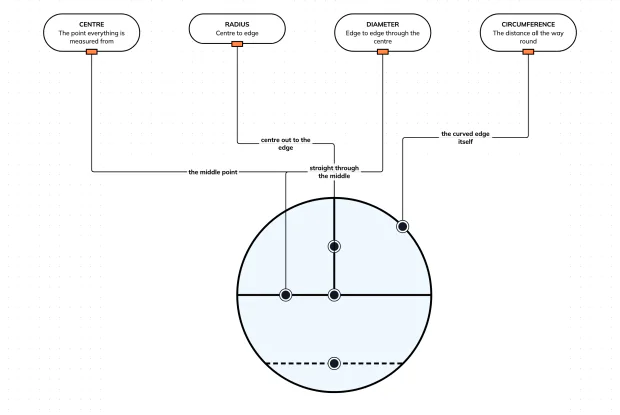
What Are a Chord, an Arc, a Sector and a Segment?
Once a circle has a centre and a radius, the rest of its vocabulary describes pieces: a straight cut across it, a stretch of its edge, a wedge from the middle and the cap left over. Place all four on real circles in an interactive playground.
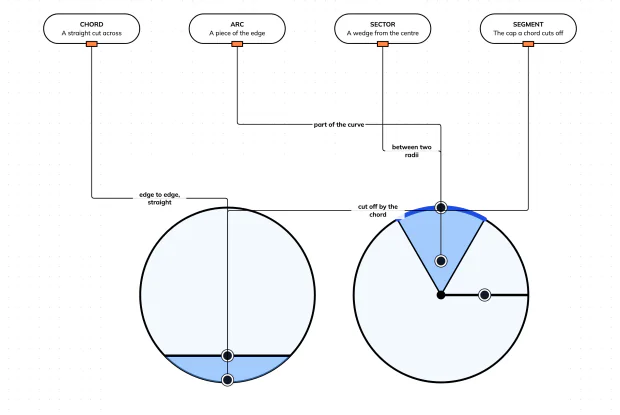
What Is the Circumference of a Circle?
The circumference is the distance all the way round a circle, and it is always π times the diameter — a little over three diameters, whatever the size. The only decision is whether you were given the diameter or the radius. Practise both in an interactive playground.
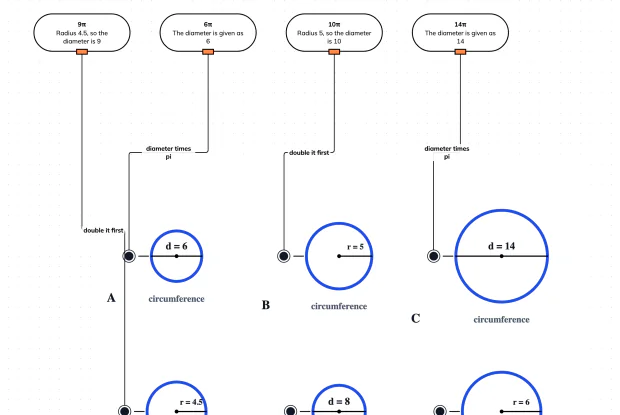
Where Does Pi Come From?
π is not a rule someone invented; it is what you get when you measure round a circle and across it and divide. Every circle gives the same answer, which is why one number works for all of them. Use it in reverse to find a circle's width in an interactive playground.
How Long Is an Arc?
An arc is part of a circle's rim, and its length is that same fraction of the whole circumference. Find the fraction from the angle at the centre, then apply it — two steps, no new formula to learn. Practise on six sectors in an interactive playground.