What Is Perimeter, and How Do You Find It?
Root Concept
Perimeter is the total distance around the outside of a shape, found by adding the lengths of all its sides — measured in units of length, never in squares, which is what distinguishes it from area.
CodePLU Goal
Upgrading Human Mental Models
Learn how to think in Workflows

Concept Development By codeplu.com
What Are You Measuring When You Measure Around a Shape?
Perimeter is the distance all the way around the outside of a shape. Put your finger on a corner, travel along every side in turn without doubling back, and stop when you arrive where you started — the distance you covered is the perimeter. That is the entire idea, and it works for any shape with sides.
The way to find it is just as plain: add up the lengths of all the sides. There are shortcuts for particular shapes and they are worth knowing, but every one of them is only a faster way of doing that addition, and if you ever forget one you can always walk the edge and count.
What matters most is what perimeter is measured in. It is a distance, so it is counted in centimetres, metres or steps — never in squares. Area is the other one, the amount of surface inside, and that is what squares count. Fence and grass. Skirting board and carpet. The two answer different questions and mixing them up is the single most expensive mistake in this part of maths.
Round the Outside, Added Up
How is perimeter different from area?
Perimeter surrounds; area covers. Perimeter is a length, so it is measured in ordinary units — centimetres, metres, feet — and area is a count of squares, which is why it is written with the small raised two as in m². The clearest way to keep them apart is to ask what you would be buying. Fencing a garden, hanging skirting board, sewing a ribbon round the edge of a tablecloth, framing a picture: all perimeter, because all of them go around the edge. Laying turf, buying carpet, painting a wall, ordering tiles: all area, because all of them cover the middle. Mixing them up is not a small error either, because the numbers are usually nothing like each other. A garden eight metres by six has a perimeter of twenty-eight metres and an area of forty-eight square metres, and ordering forty-eight metres of fence would leave you with twenty metres of it spare and a considerable bill.
Are there shortcuts for the common shapes?
Yes, and they are all just faster versions of adding up the sides. A rectangle has two lengths and two widths, so its perimeter is length plus width, doubled — you add one of each and then double, because the far side of the shape repeats both. A square has four equal sides, so its perimeter is four times one side, which is why it needs only one measurement just as its area does. A triangle has no shortcut worth the name: add its three sides, and that is that. For any irregular shape, and for every compound shape made by joining rectangles together, adding up the sides is the only method there is — which makes it the one worth being comfortable with, since the shortcuts only cover the tidy cases. The playground below uses shapes whose sides all run along a grid precisely so that the adding can be done by counting.
Can two shapes have the same area but different perimeters?
Easily, and it is worth seeing because it proves the two measurements are genuinely independent. Take twelve squares of area. Arrange them as a rectangle three by four and the perimeter is fourteen. Arrange the same twelve as a long strip, twelve by one, and the perimeter is twenty-six — nearly double, for exactly the same amount of surface. Nothing was added or taken away; the twelve squares were only rearranged. The pattern behind it is that long thin shapes have a great deal of edge for the area they hold, while compact shapes have very little. Of all rectangles with a given area, the square has the smallest perimeter, and that fact has consequences well outside mathematics. It is why animals curl up to keep warm, since heat escapes through surface, and why a circle — the most compact shape of all — encloses more area for its perimeter than any other shape can.
What happens with an L-shape or a notch?
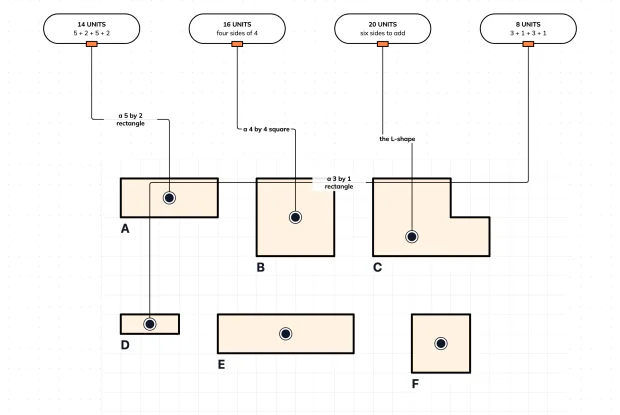
Add up the sides, exactly as always, and be careful not to miss the ones tucked into the corner. Compound shapes like an L usually have six sides rather than four, and the two short ones inside the notch are the ones people forget. There is a surprise waiting here, though, and it is the best thing in this topic. Cut a square notch out of the corner of a rectangle and the perimeter does not change at all. The cut removes a piece of the original edge but adds two new edges in its place, and for a rectangular notch those come to exactly the same total. The area certainly drops — you have removed some surface — but the distance round the outside is untouched. The L-shape in the playground below is cut from a six-by-four rectangle whose perimeter is twenty, and the L's perimeter is twenty as well. Almost nobody believes that before counting it.
Real World Example
Three Things Sold by the Metre
Anything that goes around rather than across is priced by perimeter:
Fencing a garden
8 m × 6 m → 28 m of fence
A rectangular garden eight metres by six needs twenty-eight metres of fencing, found by adding one length and one width and doubling. The area of that same garden is forty-eight square metres, and it is worth noticing how different the two numbers are, because ordering the wrong one is a genuinely common and costly error. Fencing is sold by the metre off a roll, turf by the square metre, and the merchant will ask which you want. The garden has not changed; the question has. Gates and posts complicate the ordering slightly, but the length you are buying is still the distance round the edge.
Skirting board for a room
4 m × 3 m → 14 m, less the doorway
Skirting runs round the base of the walls, so a room four metres by three needs fourteen metres of it — minus whatever the doorway takes out, since no skirting crosses a door. This is perimeter with a real-world adjustment, and it shows why the method of adding up the sides beats memorising a formula: once a piece of the edge is missing, the rectangle shortcut stops applying and you are back to walking round and adding. Fitters also add a little extra for the mitred corners, where each length is cut at an angle and loses a few centimetres.
A running track lane
400 m for the inside lane
A standard athletics track is built so that the inside lane measures exactly four hundred metres round, which is a perimeter and nothing else — the area enclosed is of no interest to anybody running. It also explains the staggered starts you see in sprint races. Runners in the outer lanes travel round a wider loop, so their perimeter is longer, and each start line is moved forward to cancel the difference exactly. Without the stagger, the outside lane would be running several metres further for the same race.
FAQs
Final Words
Perimeter is the walk around the outside, and finding it is adding up the sides. Every shortcut — doubling length plus width for a rectangle, four times a side for a square — is only a faster way of doing that same addition.
Keep the units straight and you will keep the two ideas straight. Perimeter is a distance in plain metres or centimetres; area is a count of squares and carries the raised two. Fence and grass, skirting and carpet.
And they move independently. Twelve squares can be a tidy rectangle with a perimeter of 14 or a long strip with a perimeter of 26, without a single square being added — which is why a square is the most economical rectangle to fence, and why animals curl up when they are cold.
Continue This Track
This concept is part 1 of Perimeter and Area.
What Is Perimeter, and How Do You Find It?
Perimeter is the distance around the outside of a shape — the fence, not the grass. It is measured in lengths rather than squares, which is the whole of what separates it from area. Walk six shapes round the edge and match each to its perimeter on a grid.
How Do You Find the Area of a Rectangle?
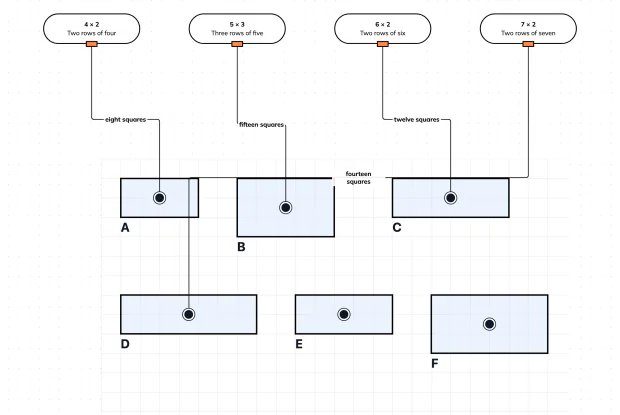
Area is not a formula to remember — it is a count of the squares that fit inside a shape. Once you can see the squares, length × width stops being a rule and becomes the fastest way to count rows. Match each multiplication to the rectangle it describes in an interactive playground.
How Do You Find the Area of a Square?
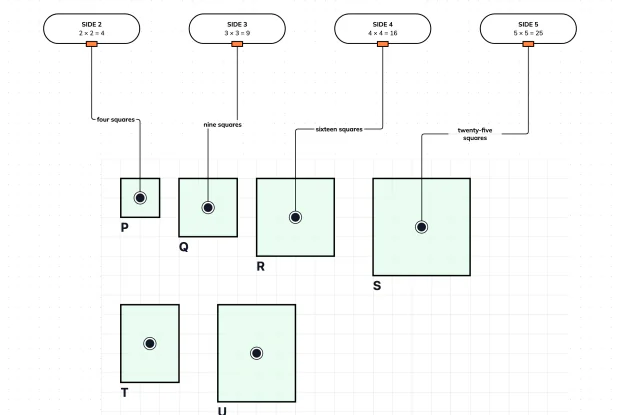
A square is a rectangle whose sides happen to match, so its area is still a count of the squares inside it — you just only need to measure once. That is why it is written s², and why area and square numbers are the same idea. Pick the real squares out of a grid in an interactive playground.
How Do You Find the Area of a Triangle?
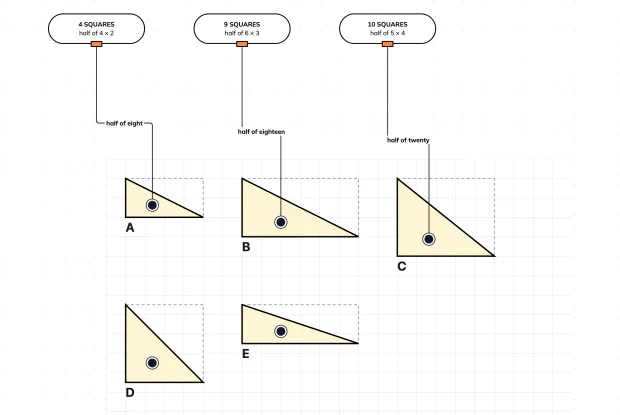
Every triangle fits inside a rectangle and fills exactly half of it. That single fact is where the half-base-times-height formula comes from, and seeing it means you never have to trust the formula again. Match each triangle to its area on an interactive grid.
How Do You Find the Area of a Circle?
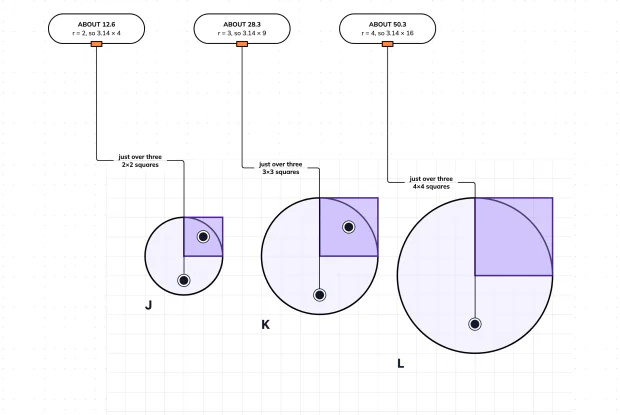
A circle has no rows of squares to count, so its area is measured against a square built on its own radius. It always holds a little over three of them, and that little-over-three is pi. Match each circle to its area on an interactive grid.