How Do You Find the Area of a Rectangle?
Root Concept
A rectangle's area is the number of unit squares that fit inside it, and because those squares sit in equal rows, multiplying the two side lengths counts them in one step.
CodePLU Goal
Upgrading Human Mental Models
Learn how to think in Workflows

Concept Development By codeplu.com
Why Does Multiplying Two Sides Give You an Area?
Area is the amount of flat space a shape covers. To measure it, you pick a small square — one centimetre across, one metre across, one tile across — and ask a single question: how many of those squares fit inside the shape? The answer is the area. Nothing more complicated is happening, and that is true of every shape there is, not just rectangles.
A rectangle is the easiest shape in the world to ask that question about, because the squares fit perfectly. No gaps, no overlaps, no awkward pieces left over at the edges. They line up in neat rows, every row holding exactly the same number of squares as every other row. That tidiness is the whole reason rectangles are where area is taught first.
And once the squares sit in equal rows, counting them one at a time is a waste of your time. Four squares in a row, two rows, is eight squares — and you knew that without counting, because multiplying is how we count equal groups quickly. That is all length × width is: not a rule to trust, but a counting shortcut you could have worked out yourself.
Squares, Rows, and the Shortcut Between Them
What does area actually measure?
Area measures covering, not distance. A common mix-up is to measure around the edge of a shape instead of across the inside — but the distance around a rectangle is its perimeter, which answers a different question. Perimeter tells you how much fence you need; area tells you how much grass you have to cut. The clearest way to keep them apart is what each is counted in. Perimeter is counted in lengths, because you are walking along a line. Area is counted in squares, because you are covering a surface. That is what the little raised two in 12 cm² is telling you: the unit being counted is a square, not a straight length. It is a label for the unit, not an instruction to multiply anything by itself.
Why do the squares fit so neatly in a rectangle?
Because all four corners of a rectangle are right angles, and the unit squares have right-angled corners too. When you lay the first square into a corner, its edges run exactly along the rectangle's edges. Put another square beside it and it lines up just as exactly, and so does the next, all the way along. When you reach the far side you have one complete row. Start a second row directly underneath and the same thing happens again, and every row you build holds the same number of squares as the first one — because the rectangle is the same width at the top as it is at the bottom. That last point is what makes rectangles special. In a shape whose sides lean, like a trapezium, the rows are different lengths and you cannot multiply your way through them. In a rectangle nothing changes as you go down, so one row tells you about every row.
How does counting rows turn into multiplying?
Once you know there are five squares in a row and three rows altogether, you are being asked a question you already know how to answer quickly: what are three fives? Multiplying exists precisely because adding equal groups over and over is slow. Five plus five plus five is fifteen, and 5 × 3 is fifteen, and those are the same calculation written two ways. So when someone says the area of a rectangle is length × width, they are not introducing a new idea about shapes. They are pointing out that you already have a fast way to count equal rows, and a rectangle's squares always come in equal rows. The formula is a shortcut for counting, which is why it is worth understanding rather than memorising: if you ever forget which way round it goes, you can draw the squares and count them, and you will get the same answer.
Does it matter which side you call the length?
No, and that is worth proving to yourself rather than taking on trust. A rectangle four squares wide and two tall holds eight squares. Turn it on its side so it is two wide and four tall, and it still holds eight — you have rotated the page, not changed the shape. Multiplication does not care about order, so 4 × 2 and 2 × 4 are both eight, and you can measure whichever side you like first. What you must not do is measure the same side twice, which is the mistake behind an answer that comes out square when the shape plainly is not. Measure across, then measure down, then multiply: two different directions, because area needs one number from each.
Real World Example
Three Rooms, One Question
Area stops feeling abstract the moment you have to buy something that covers a floor, a wall or a garden. In each of these the shopkeeper is asking you exactly the question above: how many squares?
Tiling a kitchen floor
3 m × 4 m = 12 m²
A kitchen floor three metres across and four metres deep needs twelve square metres of tile. This is the purest version of the idea, because the tiles genuinely are the squares you are counting — lay them out and the multiplication becomes a physical fact on the floor. Shops sell tile by the square metre for precisely this reason, and they will ask you for the two wall measurements rather than the area, because they expect to do the multiplying themselves. The one thing worth adding is that experienced tilers order about a tenth more than the calculation says, to cover breakages and the part-tiles cut to fit at the edges. The maths gives you the floor; experience gives you the spares.
Laying turf in a garden
8 m × 6 m = 48 m²
A back garden eight metres by six metres is forty-eight square metres of turf. Here the perimeter and the area really do pull apart in a way you can feel, and it is the clearest illustration of why the two must not be confused. The distance around that garden is twenty-eight metres, which is what you would need if you were pricing a fence. But turf is sold by the square metre, so the number you hand over is forty-eight. Same garden, same two measurements, two completely different quantities depending on whether you are covering the middle or walking around the edge — and ordering one when you meant the other is an expensive afternoon.
Choosing a phone screen
7 cm × 15 cm = 105 cm²
Phone screens are advertised by the diagonal, which is a single length and tells you surprisingly little about how much you can actually see. The usable space is the area, and a screen seven centimetres wide and fifteen tall gives you one hundred and five square centimetres of it. This is why two phones sold as the same size can feel so different in the hand: a narrow tall screen and a wider shorter one can share a diagonal while offering different amounts of room for a map or a page of text. Measuring the two sides and multiplying tells you what the marketing number is quietly leaving out.
FAQs
Final Words
Area is a count of squares, and a rectangle is the shape where those squares fit perfectly into equal rows. That is the whole idea. Multiplying the two sides is not a rule handed down to be memorised — it is the fast way to count equal rows, and if you ever forget it you can draw the squares and count them by hand and arrive at exactly the same number.
Keep three things and the rest follows. Area covers, perimeter surrounds. Area is counted in squares, which is what the little raised two is telling you. And the two measurements must come from two different directions and be in the same unit before you multiply them.
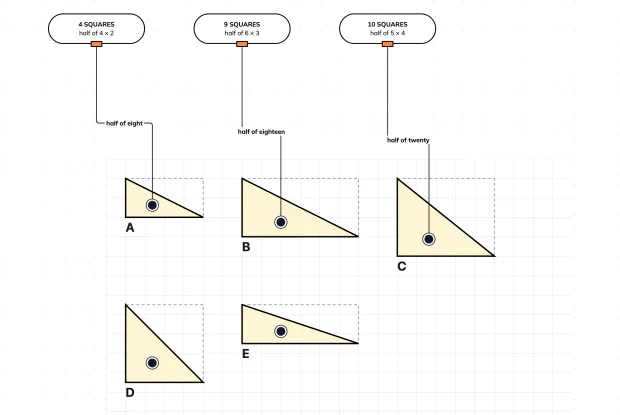
Every other area formula you will meet is built on this one. A triangle is half a rectangle. A circle is a little over three squares of its radius. Get the squares clear here and the rest of the shapes stop being a list to remember.
Continue This Track
This concept is part 2 of Perimeter and Area.
What Is Perimeter, and How Do You Find It?
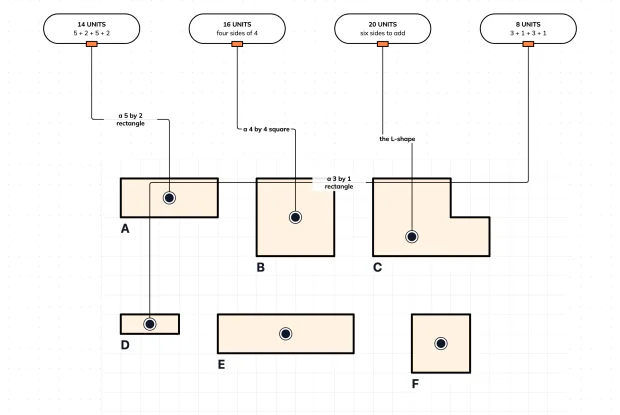
Perimeter is the distance around the outside of a shape — the fence, not the grass. It is measured in lengths rather than squares, which is the whole of what separates it from area. Walk six shapes round the edge and match each to its perimeter on a grid.
How Do You Find the Area of a Rectangle?
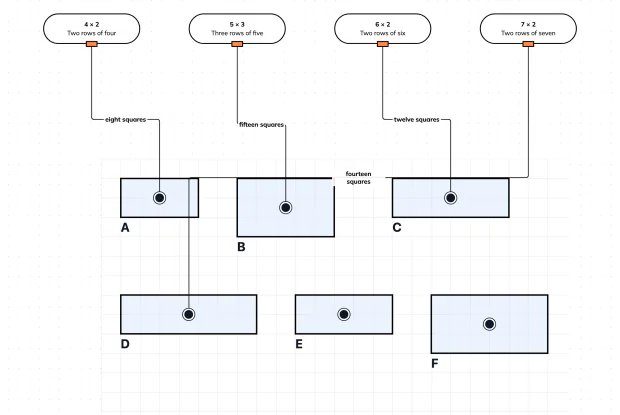
Area is not a formula to remember — it is a count of the squares that fit inside a shape. Once you can see the squares, length × width stops being a rule and becomes the fastest way to count rows. Match each multiplication to the rectangle it describes in an interactive playground.
How Do You Find the Area of a Square?
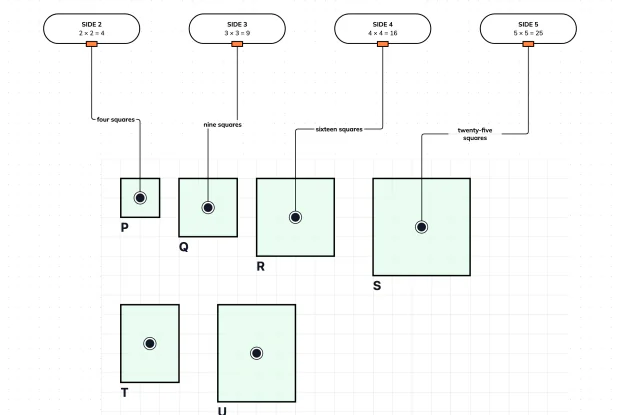
A square is a rectangle whose sides happen to match, so its area is still a count of the squares inside it — you just only need to measure once. That is why it is written s², and why area and square numbers are the same idea. Pick the real squares out of a grid in an interactive playground.
How Do You Find the Area of a Triangle?
Every triangle fits inside a rectangle and fills exactly half of it. That single fact is where the half-base-times-height formula comes from, and seeing it means you never have to trust the formula again. Match each triangle to its area on an interactive grid.
How Do You Find the Area of a Circle?
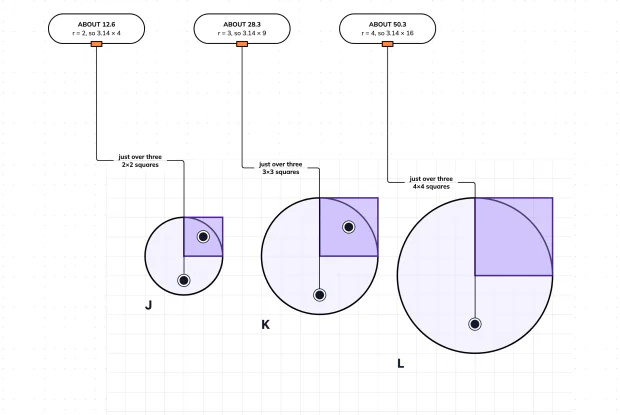
A circle has no rows of squares to count, so its area is measured against a square built on its own radius. It always holds a little over three of them, and that little-over-three is pi. Match each circle to its area on an interactive grid.