How Do You Find the Area of a Triangle?
Root Concept
A triangle occupies exactly half of the rectangle that boxes it in, so its area is half of base × height — and the height must be the perpendicular distance, not the slanted side.
CodePLU Goal
Upgrading Human Mental Models
Learn how to think in Workflows

Concept Development By codeplu.com
Why Is a Triangle Always Half of Something?
You do not need a new idea to find the area of a triangle. You need the rectangle you already understand, and one observation: any triangle can be boxed inside a rectangle, and when you do, it fills exactly half of it. Not roughly half — exactly half, every time, whatever the triangle looks like.
That is where the formula comes from. The rectangle's area is base × height, so the triangle's is half of base × height. Written the usual way that is ½ × b × h, but it is worth seeing it as 'work out the rectangle, then halve it', because that is a set of instructions you can follow even if the symbols have slipped your mind.
The one thing that genuinely needs care is which measurement counts as the height. It is not the slanted side of the triangle, however much that looks like the obvious thing to measure. It is the straight-up distance from the base to the opposite corner — the height of the box, not the length of the slope. Nearly every wrong triangle answer comes from that one substitution.
The Rectangle Around It, and the Half Inside
Why is the triangle exactly half the rectangle?
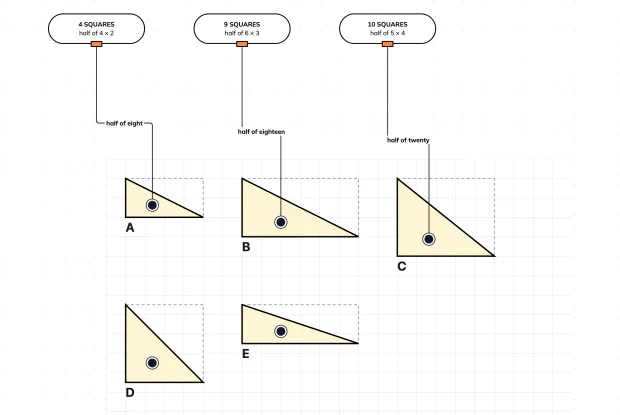
Take a right-angled triangle first, because it is the easiest to see. Draw the rectangle around it and the triangle is one of the two pieces you get by cutting the rectangle along its diagonal. The two pieces are identical — rotate one and it sits exactly on the other — so each must be half. Now take a triangle that is not right-angled, with its top corner somewhere in the middle. Drop a straight line from that corner down to the base and you have split the whole picture into two smaller rectangles, each cut along its own diagonal. The triangle is made of one half from each, so it is still half of the total. That is why the rule has no exceptions. It is not a fact about a particular kind of triangle; it is a fact about what a diagonal does to a rectangle, and every triangle can be built from diagonals.
Which measurement is the height?
The height is the perpendicular distance from the base to the opposite corner — perpendicular meaning straight up at a right angle, the way a wall stands on a floor. On the grid it is simply how many squares tall the boxing rectangle is. It is almost never the slanted side, and that is the single most common error in this whole topic. The slanted side is longer than the height, always, because a slope from a point down to a line is longer than the straight drop. So using it inflates every answer. Textbooks usually draw the height as a dashed line with a small right-angle square where it meets the base, and that little square is doing real work — it is telling you which of the lines in the picture is the one to measure. If the triangle leans so far that the drop lands outside the base, the height is still that perpendicular distance, measured to the base line extended.
Does it matter which side you call the base?
No. Any of the three sides can be the base, as long as the height you pair with it is measured perpendicular to that same side. Turn the triangle so a different side is at the bottom and both numbers change, but the answer does not — which is a good way to check your work, and a genuinely surprising thing to discover for the first time. What you must not do is mix them: take the base from one orientation and the height from another and the result means nothing at all. Base and height are a matched pair. This also explains why two triangles that look nothing alike can have exactly the same area. Slide the top corner of a triangle sideways, keeping it at the same height above the base, and the shape becomes more and more slanted while the area never changes at all, because neither the base nor the height moved.
Why halve at the end rather than the start?
You can halve at any point — the arithmetic does not care — but halving last is usually easier and less error-prone. Base times height is often a tidy whole number, and taking half of a tidy number at the end is simple. Halving first can leave you multiplying by something like 2.5 partway through, which is more work and more chance of slipping. There is one exception worth knowing: when either the base or the height is an even number, halving that one first can be the quickest route of all. A triangle with base 7 and height 6 is easier as 7 × 3 than as half of 42, even though both give 21. The important thing is that the halving happens exactly once. Forgetting it gives the rectangle's area, which is double the answer, and doing it twice gives a quarter — and both are common enough that checking the size of your answer against the picture is always worth the five seconds.
Real World Example
Three Triangles Somebody Had to Measure
Triangles show up wherever something has to be braced, roofed or cut from a corner. In each of these the calculation is the same two steps:
A gable end of a roof
½ × 8 m × 3 m = 12 m²
The triangular wall under a pitched roof is eight metres across at the bottom and rises three metres to the ridge. That gives twelve square metres of brick, render or cladding to pay for. The measurement that matters is the vertical three metres from the top of the wall to the ridge, not the length of either sloping edge, which is longer. A builder who measures the slope instead will over-order by a noticeable margin, and on a material sold by the square metre that is money spent on nothing. Boxing the gable in a rectangle eight by three and halving it is exactly the method above.
A triangular sail
½ × 4 m × 9 m = 18 m²
A sail four metres along the boom and nine metres up the mast has about eighteen square metres of cloth in it, and sail area is the number that decides how much power the wind can deliver. Sailmakers quote it for exactly that reason. Here the base and height are helpfully at right angles already, since the mast stands perpendicular to the boom, so the two numbers you need are the two you would measure anyway. It is a rare case where the geometry and the object agree about which lines matter.
A slice of pizza
½ × 12 cm × 18 cm ≈ 108 cm²
A slice is very nearly a triangle, with the crust as its base and the distance to the middle as its height. Twelve centimetres of crust and eighteen to the centre gives roughly one hundred and eight square centimetres of pizza. It is approximate because the crust curves rather than running straight, so the real slice is slightly bigger than the triangle — but it is close enough to settle an argument about whether two small slices beat one large one, which is a question the triangle answers faster than anyone can eyeball it.
FAQs
Final Words
A triangle is half of the rectangle that boxes it in — exactly half, every time, because a diagonal cuts a rectangle into two identical pieces. Work out the rectangle, halve it, and you have the area without leaning on a remembered formula.
Guard the height. It is the perpendicular distance from the base to the opposite corner, never the slanted side, and nearly every wrong answer in this topic comes from measuring the slope instead of the drop.
Base and height are a matched pair, so any side can be the base as long as the height goes with it. That is also why a triangle can lean as far as it likes without its area changing: the shape moves, but neither measurement does.
Continue This Track
This concept is part 4 of Perimeter and Area.
What Is Perimeter, and How Do You Find It?
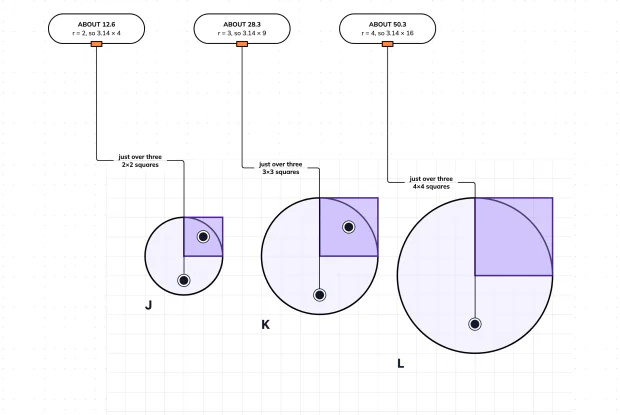
Perimeter is the distance around the outside of a shape — the fence, not the grass. It is measured in lengths rather than squares, which is the whole of what separates it from area. Walk six shapes round the edge and match each to its perimeter on a grid.
How Do You Find the Area of a Rectangle?
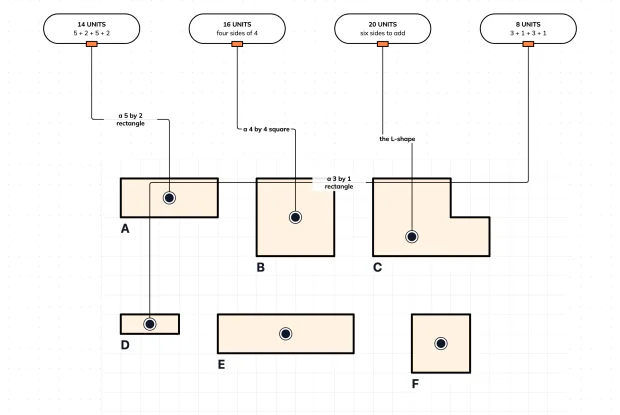
Area is not a formula to remember — it is a count of the squares that fit inside a shape. Once you can see the squares, length × width stops being a rule and becomes the fastest way to count rows. Match each multiplication to the rectangle it describes in an interactive playground.
How Do You Find the Area of a Square?
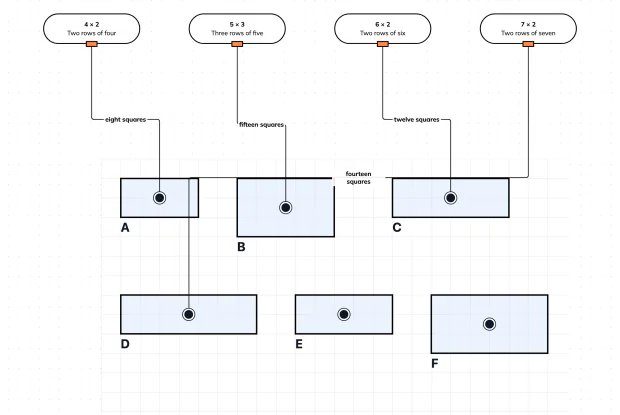
A square is a rectangle whose sides happen to match, so its area is still a count of the squares inside it — you just only need to measure once. That is why it is written s², and why area and square numbers are the same idea. Pick the real squares out of a grid in an interactive playground.
How Do You Find the Area of a Triangle?
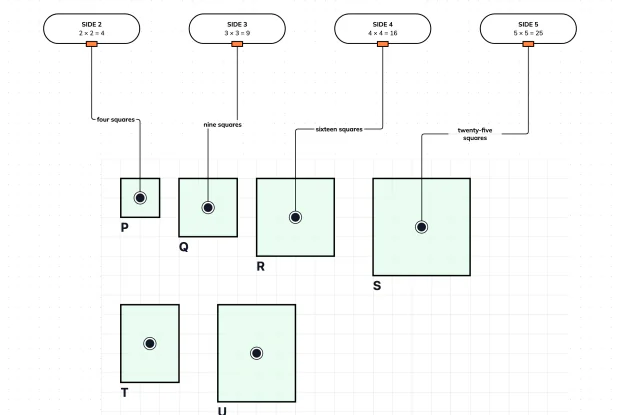
Every triangle fits inside a rectangle and fills exactly half of it. That single fact is where the half-base-times-height formula comes from, and seeing it means you never have to trust the formula again. Match each triangle to its area on an interactive grid.
How Do You Find the Area of a Circle?
A circle has no rows of squares to count, so its area is measured against a square built on its own radius. It always holds a little over three of them, and that little-over-three is pi. Match each circle to its area on an interactive grid.