How Do You Find the Area of a Circle?
Root Concept
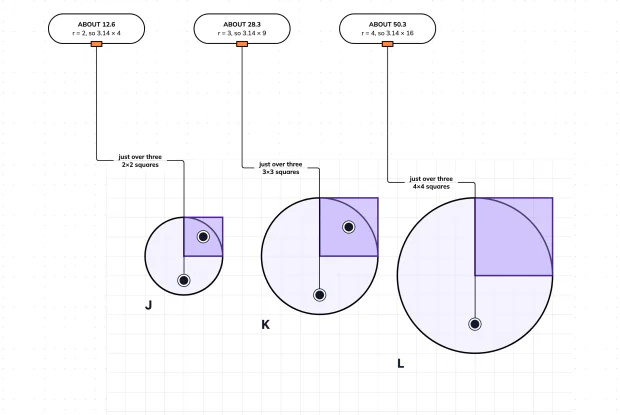
A circle's area is measured in squares built on its own radius, and it always holds a little over three of them — so the area is pi times r², with pi being that fixed little-over-three.
CodePLU Goal
Upgrading Human Mental Models
Learn how to think in Workflows

Concept Development By codeplu.com
How Do You Count Squares in Something With No Corners?
Area has meant one thing all the way through: how many unit squares fit inside a shape. A rectangle makes that easy because the squares sit in tidy rows. A circle refuses to cooperate — lay squares inside one and the edges are all curve, with little slivers left over that belong to no square at all.
So circles are measured a different way. Instead of counting little squares, you build one big square on the circle's own radius — a square r wide and r tall, sitting with its corner at the centre — and ask how many of those the circle holds. The answer is the surprising part. It is always a little more than three. Not about three for small circles and four for large ones. Always the same little-over-three, for every circle there has ever been.
That fixed number is pi, roughly 3.14, and it is the same pi that turns up in the circumference. So the area of a circle is pi × r², which reads as 'a bit over three radius-squares'. The formula is not a rule to memorise; it is a count, in the only unit a circle will accept.
The Square a Circle Is Measured Against
Why measure a circle in radius squares?
Because the radius is the only measurement a circle really has, so it is the only sensible thing to build a unit out of. A rectangle offers you two lengths and you multiply them; a circle offers exactly one, and the shape is completely determined by it. If you want a square to compare your circle against, the radius is the only honest side length to give it. And the comparison works beautifully, because both the circle and the square grow the same way. Double the radius and the radius square becomes four times bigger; the circle also becomes four times bigger. The relationship between them never shifts, which is precisely why the ratio can be a fixed number at all. Had the circle grown differently from its square, there would be no single pi to find and every circle would need measuring separately.
Where does the 'three and a bit' come from?
You can see it without any algebra. Draw a circle, then draw the square on its radius, and lay copies of that square over the circle: three of them cover most of it, and a fourth is far too much — you are left with about fourteen hundredths of a square unaccounted for. That is 3.14, and people have been arriving at it by careful measurement for thousands of years, long before anyone could prove why. A neater way to see it is to slice the circle into many thin wedges and rearrange them alternately, point up and point down. They interlock into a shape that gets closer and closer to a rectangle as the wedges get thinner — a rectangle whose height is the radius and whose width is half the circumference. Multiply those and you get πr² exactly. The wedge picture is the proof; the three-squares picture is the one to keep in your head.
Why is it r² and not 2r?
Because area is a two-dimensional measurement, and it always grows in two directions at once. This is the same trap as doubling the side of a square, and it bites harder with circles because the labels make it easy to miss. A pizza of twice the diameter is not twice the pizza — it is four times, because the radius doubled and the area follows the square of the radius. This is also the single most common wrong answer in the topic: using πr² when the question gave you a diameter. A plate thirty centimetres across has a radius of fifteen, and its area is π × 15², about seven hundred and seven square centimetres. Put the thirty into the formula instead and you get four times too much. Halve first, then square — and if an answer looks four times larger than it should, that is almost always why.
What does the answer actually mean?
It means squares, the same as every other area. If the radius was measured in centimetres, the area is in square centimetres, and the little raised two in cm² is doing the same job it has done throughout: telling you the unit being counted is a square. It is worth separating the two raised twos here, since both appear in the same line of working. The two in r² is an instruction to multiply the radius by itself. The two in cm² is a label for the answer. And because pi is not a whole number, the result almost never is either. That is expected and it is not a sign of a mistake — a circle simply does not contain a whole number of squares, which is where this whole detour began. Rounding sensibly at the end is the right move; rounding pi to 3 at the start is not, because it throws away about five per cent of the answer.
Real World Example
Three Circles Worth Measuring
Every one of these is sold or specified by its diameter, so each begins with the same halving step:
Comparing two pizzas
r = 6 in → 113 in²; r = 9 in → 254 in²
A twelve-inch pizza gives about a hundred and thirteen square inches of food, and an eighteen-inch gives about two hundred and fifty-four. The eighteen is only half again as wide, yet holds more than twice as much — which is why one large almost always beats two smalls at the same total price. This is the squaring at work in the most useful possible setting. It is also a good check on your instincts: almost nobody guesses the gap correctly by eye, because we judge size by width and pay for area.
A circular tablecloth
r = 0.75 m → about 1.77 m²
A round table a metre and a half across needs a cloth covering about one point seven seven square metres, before any overhang is added. Fabric is sold by the metre off a roll of fixed width, so the shop will work out how much of that roll your circle needs — and the leftover corners are the reason round cloths cost more per usable square metre than rectangular ones. The circle is efficient as a shape to sit around and wasteful as a shape to cut from a rectangle, which is a trade-off with the geometry right at the heart of it.
A sprinkler's reach
r = 5 m → about 78.5 m²
A sprinkler throwing water five metres in every direction waters about seventy-eight and a half square metres. Move up to a model with a seven metre reach and the coverage jumps to roughly a hundred and fifty-four — nearly double the area from a forty per cent increase in reach. This is the squaring again, and it is why a small improvement in throw is worth paying for. It also explains why moving a sprinkler to a corner is so costly: the same circle, quartered by the boundaries, waters a quarter of the ground.
FAQs
Final Words
A circle cannot be tiled with little squares, so it is measured against one big square built on its own radius. It holds a little over three of them, every time, and that fixed little-over-three is pi.
So πr² is a count rather than a rule: build the radius square, take about 3.14 of it. If you remember the picture you can rebuild the formula, and you will also know roughly what answer to expect before you calculate.
Two habits will keep you right. Halve a diameter before you square anything, because the labels on real objects quote widths and the formula wants radii. And remember that area follows the square of the radius — which is why a pizza half again as wide is more than twice the meal.
Continue This Track
This concept is part 5 of Perimeter and Area.
What Is Perimeter, and How Do You Find It?
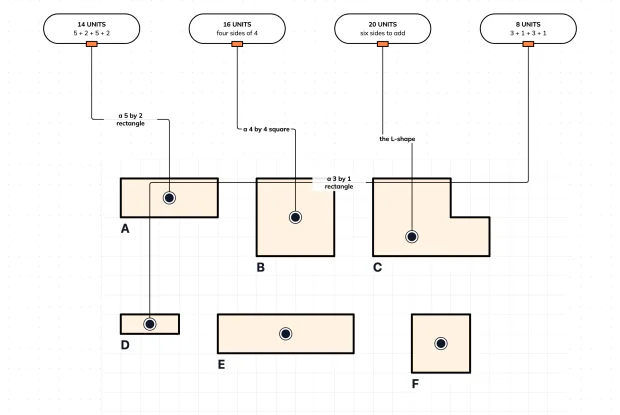
Perimeter is the distance around the outside of a shape — the fence, not the grass. It is measured in lengths rather than squares, which is the whole of what separates it from area. Walk six shapes round the edge and match each to its perimeter on a grid.
How Do You Find the Area of a Rectangle?
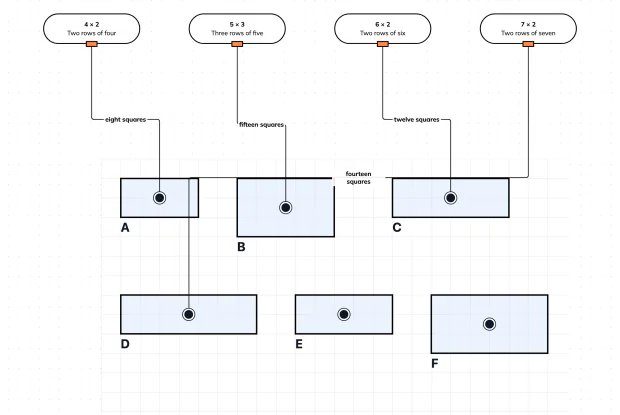
Area is not a formula to remember — it is a count of the squares that fit inside a shape. Once you can see the squares, length × width stops being a rule and becomes the fastest way to count rows. Match each multiplication to the rectangle it describes in an interactive playground.
How Do You Find the Area of a Square?
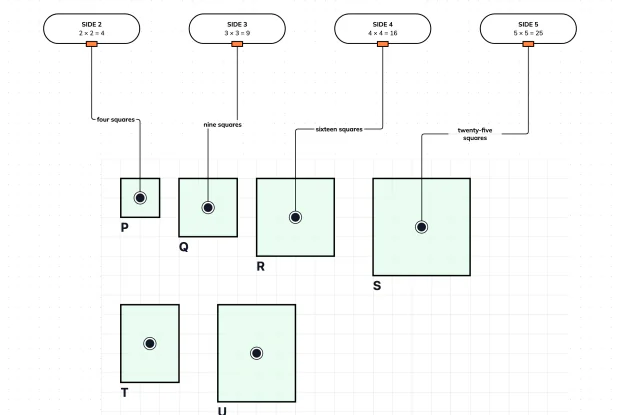
A square is a rectangle whose sides happen to match, so its area is still a count of the squares inside it — you just only need to measure once. That is why it is written s², and why area and square numbers are the same idea. Pick the real squares out of a grid in an interactive playground.
How Do You Find the Area of a Triangle?
Every triangle fits inside a rectangle and fills exactly half of it. That single fact is where the half-base-times-height formula comes from, and seeing it means you never have to trust the formula again. Match each triangle to its area on an interactive grid.
How Do You Find the Area of a Circle?
A circle has no rows of squares to count, so its area is measured against a square built on its own radius. It always holds a little over three of them, and that little-over-three is pi. Match each circle to its area on an interactive grid.