How Do You Find the Area of a Square?
Root Concept
A square is a rectangle with equal sides, so multiplying its two sides means multiplying one length by itself — which is what s² records, and why the answer is always a square number when the side is whole.
CodePLU Goal
Upgrading Human Mental Models
Learn how to think in Workflows

Concept Development By codeplu.com
Why Does a Square Need Only One Measurement?
A square is not a new shape with new rules. It is a rectangle that happens to have all four sides the same length, and everything you already know about rectangles still applies to it without a single change. The unit squares still fit perfectly, still sit in equal rows, and are still counted by multiplying the two sides together.
What changes is how much you have to measure. In a rectangle the two sides can differ, so you need both numbers. In a square they cannot differ, so the moment you know one side you know the other — measuring the second one tells you nothing you did not already have. One measurement, and the shape is pinned down completely.
That is why the area of a square gets written as s × s, or s², instead of length × width. It is the same multiplication as before, with one number doing both jobs. And it is the reason the numbers 1, 4, 9, 16 and 25 are called square numbers: they are literally the counts of squares you get from squares with whole-number sides.
One Side, and Everything That Follows From It
What makes a shape a square rather than a rectangle?
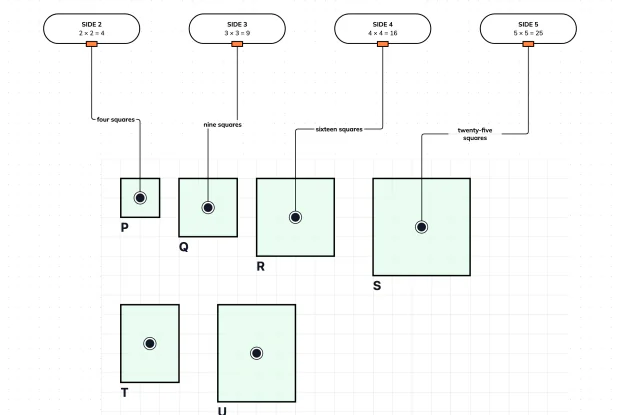
Every square is a rectangle, but most rectangles are not squares. A rectangle needs four right-angled corners and opposite sides that match. A square needs all of that plus one extra condition: all four sides must be the same, not just the opposite pairs. That single extra condition is easy to state and surprisingly easy to misjudge by eye. A shape three units wide and four tall looks very nearly square at a glance, and a shape four by five looks squarer still, because the longer the sides get the smaller the difference looks in proportion. This is exactly why counting beats looking. On a grid you can settle it in a second — count across, count down, and if the two numbers are not identical it is not a square, however convincing it looks. In the playground below, two of the six shapes are near-squares of precisely this kind.
Why is it written s² rather than s × s?
Because writing the same letter twice is repetition, and mathematics compresses repetition. The small raised two says 'two of these multiplied together', so s² means s × s in exactly the way that 2⁴ means 2 × 2 × 2 × 2. Nothing new is happening. What is worth being careful about is that this raised two and the one in cm² are doing different jobs, even though they look identical. In s² the two is an instruction: multiply the side by itself. In cm² it is a label: the unit being counted is a square centimetre. So a square with sides of 5 cm has an area of 5² = 25 cm², and the first two told you to multiply while the second two told you what you ended up with. Reading them as the same symbol is a common and expensive confusion.
How are areas of squares and square numbers connected?
They are the same thing seen from two directions, and the name gives it away. A square number is what you get when you multiply a whole number by itself: 1, 4, 9, 16, 25, 36. A square's area is what you get when you multiply its side by itself. So if you draw squares with sides 1, 2, 3, 4, 5 on a grid and count the unit squares inside each one, the counts you get are the square numbers in order. That connection is useful in both directions. It means you can often spot an area without calculating, because you recognise the number. And it means that if you know the area and want the side, you are looking for the number that was multiplied by itself — which is exactly what a square root is, and why the operation is called that.
What happens to the area when you double the side?
It does not double. It quadruples, and this catches people out constantly. A square with sides of 3 has an area of 9. Double the sides to 6 and the area becomes 36, which is four times as much, not twice. The reason is visible the moment you draw it: doubling the side gives you twice as many squares across and twice as many down, and two times two is four. You are stretching the shape in two directions at once, and the area feels both stretches. This is why a pizza twice the diameter is four times the food, and why a room twice as wide in both directions needs four times the carpet. Any time a shape grows in two dimensions together, the area grows by the square of the growth, not by the growth itself.
Real World Example
Three Squares You Meet Without Noticing
Squares turn up wherever something is made to be turned any way round, or cut from a roll without waste. In each of these you measure once:
A square floor tile
30 cm × 30 cm = 900 cm²
A standard floor tile thirty centimetres on each side covers nine hundred square centimetres, which is nine hundredths of a square metre — so it takes about eleven of them to cover a square metre of floor. Tiles are made square for a practical reason rather than a decorative one: a square tile can be laid in any of four rotations and still fit, which makes laying faster and means a tile cut from the wrong end of a box still works. It also means the shop only has to print one number on the label, because the second measurement is the same as the first.
A chessboard
8 × 8 = 64 squares
A chessboard is the clearest picture of this idea that exists, because the unit squares are not imagined — they are printed. Eight along each edge gives sixty-four squares, and sixty-four is a square number for exactly that reason. It is also a neat demonstration of the doubling trap: a board with four squares along each edge would have sixteen, not thirty-two. Halving the side did not halve the board, it quartered it. Anyone who has tried to explain why a small chess set feels so much smaller than it looks has run into this.
A square garden bed
2 m × 2 m = 4 m²
A raised bed two metres on each side gives four square metres of growing space, and a gardener planning it needs both numbers that come out of that shape. The area tells you how much soil to order, because soil fills the middle. The perimeter — eight metres — tells you how much timber to buy for the sides, because timber goes around the edge. It is the same distinction as fencing a lawn versus turfing it, and a square makes it especially easy to get wrong, because with equal sides the two calculations look confusingly similar on paper.
FAQs
Final Words
A square is a rectangle that has stopped needing two measurements. The unit squares still fit in equal rows and are still counted by multiplying the sides — there is just one number doing both jobs, which is all that s² records.
Two things are worth carrying away. The raised two in s² is an instruction and the raised two in cm² is a label, and they are not the same thing. And growth in two directions at once multiplies rather than adds, which is why doubling a side quadruples the area.
The link to square numbers is not a coincidence of naming either. Draw squares of side 1, 2, 3, 4, 5 on a grid, count what is inside, and you have written out 1, 4, 9, 16, 25 — which is also why going backwards from an area to a side is called taking a root.
Continue This Track
This concept is part 3 of Perimeter and Area.
What Is Perimeter, and How Do You Find It?
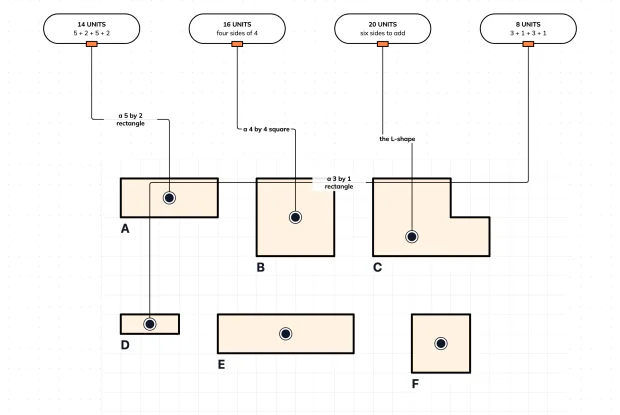
Perimeter is the distance around the outside of a shape — the fence, not the grass. It is measured in lengths rather than squares, which is the whole of what separates it from area. Walk six shapes round the edge and match each to its perimeter on a grid.
How Do You Find the Area of a Rectangle?
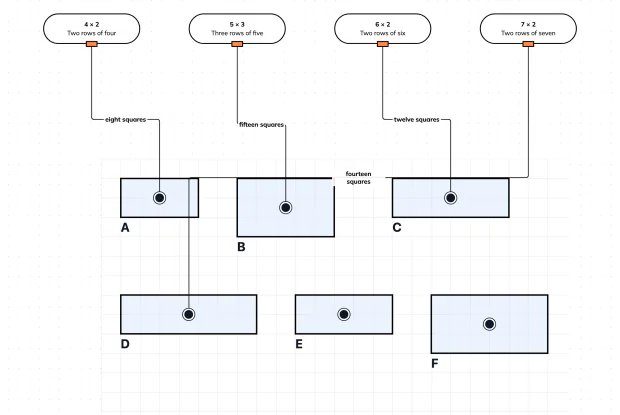
Area is not a formula to remember — it is a count of the squares that fit inside a shape. Once you can see the squares, length × width stops being a rule and becomes the fastest way to count rows. Match each multiplication to the rectangle it describes in an interactive playground.
How Do You Find the Area of a Square?
A square is a rectangle whose sides happen to match, so its area is still a count of the squares inside it — you just only need to measure once. That is why it is written s², and why area and square numbers are the same idea. Pick the real squares out of a grid in an interactive playground.
How Do You Find the Area of a Triangle?
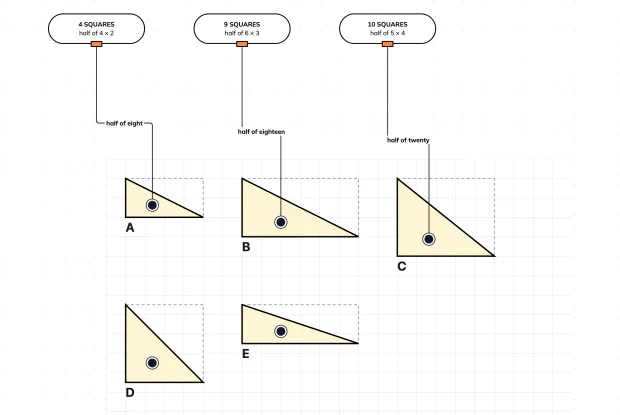
Every triangle fits inside a rectangle and fills exactly half of it. That single fact is where the half-base-times-height formula comes from, and seeing it means you never have to trust the formula again. Match each triangle to its area on an interactive grid.
How Do You Find the Area of a Circle?
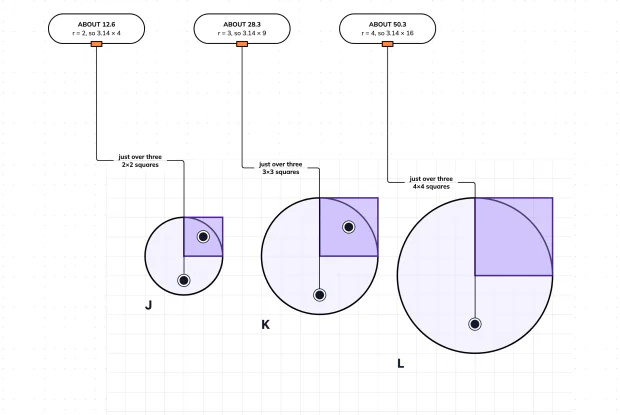
A circle has no rows of squares to count, so its area is measured against a square built on its own radius. It always holds a little over three of them, and that little-over-three is pi. Match each circle to its area on an interactive grid.