What Is an Algebraic Identity?
Root Concept
An identity is a statement that survives every value you test it with, which is why it can be used as a rule rather than solved.
CodePLU Goal
Upgrading Human Mental Models
Learn how to think in Workflows

Concept Development By codeplu.com
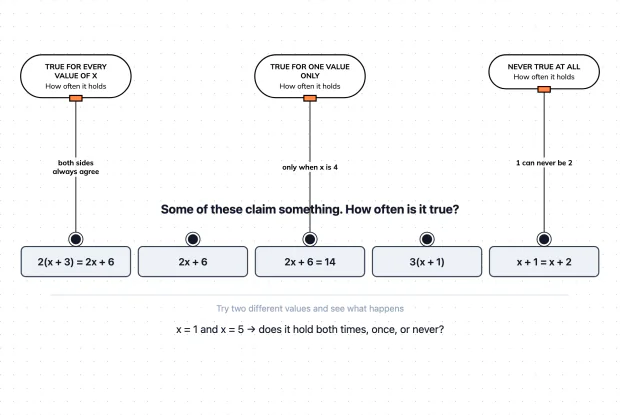
Try two values in each — always, once, never, or no claim at all
What Makes a Statement True Every Single Time?
2x + 6 = 14 and 2(x + 3) = 2x + 6 look like the same sort of thing. Both have an equals sign, both have letters, both claim two sides are equal. They are not the same sort of thing at all, and the difference decides what you are allowed to do with each.
Test them. Put x as 1: the first gives 8 = 14, which is false; the second gives 8 = 8, which is true. Put x as 5: the first gives 16 = 14, false again; the second gives 16 = 16, true again. The first is only true for one particular value — four, as it happens — and the second has been true for everything tried so far.
A statement true for every value is called an identity, and the reason it matters is practical. An equation is something you solve, because it points at particular values. An identity is something you use, because it lets you swap one form for another at any time. Every rule in the rest of this track is an identity. In the playground below you sort five statements, two of which claim nothing at all.
How Do You Tell Them Apart?
How do you test whether something is an identity?
Try several different values and see whether it survives all of them. One value proves nothing much — 2x + 6 = 14 happens to hold at x equals 4, and that does not make it an identity. Two or three values that all work is strong evidence, and for the identities you meet at this level it is enough to be confident. Strictly, testing can never prove an identity, only disprove one, because you cannot try every number. Proving it properly means showing the two sides are the same expression written differently, which is exactly what multiplying out a bracket does: expand 2(x + 3) and you get 2x + 6, so the two sides were never different quantities to begin with.
Why does the difference matter in practice?
Because it decides what the statement is for. An equation is a question: it singles out particular values and asks you to find them, so you solve it. An identity is a tool: it says these two forms are interchangeable, so you may replace either with the other whenever it is convenient, without doing any work to justify it. When you multiply out a bracket in the middle of solving, you are using an identity. When you factorise, you are using one backwards. Mixing the two up leads people to try to solve an identity, which produces something like 0 = 0 and a great deal of confusion, when nothing was ever there to be found.
What about a statement that is never true?
It is the third possibility and worth recognising so it does not look like a mistake. x + 1 = x + 2 has a letter on both sides, so it looks solvable, but subtract x from both sides and you are left with 1 = 2. No value of x can rescue that, because x cancelled out entirely and took the question with it. The statement is simply false. Compare it with x + 1 = x + 1, where the same cancelling leaves 1 = 1, which is true regardless — that one is an identity. When the letters vanish, look at what is left: something true means every value works, and something false means none does.
Real World Example
Where Would You Rely on an Identity?
The difference between a rule and a question shows up whenever the same quantity can be described two ways:
Two descriptions of one bill
3(x + 2) and 3x + 6
A shop sells party bags, each holding a toy costing x rupees and two rupees of sweets. Three bags cost 3(x + 2) rupees if you think bag by bag, or 3x + 6 rupees if you think of all the toys together and all the sweets together. Both descriptions are correct, and they must come to the same total, because they describe the same shopping. Writing 3(x + 2) = 3x + 6 records that fact. It is not a question about the price of a toy; it is a statement that the two ways of counting always agree, whatever the toy costs.
Why it holds for every price
An identity, not a question
Try it with a toy at four rupees: the left gives three sixes, which is eighteen, and the right gives twelve plus six, also eighteen. Try it at ten rupees: the left gives three twelves, thirty-six, and the right gives thirty plus six, again thirty-six. It will keep agreeing because the two sides are the same arithmetic in a different order, not two different quantities that happen to meet. That is what makes it a rule you can apply without checking each time, which is the whole practical value of knowing something is an identity rather than an equation.
Now a real question
3(x + 2) = 18 has one answer
Suppose the receipt says eighteen rupees and you want the price of one toy. Now you write 3(x + 2) = 18, and this is a genuine question. It is true when the toy costs four rupees and false for every other price, which is precisely why it can be solved. The identity from before is still useful here — you can swap 3(x + 2) for 3x + 6 on the way — but the two statements are doing entirely different jobs. One is the rule you use; the other is the question you answer with it.
FAQs
Final Words
An identity is a statement that holds for every value, not just some. That is what separates it from an ordinary equation, and it changes the statement's job entirely: an equation is a question you solve, an identity is a rule you apply.
Test with two or three values to tell which you are looking at, and watch for the letters cancelling — what is left behind tells you whether everything works or nothing does. The rest of this track is a short list of identities worth knowing by sight, starting with the one most often got wrong.
Continue This Track
This concept is part 1 of Identities and Factorising.
What Is an Algebraic Identity?
An equation is true for particular values; an identity is true for all of them. Learn to tell them apart and sort real statements in an interactive playground.
Why Does (a + b)² Not Equal a² + b²?
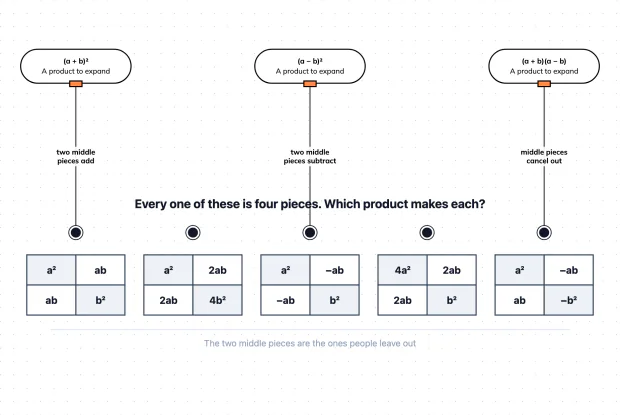
Squaring a bracket is not squaring each piece. Four pieces come out, and the two middle ones are the part people lose. See where they sit in an interactive playground.
How Do You Factorise Using a Common Factor?
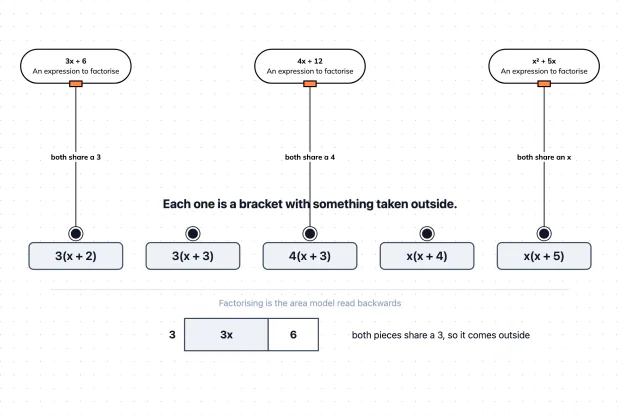
Factorising is expanding run backwards. Learn how to find what all the terms share and pull it outside, then match expressions to their factorised forms in a playground.
How Do You Factorise an Expression With Four Terms?
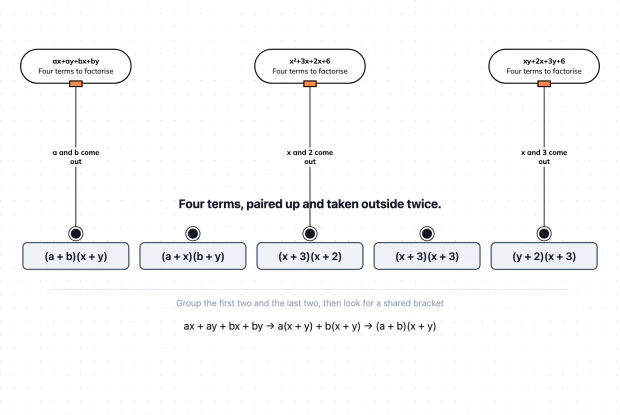
Four terms with nothing shared by all of them can still factorise, if you pair them first. Learn the method and match expressions to their brackets in a playground.
How Do You Factorise by Spotting a Pattern?
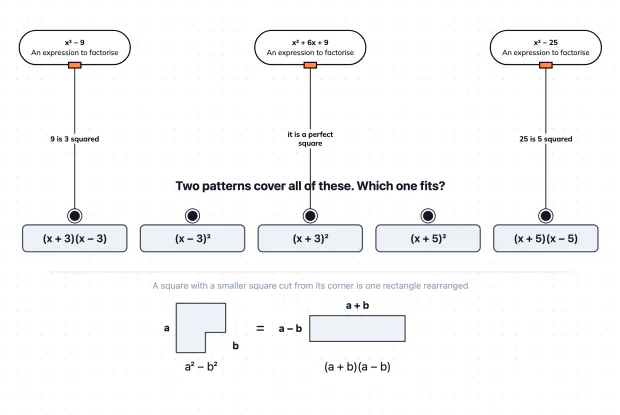
Some expressions factorise the moment you recognise them. Learn the difference of two squares and the perfect square, and match three to their brackets in a playground.