How Do You Factorise by Spotting a Pattern?
Root Concept
The expanding identities run backwards, so recognising the shape of an expression replaces the working entirely.
CodePLU Goal
Upgrading Human Mental Models
Learn how to think in Workflows

Concept Development By codeplu.com
Spot the pattern rather than working it out — then match the brackets
Can You Factorise Something Without Working It Out?
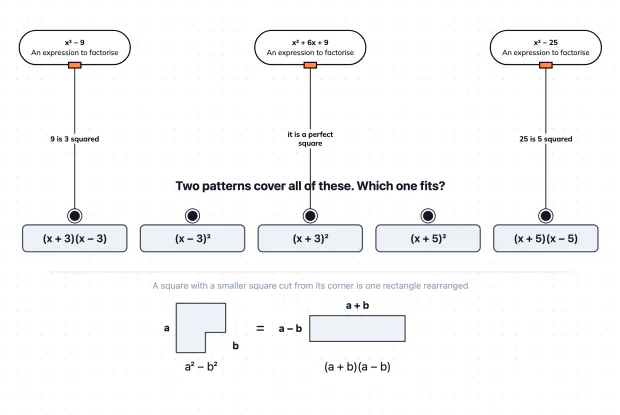
x² − 9 has two terms with nothing in common, so the common-factor method does not touch it, and there are not four terms to group. It factorises all the same, instantly, once you notice what it is: a square minus a square. Nine is three squared, so the expression is x² − 3², and that shape always factorises as (x + 3)(x − 3).
This works because you already proved it. Multiplying (a + b)(a − b) gave a² − b², with the two middle pieces cancelling. An identity holds in both directions, so having established it once for expanding, you may read it backwards for factorising without doing any further work.
The other pattern worth recognising is the perfect square. x² + 6x + 9 is (x + 3)², because it matches a² + 2ab + b² with a as x and b as 3 — check the middle term, which must be twice the product of the two roots. In the playground below you match three expressions to their brackets, and the decoys are exactly what you get if the sign or the middle term is misread.
Which Patterns Are Worth Knowing?
How do you spot a difference of two squares?
Three conditions, all of which must hold. There are exactly two terms; both are perfect squares; and they are subtracted rather than added. x² − 25 qualifies: two terms, x² is a square and 25 is five squared, and there is a minus between them, so it factorises to (x + 5)(x − 5). Take the square root of each part and write one bracket with a plus and one with a minus — the order of the brackets does not matter. The condition people forget is the third. x² + 25 is a sum of two squares and does not factorise at all with ordinary numbers, which is a genuinely different situation rather than a harder version of the same one.
How do you recognise a perfect square?
Three terms, with the first and last being perfect squares and the middle being twice the product of their roots. Take x² + 6x + 9. The roots are x and 3, twice their product is 6x, and that matches the middle term exactly, so it is (x + 3)². The middle term is the part that must be checked rather than assumed: x² + 7x + 9 has the same first and last terms but is not a perfect square, because twice the product would be 6x and not 7x. If the middle term is negative, the bracket takes a minus — x² − 6x + 9 is (x − 3)² — and the last term stays positive either way.
What order should you try things in?
Common factor first, always, then look for a pattern. 2x² − 18 does not look like a difference of two squares, because two and eighteen are not squares. Take out the common factor of two first and you get 2(x² − 9), and now the bracket is plainly a difference of two squares, giving 2(x + 3)(x − 3). Going straight for the pattern would have missed it entirely. This ordering matters more than it looks: a great many expressions that appear to fit no method at all are one common factor away from an obvious one, and checking for a shared factor takes a couple of seconds.
Real World Example
Is the Pattern Ever Actually Useful?
The difference of two squares is one of the few bits of algebra that earns its keep in arithmetic:
An awkward sum
97 × 103
Somebody asks you for ninety-seven times a hundred and three, and there is no calculator to hand. Done the long way it is a fiddly piece of multiplication with several carries, and most people would get it wrong at least once before settling on an answer. Look at the two numbers again, though, and there is something regular about them: both sit exactly three away from one hundred, one below and one above. That symmetry is the thing to notice, and it is what the difference of two squares is built to exploit, turning a fiddly multiplication into a subtraction you can do standing up.
Seeing the pattern
(100 − 3)(100 + 3)
Write the numbers as 100 minus 3 and 100 plus 3. Now the product is (100 − 3)(100 + 3), which is exactly the shape (a − b)(a + b) with a as a hundred and b as three. The identity says that comes to a² − b², so the answer is ten thousand minus nine. The middle terms, which would have been three hundred and minus three hundred, cancel each other out, and that cancelling is precisely why the awkward part of the multiplication disappears rather than having to be done. All that survives is a square and a much smaller square.
The answer, in one line
10000 − 9 = 9991
Ten thousand take away nine is nine thousand nine hundred and ninety-one, and that is the whole calculation. No carrying, no long multiplication, and it can be done in your head. The same trick handles any pair of numbers spaced evenly either side of a round one: forty-eight times fifty-two is two thousand five hundred minus four, which is two thousand four hundred and ninety-six. Recognising an algebraic pattern in a pair of ordinary numbers is a good demonstration that identities are about structure rather than about letters, and the structure is there whether or not anybody wrote an x.
FAQs
Final Words
Two patterns are worth knowing on sight. A difference of two squares — two terms, both squares, subtracted — factorises to the sum times the difference of their roots. A perfect square has three terms whose middle is twice the product of the outer roots, and it collapses into a single bracket squared.
Always look for a common factor before hunting for a pattern, because one often hides the other. And remember that a sum of two squares does not factorise at all, which is information rather than a dead end. That completes the identities: expanding and factorising are now the same small set of facts, read in whichever direction the question needs.
Continue This Track
This concept is part 5 of Identities and Factorising.
What Is an Algebraic Identity?
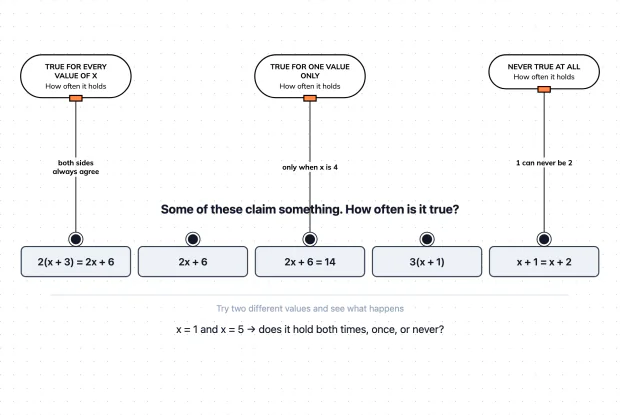
An equation is true for particular values; an identity is true for all of them. Learn to tell them apart and sort real statements in an interactive playground.
Why Does (a + b)² Not Equal a² + b²?
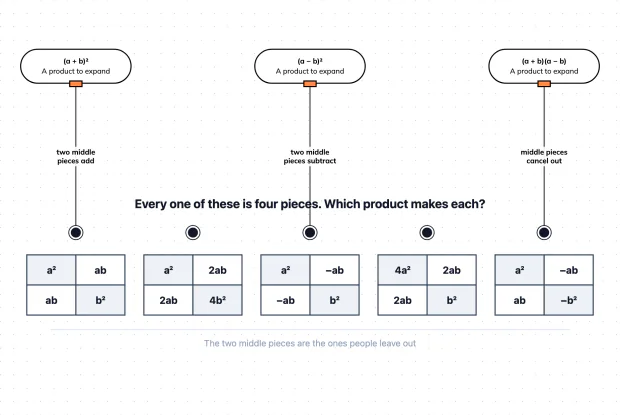
Squaring a bracket is not squaring each piece. Four pieces come out, and the two middle ones are the part people lose. See where they sit in an interactive playground.
How Do You Factorise Using a Common Factor?
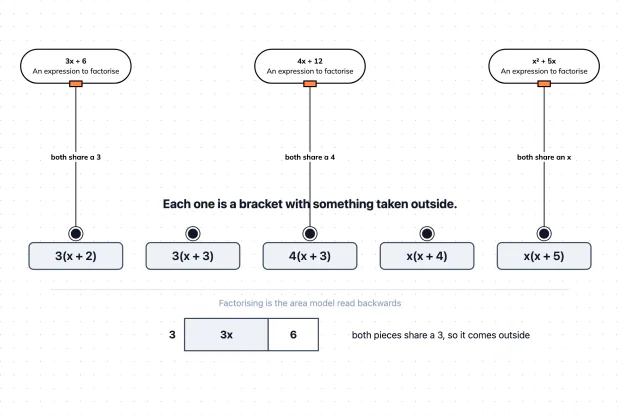
Factorising is expanding run backwards. Learn how to find what all the terms share and pull it outside, then match expressions to their factorised forms in a playground.
How Do You Factorise an Expression With Four Terms?
Four terms with nothing shared by all of them can still factorise, if you pair them first. Learn the method and match expressions to their brackets in a playground.
How Do You Factorise by Spotting a Pattern?
Some expressions factorise the moment you recognise them. Learn the difference of two squares and the perfect square, and match three to their brackets in a playground.