Identities and Factorising
Some statements in algebra are true for every value there is, and those are the ones you use as rules rather than solve. This series sorts them from ordinary equations, settles the (a + b)² question with a picture, and then runs the whole of expanding backwards — taking a factor out, pairing four terms up, and recognising the two patterns that need no working at all.
CodePLU Goal
Upgrading Human Mental Models
Learn how to think in Workflows
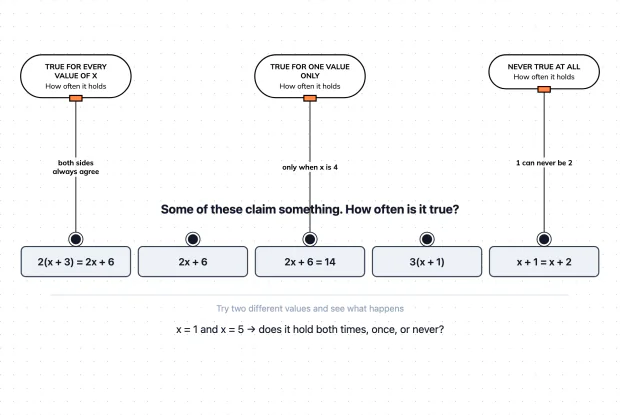
What Is an Algebraic Identity?
An equation is true for particular values; an identity is true for all of them. Learn to tell them apart and sort real statements in an interactive playground.
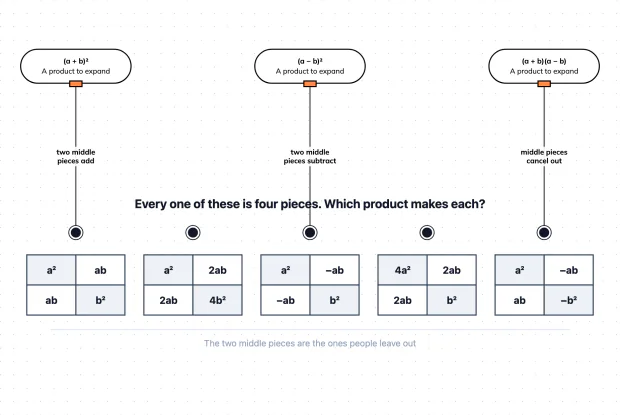
Why Does (a + b)² Not Equal a² + b²?
Squaring a bracket is not squaring each piece. Four pieces come out, and the two middle ones are the part people lose. See where they sit in an interactive playground.
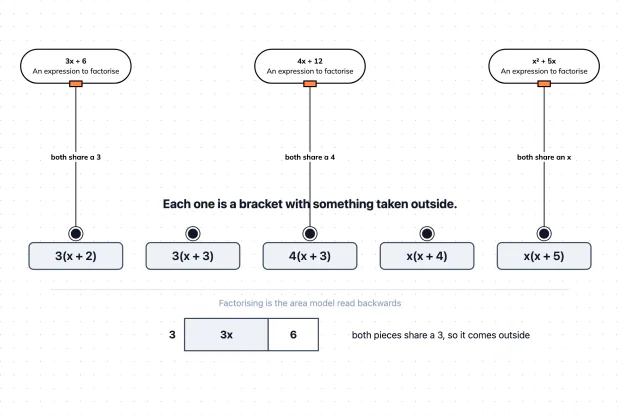
How Do You Factorise Using a Common Factor?
Factorising is expanding run backwards. Learn how to find what all the terms share and pull it outside, then match expressions to their factorised forms in a playground.
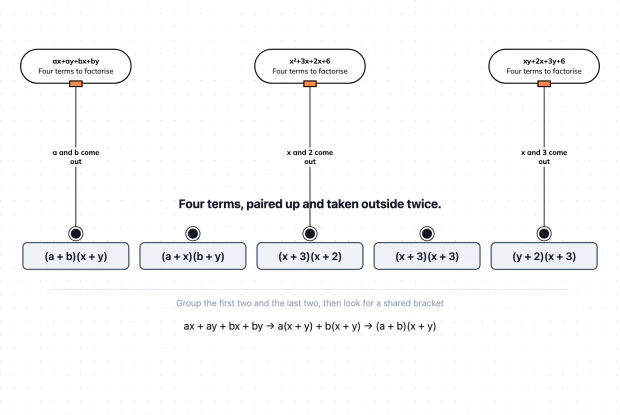
How Do You Factorise an Expression With Four Terms?
Four terms with nothing shared by all of them can still factorise, if you pair them first. Learn the method and match expressions to their brackets in a playground.
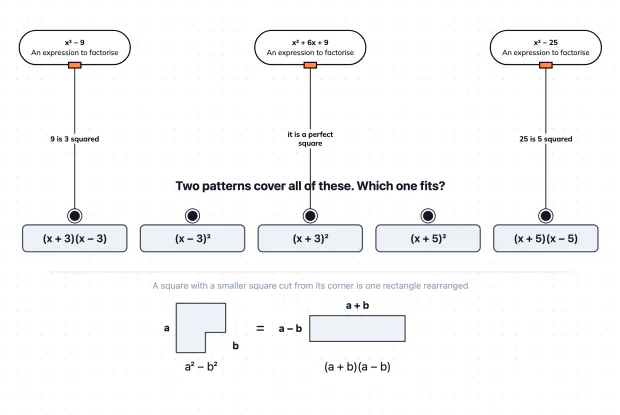
How Do You Factorise by Spotting a Pattern?
Some expressions factorise the moment you recognise them. Learn the difference of two squares and the perfect square, and match three to their brackets in a playground.