Why Does (a + b)² Not Equal a² + b²?
Root Concept
A square of side a + b contains two smaller squares and two rectangles, so the two rectangles are precisely what a² + b² leaves out.
CodePLU Goal
Upgrading Human Mental Models
Learn how to think in Workflows

Concept Development By codeplu.com
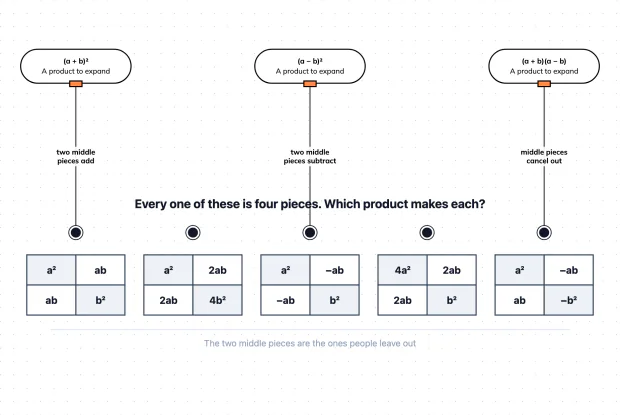
Four pieces every time — match each product to the grid it builds
What Does Squaring a Bracket Really Do?
(a + b)² = a² + b² is probably the most common wrong statement in school algebra, and it is wrong in a way that is easy to see once. The square symbol does not distribute over a plus sign. Squaring means multiplying the whole thing by itself, so (a + b)² is (a + b)(a + b), and that is two brackets — which always give four pieces.
Draw a square with sides of a + b. Cut it once across and once down where the a part ends. You get four regions: a square of a by a in one corner, a square of b by b in the opposite corner, and two rectangles of a by b between them. Add them up and you have a² + 2ab + b².
The two ab rectangles are exactly what a² + b² throws away, and they are not small. With a as 3 and b as 4, the true answer is forty-nine, while a² + b² gives twenty-five — the two missing rectangles were twelve each. In the playground below, five grids of four pieces are shown, and you match three products to the grids they build.
Where Do the Missing Pieces Go?
Why does the square not just go onto each piece?
Because squaring is multiplication, and multiplication over a sum is not the same as multiplication of each part separately. It is easiest to see with plain numbers, which is worth doing before any algebra. (3 + 4)² is 7², which is 49. But 3² + 4² is 9 + 16, which is 25. They are not close, and no rule could make them agree. The same test settles the question every time you are unsure about a manipulation: put small numbers in and see whether both sides come out the same. A single pair of numbers that disagree is enough to prove a statement is not an identity.
What changes when the bracket has a minus in it?
Only the sign of the middle term. (a − b)² is (a − b)(a − b), and the four pieces come out as a², then two lots of negative ab, then positive b² — positive because a negative times a negative is a positive. So the result is a² − 2ab + b². The first and last terms are exactly as they were; only the middle flips. That is worth memorising as a pair, because the two results differ by one sign and are otherwise identical, and writing a minus in front of the b² is a very common slip that the four-piece picture makes obvious.
What happens when the two brackets differ in sign?
Something unusually tidy: the middle pieces cancel. In (a + b)(a − b) the four pieces are a², then negative ab, then positive ab, then negative b². The two middle terms are equal and opposite, so they add to nothing and you are left with a² − b². This is the difference of two squares, and it is the one case where two brackets give a two-term answer rather than three. It is worth recognising by sight in both directions, because spotting it is what makes a whole class of factorising questions almost instant later in this track.
Real World Example
How Much Does the Mistake Actually Cost?
The missing rectangles are not an abstraction — they are a specific amount of ground:
The terrace as it is
a square, 3 metres each way
A square terrace measures three metres along each side, so it covers nine square metres of paving. Nobody has to think about that. The reason this example uses small numbers is that it lets you check the whole thing by counting slabs at the end, which is the surest way to settle an argument about algebra. Keep the original nine square metres in mind, because it will still be there as one corner of everything that follows, unchanged however much gets added around it. Everything the extension adds is new ground laid beside that original square, never on top of it.
Widening it in both directions
(3 + 4)² = 49 square metres
Now extend it by four metres on two adjoining sides, keeping it square. Each side is now three plus four, which is seven metres, so the terrace covers forty-nine square metres. Drawn out, the new terrace divides into four regions: the original three-by-three corner at nine, a new four-by-four corner at sixteen, and two three-by-four strips at twelve each running between them. Nine plus sixteen plus twelve plus twelve is forty-nine, which agrees with squaring the seven directly. Four pieces, and all four are visible on the ground, which is the point: none of them is a bookkeeping device invented by the algebra.
What the wrong answer would order
25 instead of 49
Somebody applying the square to each piece separately works out 3² + 4², which is nine plus sixteen, and orders twenty-five square metres of paving. They have counted both corners and neither strip. On the ground that is twenty-four square metres of bare earth — nearly half the terrace — in two long strips running between the paved corners. The error is not a small inaccuracy that might be tolerable; it leaves out the two middle pieces entirely, and the bigger the numbers get, the more of the total those middle pieces are. Double both measurements and the two strips grow faster than either corner does, so the gap between the right answer and the wrong one widens.
FAQs
Final Words
Squaring a bracket is multiplying it by itself, so it always gives four pieces. Two of them are squares and two are identical rectangles, and those rectangles are exactly what a² + b² leaves out. Three results are worth knowing by sight: the plus version has + 2ab in the middle, the minus version has − 2ab, and the mixed pair cancels to a² − b².
Better than memorising them is being able to rebuild them from a square cut into four, which takes ten seconds and never goes slightly wrong. Next the whole process runs backwards, starting with the simplest kind of factorising.
Continue This Track
This concept is part 2 of Identities and Factorising.
What Is an Algebraic Identity?
An equation is true for particular values; an identity is true for all of them. Learn to tell them apart and sort real statements in an interactive playground.
Why Does (a + b)² Not Equal a² + b²?
Squaring a bracket is not squaring each piece. Four pieces come out, and the two middle ones are the part people lose. See where they sit in an interactive playground.
How Do You Factorise Using a Common Factor?
Factorising is expanding run backwards. Learn how to find what all the terms share and pull it outside, then match expressions to their factorised forms in a playground.
How Do You Factorise an Expression With Four Terms?
Four terms with nothing shared by all of them can still factorise, if you pair them first. Learn the method and match expressions to their brackets in a playground.
How Do You Factorise by Spotting a Pattern?
Some expressions factorise the moment you recognise them. Learn the difference of two squares and the perfect square, and match three to their brackets in a playground.